
What’s inside the Article?
- Discovery of Ebola Virus (1976)
- Sporadic Outbreaks (1977-1993)
- Re-emergence in Central Africa (1994-1996)
- Continued Outbreaks in Africa (2000-2012)
- The West African Epidemic: The Largest Outbreak (2014-2016)
- Recent Outbreaks
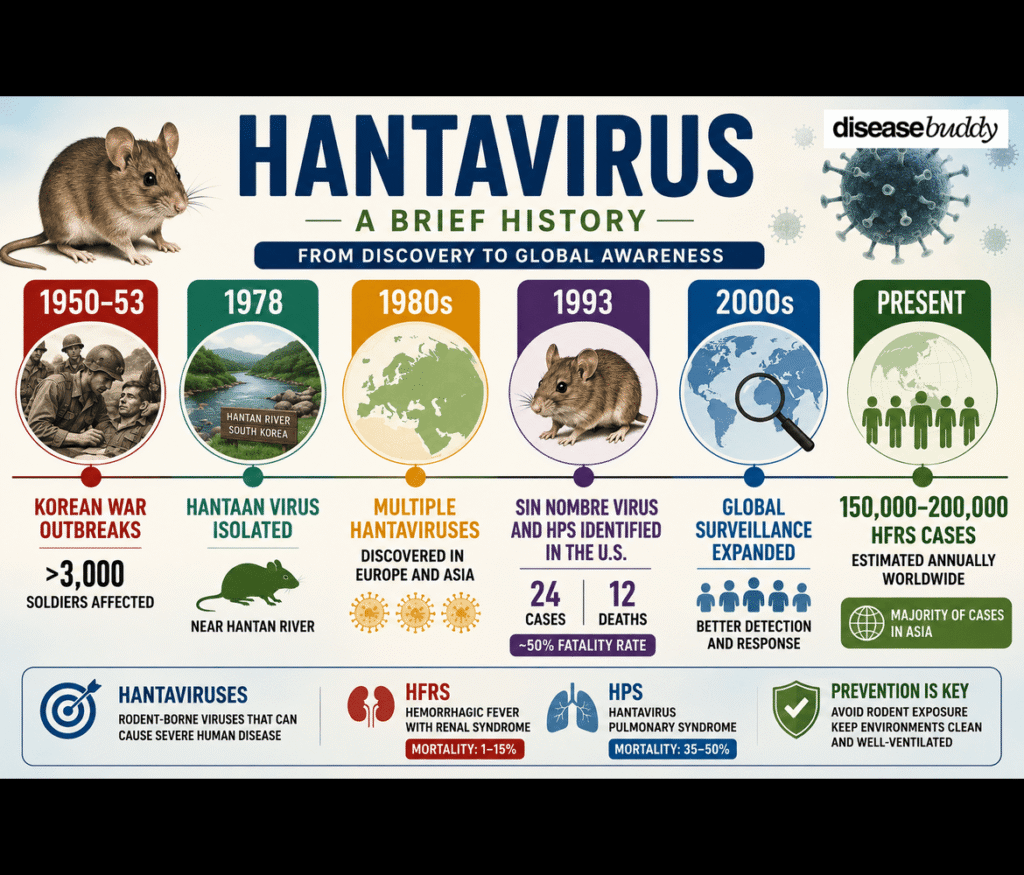
The emergence of Ebola shares important similarities with the history of Hantavirus, particularly in the challenges of outbreak detection and containment. Ebola virus disease are of five species: Zaire ebolavirus, Tai Forest ebolavirus, Sudan ebolavirus, Bundibugyo ebolavirus and Reston ebolavirus. It is considered as one of the deadliest infectious diseases ever discovered and caused by the Ebola virus, a member of Filoviridae family (Beeching, Fenech and Houlihan, 2014).
Discovery of Ebola Virus (1976)
In 1967, the first case of filovirus hemorrhagic fever was identified in Germany and the former Yugoslavia. It was named after the town Marburgh and called Marburgh virus. The Ebola virus in particular was first officially discovered in 1976 during two simultaneous outbreaks in Africa, one in Nzara, Sudan, and the other in Yambuku, Zaire (now the Democratic Republic of Congo). It was named after Ebola river, located close to the outbreak region in Zaire.
Out of 284 reported cases in Sudan, 151 deaths were reported, whereas the fatality rate in Zaire was nearly 88% with 280 deaths out of 318 cases (Awah, Boock and Kum, 2015).

Sporadic Outbreaks (1977-1993)
For nearly two decades, Ebola appeared only sporadically, as rare but lethal cases were reported in Central Africa (Majid et al., 2016).
Re-emergence in Central Africa (1994-1996)
In the mid-1990s, Ebola re-emerged with larger outbreaks in Gabon, Cote d’Ivoire, and Democratic Republic of Congo. The outbreak in Kikwit, Democratic Republic of Congo in 1995 depicted the quick transmission and spread of disease for vulnerable groups, such as hospital workers and family members of the patients.
From the Kikwit epidemic, researchers confirmed that the virus spreads through direct contact with infected blood and body fluids, contaminated medical instruments, and close contact (Awah, Boock and Kum, 2015).
Continued Outbreaks in Africa (2000-2012)
Several Ebola outbreaks occurred from 2000 to 2012, which majorly included Uganda, Sudan, Republic of Congo, and Democratic Republic of Congo. Scientists made significant advances during this period, as they were able to find out that the virus attacks:
- Immune cells
- Blood vessels
- Major organs such as the liver and spleen (Harrod, 2014)
The common symptoms observed were:
- High fever
- Severe weakness
- Vomiting and diarrhea
- Internal and external bleeding
- Multi-organ failure
Mortality rates during outbreaks varied widely, ranging from approximately 25% to 90%, depending on the viral strain, healthcare conditions, and speed of intervention (Harrod, 2014).
The West African Epidemic: The Largest Outbreak (2014-2016)
In late 2013, the world witnessed the most severe Ebola outbreak in history in Guinea, which rapidly rised to Liberia and Sierre Leone.
This time the outbreak was not limited to isolated rural areas. It affected the densely populated urban centers, contributed by weak healthcare systems, delayed international responsse, and cross-border movement.
More than 28,000 cases of Ebola were reported during the epidemic, with over 11,000 deaths. The World Health Organization (WHO) declared Ebola as Public Health Emergency of International Concern (Malvy et al., 2019).
Recent Outbreaks (2018-2026)
In 2018, two separate outbreaks of Ebola Virus Disease were reported in the Democratic Republic of Congo (DRC). The first was declared in May 2018 in the remote Equateur Province, while a second and more complex outbreak was confirmed in August 2018 in North Kivu Province. The Equateur outbreak became particularly concerning when the virus reached Mbandaka, a densely populated urban center and major transport hub along the Congo River. However, 54 confirmed cases were reported with 33 deaths.
The North Kivu-Ituri Epidemic was the second-largest Ebola epidemic ever recorded, with persistent conflict, mistrust of health authorities, and attacks on health facilities. The outbreak lasted until June 2020 with overall case fatality rate 66%. 2,287 deaths were reported and the confirmed cases were 3,317 (WHO).
Sporadic outbreaks in Central Africa has been continuing since then. However, those were generally smaller than earlier epidemics.
Latest Ebola Outbreak DRC-Uganda (2026)
A recent outbreak of Ebola Virus Disease has been reported in eastern Democratic Republic of Congo (Ituri Province) and has also spread into Uganda, prompting a rapid international health response and a WHO emergency declaration.

The outbreak has affected hundreds of people, with early estimates indicating:
- Around 246 suspected cases
- At least 88 confirmed deaths
- Cases detected in both DRC and Uganda, including movement-linked spread across borders
Health officials have raised serious concerns because the outbreak involves a rare Ebola strain (Bundibugyo virus), which has limited specific medical countermeasures available (BBC).
Frequently Asked Questions (FAQs)
1. When was Ebola first discovered?
Ebola virus was first identified in 1976 during simultaneous outbreaks in what are now the Democratic Republic of the Congo and Sudan.
2. What was the deadliest Ebola outbreak?
The 2014–2016 West Africa outbreak was the largest and deadliest, causing more than 28,000 cases and 11,000 deaths.
3. Is there a vaccine for Ebola?
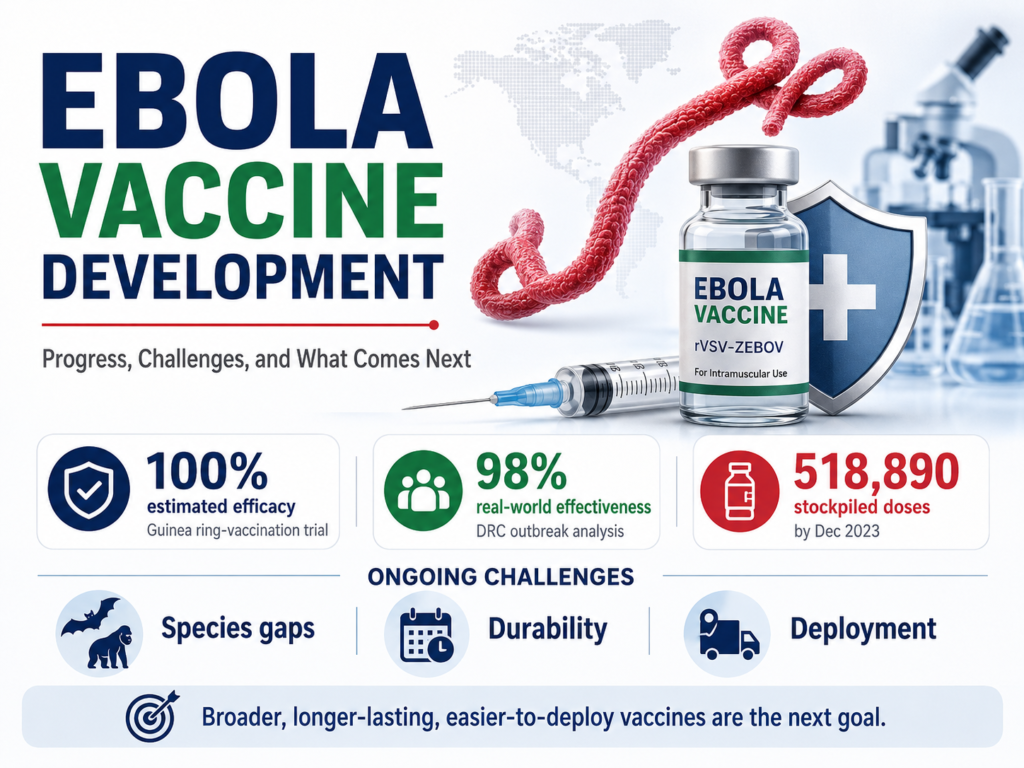
Yes. The Ervebo (rVSV-ZEBOV) vaccine was approved in 2019 to help protect against the Zaire species of Ebola virus.
4. Which countries have experienced Ebola outbreaks?
Major outbreaks have occurred in the Democratic Republic of the Congo, Sudan, Uganda, Guinea, Liberia, Sierra Leone, and several other African countries.
5. Does Ebola still occur today?
Yes. Sporadic Ebola outbreaks continue to occur, particularly in parts of Central and East Africa, although they are usually controlled more quickly than in the past.
6. Why is Ebola so dangerous?
Ebola can cause severe illness with internal and external bleeding, organ failure, and a high case fatality rate if not diagnosed and treated promptly.
References
Beeching NJ, Fenech M, Houlihan CF. Ebola virus disease. BMJ. 2014;349:g7348. doi: 10.1136/bmj.g7348 PMID: 25497512 PMCID: PMC4707720
Majid M. Nature and History of Ebola Virus: An Overview. 2016. Available from: ResearchGate publication. DOI (as cited in document): 10.13140/RG.2.1.1234.4567
Feldmann H, Geisbert TW. Ebola haemorrhagic fever. Lancet Infect Dis. 2011;11(2):152–165. doi: 10.1016/S1473-3099(10)70182-8 PMCID: PMC4695518
Sullivan NJ, et al. Ebola virus pathogenesis: implications for treatment and vaccines. Am J Physiol Lung Cell Mol Physiol. 2014;307(3):L205–L220. doi: 10.1152/ajplung.00354.2014
Wenham C, Smith J, Morgan R. COVID-19: the gendered impacts of the outbreak (Note: Lancet Ebola-related editorial articles are often grouped in outbreak policy discussions; your link corresponds to Lancet outbreak analysis literature) Lancet. 2018;392(10149):e1–e2. doi: 10.1016/S0140-6736(18)33132-5
Pingback: History of Hantavirus : Timeline – Disease Buddy
Pingback: Why there is still no Universal Ebola Vaccine – Disease Buddy
Pingback: The Missing Millions: Who Are the 2 Million People Missing from TB Tracking? – Disease Buddy
Pingback: History of Measles: Major Outbreaks, Vaccine Development, and Global Impact – Disease Buddy
Pingback: The Outbreak That Wouldn’t Die: Ebola – Disease Buddy
Pingback: Oxford Launches World’s First Human Trial of Bundibugyo Ebola Vaccine – Disease Buddy
Pingback: Measles History Timeline: Major Outbreaks, Vaccine Development and Global Impact – Disease Buddy
Pingback: Marburg Virus History: Shocking Timeline of Outbreaks and Global Impact - Disease Buddy
Pingback: Marburg Virus Disease: Deadly Symptoms, Diagnosis, Treatment and Global Impact - Disease Buddy
Pingback: The Missing Millions: Who Are the Hidden 2 Million People Missing from TB Tracking? - Disease Buddy
Pingback: The Shocking Cost of Ebola Outbreak: A $98 Vaccine Dose Or a Billion-Dollar Response? - Disease Buddy