
Introduction
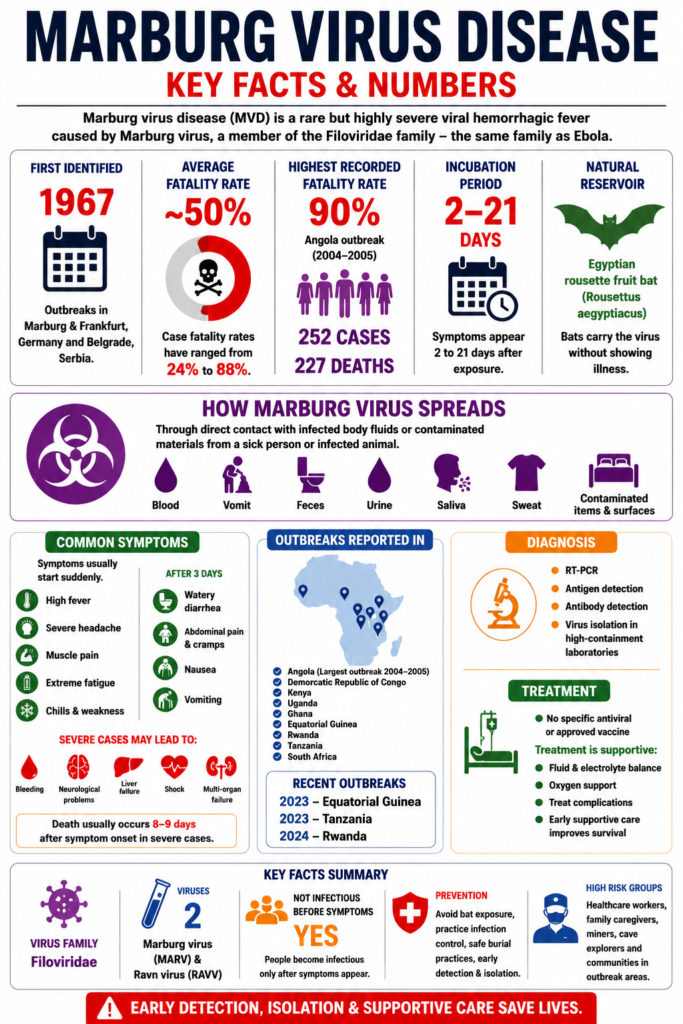
Marburg virus disease (MVD) is a rare but highly severe viral haemorrhagic fever caused by Marburg virus, member of the Filoviridae family, the same viral family that includes Ebola virus. Marburg virus is a major public health concern due to it’s high case fatality rate (CFR) of approximately 50%. Previous outbreaks have recorded fatality rates ranging from 24% to 88% depending on healthcare capacity, outbreak conditions, and access to early treatment.
Discovery and History of Marburg Virus
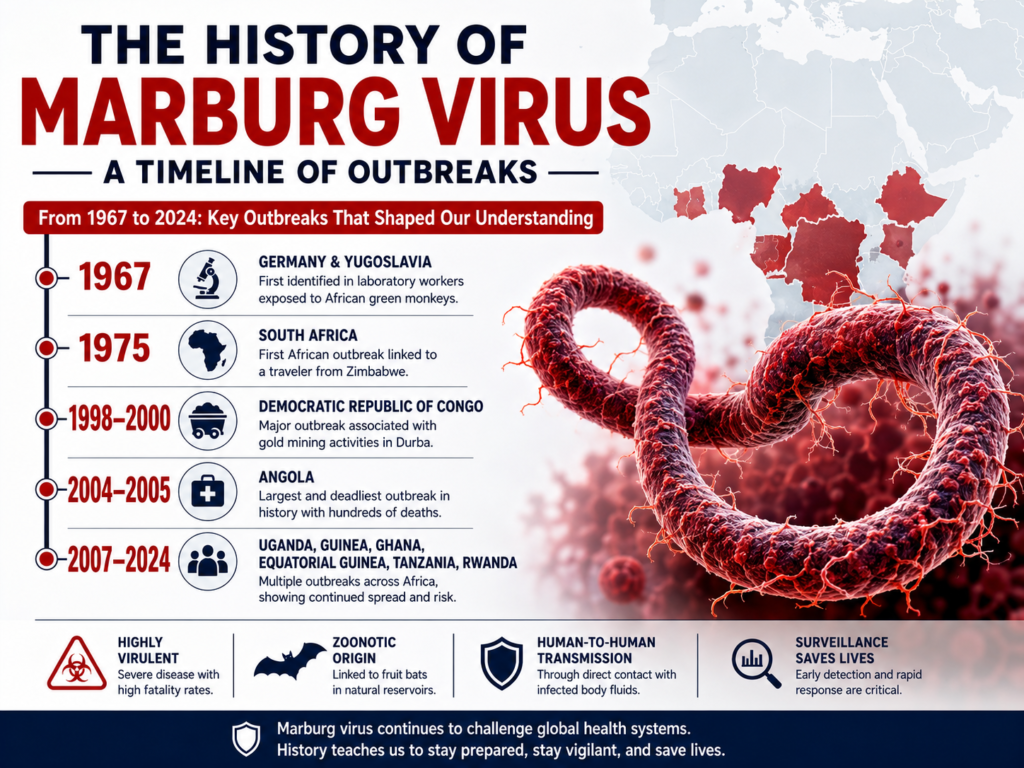
Marburg virus disease was first recognized in 1967 after simultaneous outbreaks occurred in Marburg and Frankfurt, Germany, and Belgrade, Serbia. The outbreaks involved laboratory workers who were exposed while handling infected African green monkeys (Cercopithecus aethiops) imported from Uganda for research purposes.
Since its discovery, Marburg virus disease outbreaks and sporadic cases have been reported in sub-Saharan Africa, including Angola, Democratic Republic of Congo (DRC), Kenya, Uganda, Ghana, Guinea, Equatorial Guinea, Rwanda, Tanzania, and South Africa.
Key Facts About Marburg Virus Disease
| Feature | Information |
| Virus family | Filoviridae |
| Main viruses | Marburg virus and Ravn virus |
| Natural reservoir | Egyptian rousette fruit bat |
| Incubation period | 2-21 days |
| Average fatality rate | ~50% |
| Highest reported fatality | Up to 90% |
| First Identified | 1967, Germany and Serbia |
| Transmission | Direct contact with infected body fluids |
| Approved vaccine | None currently available |
Transmission of Marburg Virus
The natural reservoir of Marburg virus is found to be the Egyptian rousette fruit bat (Rousettus aegyptiacus). Humans may become infected after prolonged exposure to caves or mines inhabited by infected bat colonies.
Marburg virus spreads through direct contact with infected body fluids and not through airborne transmission. Human-to-human transmission occurs through contact with blood, vomit, faeces, saliva, urine, sweat, other body fluids, and contaminated clothing, bedding, medical equipment, or surfaces.
Many historical outbreaks have involved healthcare-associated transmission due to close contact with infected patients. People are generally not infectious before symptoms appear, but remain contagious while infectious virus is present in their blood and body fluids.
Incubation Period and Symptoms
The incubation period of Marburg virus disease ranges from 2 to 21 days. Symptoms usually begin suddenly and can progress rapidly.

Early symptoms include:
- High fever
- Severe headache
- Extreme fatigue
- Muscle pain
- Chills
- Weakness
After approximately 3 days, patients may develop:
- Severe watery diarrhoea
- Abdominal pain and cramps
- Nausea
- Vomiting
Between day 5 and later stages, some patients develop haemorrhagic symptoms, including bleeding manifestations. Severe disease may progress to:
- Liver dysfunction
- Confusion and neurological symptoms
- Shock
- Multi-organ failure
In fatal cases, death commonly occurs around 8–9 days after symptom onset, often associated with severe shock and organ failure.
Diagnosis and Treatment
Early symptoms overlap with other infectious diseases, including malaria, typhoid fever, and other viral haemorrhagic fevers.
Laboratory confirmation requires specialized testing, including:
- Reverse transcription polymerase chain reaction (RT-PCR)
- Antigen detection tests
- Antibody detection
- Virus isolation in high-containment laboratories
Currently, there are no officially approved vaccines or specific antiviral treatments for Marburg virus disease.
Early supportive care significantly improves survival. Treatment focuses on:
- Maintaining hydration
- Correcting electrolyte imbalance
- Providing oxygen support
- Treating complications such as shock and infections
Major Recent Outbreaks and Global Concern
Recent outbreaks demonstrate that Marburg remains an emerging infectious disease threat.
In 2023, Marburg virus outbreaks were reported for the first time in both Equatorial Guinea and Tanzania.
The year 2023 represented a major period in Marburg virus history, with outbreaks reported for the first time in both Equatorial Guinea and Tanzania.
Similarly, Rwanda reported its first Marburg outbreak in 2024. However, the fatality rate was lower with CFR 23% and 15 deaths.
Reference
World Health Organization. Marburg virus disease. Geneva: WHO; 2025. Available from: https://www.who.int/news-room/fact-sheets/detail/marburg-virus-disease
Centers for Disease Control and Prevention. About Marburg virus disease. Atlanta: CDC; 2025. Available from: https://www.cdc.gov/marburg/about/index.html
World Health Organization. Marburg virus disease: Health topics. Geneva: WHO. Available from: https://www.who.int/health-topics/marburg-virus-disease
World Health Organization. Marburg virus disease outbreak updates. Geneva: WHO; 2025.
Marburg virus disease: recent advances in epidemiology, pathogenesis, diagnosis and therapeutics. Reviews in Medical Virology. doi:10.1002/rmv.2461.
Marburg virus disease: clinical characteristics and public health challenges. Health Science Reports. doi:10.1002/hsr2.70669.
Marburg virus infection: epidemiology, transmission and prevention strategies. Health Science Reports. doi:10.1002/hsr2.1545.
Pathological features of Marburg virus infection. Journal of Pathology. doi:10.1002/path.4476.
Pingback: Marburg Virus History: Shocking Timeline of Outbreaks and Global Impact - Disease Buddy
Pingback: Ebola and Marburg Viruses: A Comparative Overview - Disease Buddy