
Ancient Findings and Early Observations
Historical records suggest that Haemorrhagic Fever with Renal Syndrome (HFRS) – like disease was mentioned in 900 years old Chinese writings. By the 20th century, the disease drew the attention of military researchers, who were sometimes using prisoners of war in infection experiments to investigate the cause of the disease. Nephropathia epidemica, a milder form of HFRS, was first described by Swedish authors in 1934, in Fennoscandia (Scandinavia and Finland) (Vapalahti et al., 2003)

Recognition During Korean War (1950s)
Hantavirus disease was first identified during the Korean War in 1950s. More than 3,200 United Nations soldiers developed a rare hemorrhagic fever, known as “Korean haemorrhagic fever”, later termed as HFRS. The mortality rate ranged from 5-15%, depending upon the viral strain (Lee HW et al., 1994).
Discovery of Hantaan Virus (1970s)
After 25 years, in 1978, the causative agent was isolated from its reservioir, the striped field mouse (Apodemus agrarius), near the Hantan river in South Korea. The virus was named Hantaan virus, giving rise to the term “Hantavirus” (Jonsson et al., 2010). A similar approach was used in Puumala, Finland to discover Clethrionomys glareolus as the reservoir for the Puumala virus, the causative agent of nephropathia epidemica, which was also seen to cause HFRS (Vapalahti et al., 2003).
Expansion Across Europe and Asia (1980s)
The presence of Hantaan virus (HTNV) and HTNV-like viruse were seen in Apodemus agrarius and A. peninsulae rodents in Far East Russia, China, and South Korea. In Europe, Dobrava virus (DOBV), and Dobrava-like viruses were harbored by Apodemus flavicollis (yellow-necked mouse), A. agrarius, and A. ponticus near Dobrava village in Slovenia. Similarly, it was found that etiological agent for urban cases of HFRS in Asia were the rat-borne Seoul virus (SEOV), and Nephropathia epidemica, caused by Puumala virus, in Europe. However, the disease severity varied as the mortality rate of Puumala virus was found to be below 1%, while the mortality rate rised up to 15% for Hantaan and Dobrava viruses.
Emergence in America (1990s)
An outbreak of severe respiratory disease occured in the “Four Corners” region of the United States in 1993. 12 deaths were reported in the initial outbreak out of 24 confirmed cases. It was first recognized as an acute respiratory distress syndrome (ARDS). This outbreak led to the discovery of Sin Nombre virus (SNV), and other hantaviruses causing Hantavirus Pulmonary Syndrome (HPS), caused by sigmodontine rodents. 451 cases and 159 deaths have been reported since the first case in 1993 to 2006, in the US. Moreover, 1685 cases resulting in 331 deaths were reported from 1993 to 2004 in Panama, Brazil, Bolivi, Chile, Paraguay, Uruguay, and Argentina (Kariwa, Yoshimatsu, and Arikawa, 2007).

Global Epidemiology
The annual global HFRS burden is estimated to be 150,000-200,000 cases, out of which more than 90% of cases occur in Asian countries, including China, Russia, and Korea. HFRS accounts for 1-15% mortality rate, whereas HPS is found to be more severe with 35-50% mortality rate.
Recent 2026 clusters of Andes virus (ANDV) on a cruise ship in the South Atlantic, have further highlighted the potential for human-to-human transmission, emphasizing the need for continued vigilance.
Those interested in deadly zoonotic diseases should also explore the history of Ebola Virus Disease and its impact on international public health.
References
Vapalahti O, Mustonen J, Lundkvist Å, et al. Hantavirus infections in Europe. Lancet Infectious Diseases. 2003;3(10):653–661.
Jonsson CB, Figueiredo LTM, Vapalahti O. A Global Perspective on Hantavirus Ecology, Epidemiology, and Disease. Clinical Microbiology Reviews. 2010;23(2):412–441.
Schmaljohn C, Hjelle B. Hantaviruses: a global disease problem. Emerging Infectious Diseases. 1997;3(2):95–104.
Bi Z, Formenty PBH, Roth CE. Hantavirus infection: a review and global update. Journal of Infection in Developing Countries. 2008;2(1):3–23.
Vaheri A, Strandin T, Hepojoki J, et al. Uncovering the mysteries of hantavirus infections. Nature Reviews Microbiology. 2013.
Lee HW. Hemorrhagic fever with renal syndrome in Korea. New England Journal of Medicine. 1994;330:949–955.

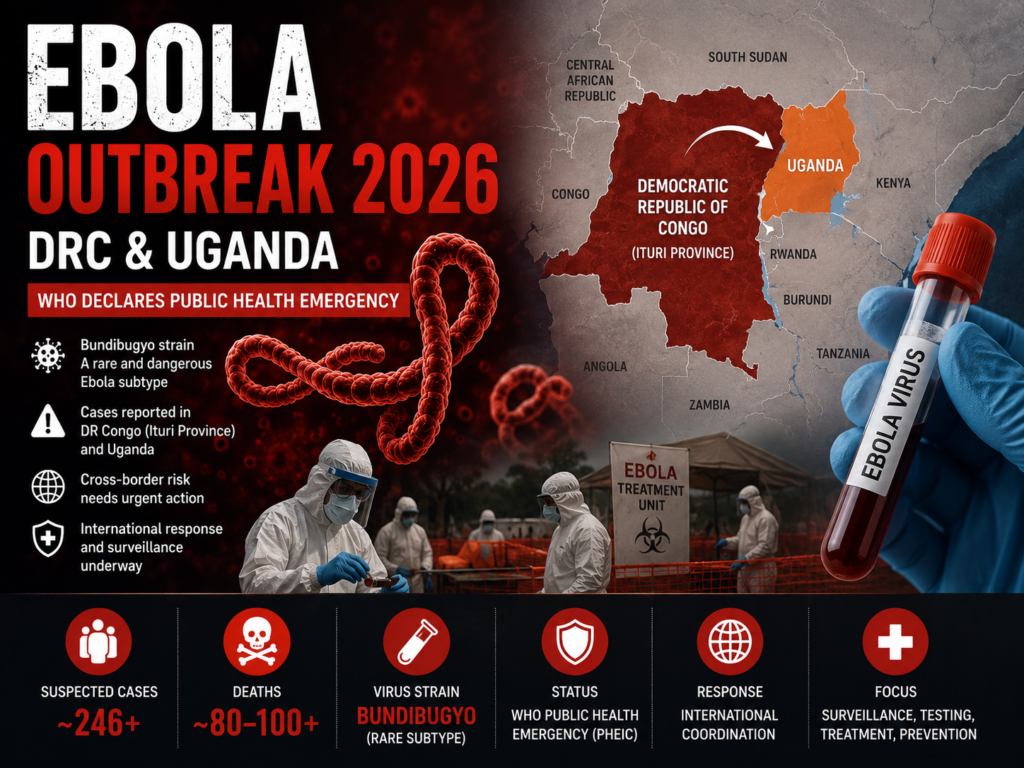
Pingback: Hantavirus: Global Overview, Clinical manifestations and diagnostics – Disease Buddy
Pingback: History of Ebola: Outbreak and Timeline – Disease Buddy
Pingback: History of Ebola: Discovery, Outbreaks and Timeline – Disease Buddy
Pingback: Hantavirus: Global overview, Clinical manifestations and Diagnostics - Disease Buddy