
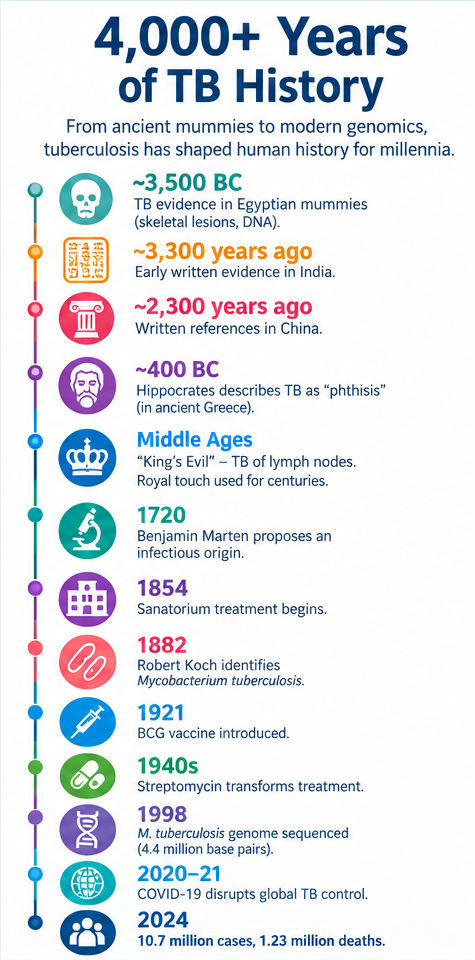
Tuberculosis (TB) is not a modern disease. History of Tuberculosis infection extends back thousands of years, while the modern scientific understanding of the disease emerged mainly during the 19th century.
Researchers have proposed that the Mycobacterium genus may have originated more than 150 million years ago. Some evolutionary studies suggest that an ancestral tuberculosis organism may have infected early hominids in Africa approximately 3 million years ago.
History of Tuberculosis in Ancient Egypt: More Than 4,000 Years Ago
Egyptian mummies dating to around 2400 BC show skeletal abnormalities compatible with TB, including lesions associated with Pott’s disease, the form of TB affecting the spine.
Molecular research has gone even further. TB-related DNA has been identified in Egyptian remains dating from approximately 3500–500 BC. Researchers found evidence of ancestral M. tuberculosis strains in remains from 3500–2650 BC at Abydos.
4,000+ years of evidence therefore separates modern TB from some of its earliest documented manifestations.
India and China Recorded TB Thousands of Years Ago
Historical reviews identify early written references to TB-like disease in India approximately 3,300 years ago and in China approximately 2,300 years ago.
In ancient Greece, tuberculosis was known as phthisis. Hippocrates described it as a frequently fatal disease, particularly among young adults, and documented characteristic respiratory symptoms and lung lesions.
TB Was Once Called the “King’s Evil”
During the Middle Ages, tuberculosis could appear outside the lungs.
One important manifestation was scrofula, a TB infection of the lymph nodes of the neck. In England and France it became known as the “King’s Evil.”
For centuries, people believed that monarchs could cure the disease through a royal touch. The practice survived for hundreds of years. In England, Queen Anne performed the ritual as late as 1712, while George I ended it in 1714. In France, the practice continued until approximately 1825.
This illustrates how tuberculosis was understood very differently before germ theory.
1699: TB Begins to Be Treated as an Infectious Disease
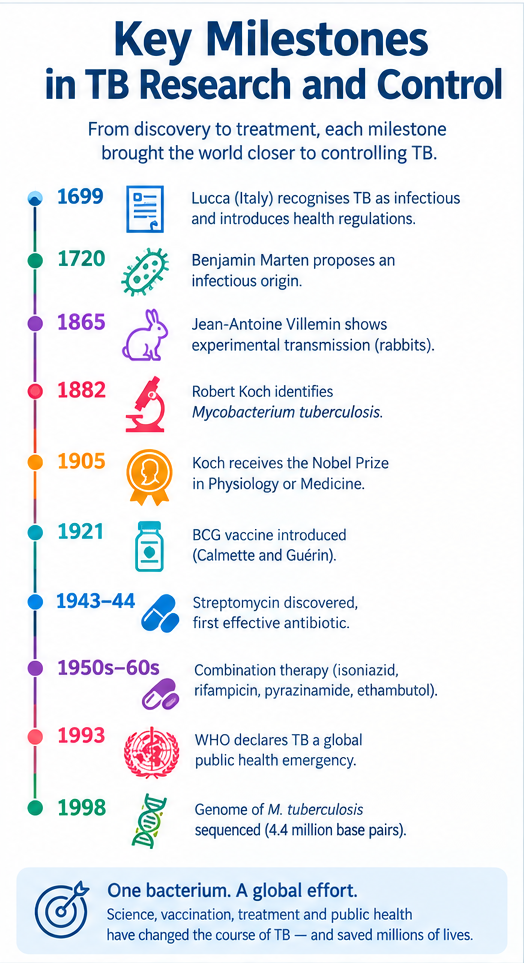
In the 16th century, Girolamo Fracastoro provided an early description of the contagious nature of tuberculosis. By 1699, health regulations in the Republic of Lucca in Italy explicitly referred to the infectious nature of the disease.
In 1735, Lucca’s health authorities went further, ordering compulsory notification and isolation of people with consumption and establishing designated locations for treatment.
These measures appeared more than 200 years before modern TB-control programmes.
1720: The Infectious Theory Gains Ground
In 1720, English physician Benjamin Marten proposed that tuberculosis could have an infectious origin.
His book, A New Theory of Consumptions, suggested that consumption could be caused by tiny living organisms capable of spreading between people.
The theory was remarkably early because the bacterium responsible for TB would not be identified for another 162 years.
The “White Plage” and the Industrial Revolution
During the 18th and 19th centuries, tuberculosis became devastating across rapidly growing European cities. Overcrowded housing, poor ventilation, malnutrition, poverty and difficult working conditions created ideal conditions for transmission.
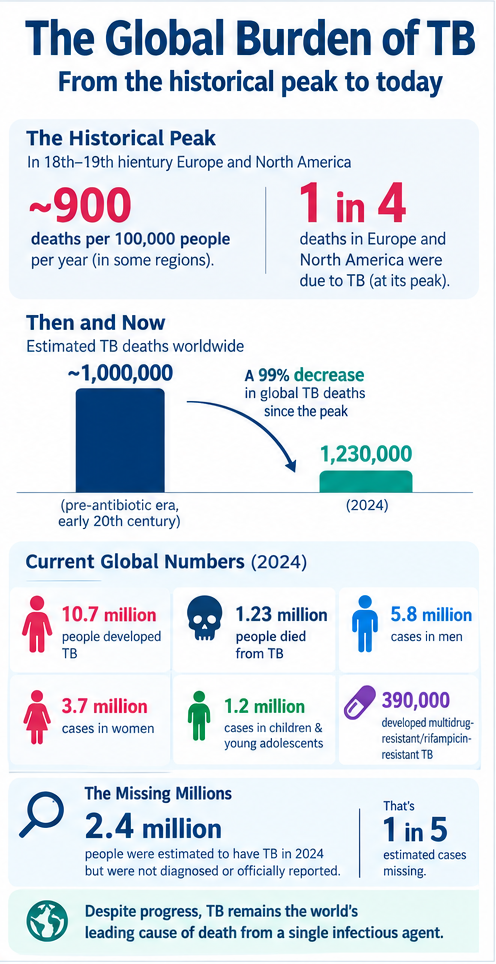
In parts of 18th-century Western Europe, TB mortality reportedly reached as high as 900 deaths per 100,000 people per year.
During 1838–1839, as many as one-third of English tradesmen and employees reportedly died from TB, compared with approximately one-sixth among the upper classes.
TB became so widespread that it was described as the “White Plague” and the “robber of youth.” At its historical peak in Europe and North America, TB was estimated to account for approximately 1 in 4 deaths.
1854: The Sanatorium Era Begins
In 1854, German physician Hermann Brehmer published a dissertation arguing that tuberculosis could be cured. He subsequently established a sanatorium in Görbersdorf, where patients were treated with fresh air, rest and improved nutrition.
The sanatorium movement subsequently spread across Europe and North America.
Although sanatorium treatment could not eliminate the underlying infection, it represented one of the first organized attempts to manage TB through environmental and nutritional interventions.
1865: TB is Experimentally Shown to Be Infectious
In 1865, French military surgeon Jean-Antoine Villemin demonstrated that material from a TB lesion could transmit disease to rabbits. He subsequently published additional experimental evidence supporting the infectious nature of tuberculosis.
His work helped shift TB from being viewed primarily as a hereditary or constitutional illness toward being understood as an infectious disease.
1882: Robert Koch Identifies the TB Bacillus
On 24 March 1882, German scientist Robert Koch announced that he had identified and isolated the bacterium responsible for tuberculosis: Mycobacterium tuberculosis. Koch used staining, culture and animal experiments to demonstrate the organism’s relationship with the disease.
Today, 24 March is observed annually as World TB Day, commemorating Koch’s landmark announcement.
He received the 1905 Nobel Prize in Physiology or Medicine for his investigations concerning tuberculosis. It had taken roughly 23 years from his 1882 announcement to the Nobel recognition.
1921: The BCG Vaccine
French researchers Albert Calmette and Camille Guérin developed the BCG vaccine, derived from an attenuated strain of Mycobacterium bovis.
The first human administration occurred in 1921.
After nearly 20 years, Selman Waksman and his collaborators identified streptomycin in the early 1940s, and clinical trials soon demonstrated its activity against TB.
The arrival of antibiotics transformed TB from a disease frequently associated with prolonged illness and death into one that could increasingly be cured with antimicrobial therapy.
The 1950s-1960s: Combination Theory
Using a single TB drug created a major problem: drug resistance.
Treatment therefore evolved toward combinations of antibiotics. Drugs such as isoniazid, rifampicin, pyrazinamide and ethambutol eventually became central components of modern TB treatment.
The principle remains important today: using multiple effective drugs simultaneously reduces the likelihood that resistant organisms will survive and multiply.
1993: WHO Declares TB a Global Emergency
Despite all these efforts, TB did not disappear. In 1993, the World Health Organization declared tuberculosis a global public health emergency. The declaration reflected the continuing worldwide burden and the growing problem of TB associated with HIV and drug resistance.
A historical review published that same year described TB as a slowly progressing worldwide epidemic, shaped by urbanization, population movement, socioeconomic conditions and immunity.
However, another scientific milestone arrived in 1998 when researchers published the complete genome sequence of Mycobacterium tuberculosis in Nature. The genome contained approximately 4.4 million base pairs.
COVID-19 Reversed Years of Progress
Between 2019 and 2020, the number of people newly diagnosed with TB globally fell from approximately 7.1 million to 5.8 million. It rose to about 6.4 million in 2021.
Disruptions to diagnosis and treatment contributed to increased TB mortality during the pandemic.
In 2024, an estimated:
- 10.7 million people developed TB
- 1.23 million people died from TB
- 5.8 million cases occurred among men
- 3.7 million occurred among women
- 1.2 million occurred among children and young adolescents
- 390,000 people developed multidrug-resistant or rifampicin-resistant TB
TB therefore remains the world’s leading cause of death from a single infectious agent.
The Missing Millions
In 2024, approximately 10.7 million people were estimated to have developed TB, but only 8.3 million were officially reported as newly diagnosed. That leaves approximately 2.4 million people who were either not diagnosed or not officially reported.
In other words, roughly 1 in every 5 estimated TB cases was missing from official diagnosis/reporting systems.
However, global TB-control efforts have saved an estimated 83 million lives since 2000.
References
Daniel TM. The history of tuberculosis. Respir Med. 2006;100(11):1862-1870. doi:10.1016/j.rmed.2006.08.006.
Daniel TM, Bates JH, Downes KA. History of tuberculosis. In: Bloom BR, editor. Tuberculosis: Pathogenesis, Protection, and Control. Washington, DC: ASM Press; 1994. p.13-24. doi:10.1128/9781555818357.ch2.
Barberis I, Bragazzi NL, Galluzzo L, Martini M. The history of tuberculosis: from the first historical records to the isolation of Koch’s bacillus. J Prev Med Hyg. 2017;58(1):E9-E12. doi:10.15167/2421-4248/jpmh2017.58.1.728.
Zink AR, Molnár E, Motamedi N, Pálfy G, Marcsik A, Nerlich AG. Molecular history of tuberculosis from ancient mummies and skeletons. Int J Osteoarchaeol. 2007;17(4):380-391. doi:10.1002/oa.909.
Murray JF. A century of tuberculosis. Am J Respir Crit Care Med. 2004;169(11):1181-1186. doi:10.1164/rccm.200402-140OE.
Bates JH, Stead WW. The history of tuberculosis as a global epidemic. Med Clin North Am. 1993;77(6):1205-1217. doi:10.1016/S0025-7125(16)30188-2.
World Health Organization. Global tuberculosis report 2025. Geneva: World Health Organization; 2025. ISBN 978-92-4-011692-4.

Pingback: Multidrug-Resistant Tuberculosis (MDR-TB): Symptoms, Causes & Dangerous Global Threat - Disease Buddy
Pingback: The Missing Millions: Who Are the Hidden 2 Million People Missing from TB Tracking? - Disease Buddy