
Parkinson’s disease is usually associated with a resting tremor, stiffness and slow movement. However, the disease can involve the nervous system long before these familiar movement symptoms become obvious. Some people experience non-motor symptoms years before the first clear motor signs.
These early symptoms are sometimes called prodromal symptoms. While these are not sufficient to diagnose Parkinson’s disease, they may provide clues about Parkinson’s disease before a conventional clinical diagnosis becomes possible.
1. Loss of smell
A reduced ability to smell, known as hyposmia, is one of the best-recognised early non-motor features of Parkinson’s disease. Changes in the olfactory system can occur before the typical movement problems appear.
Importantly, losing sense of smell does not mean the person is developing Parkinson’s disease. Hyposmia can have many other causes, including respiratory infections, nasal disease and normal ageing.
2. Constipation
Changes in bowel function, particularly persistent constipation, can occur before Parkinson’s motor symptoms. Research has identified constipation as one of the non-motor features associated with the prodromal phase of the disease.
The relationship is particularly interesting because Parkinson’s involves systems outside the brain regions traditionally associated with movement, including the autonomic nervous system and gastrointestinal function.
3. Acting out dreams during sleep
One particularly important symptom is Rapid Eye Movement (REM) sleep behaviour disorder (RBD). During normal REM sleep, most skeletal muscles are temporarily inhibited. In RBD, this muscle paralysis is reduced or absent, allowing a person to physically act out dreams through movements or vocalisations.
RBD has a stronger relationship with future neurodegenerative disease than many other early symptoms. It can precede the development of Parkinson’s disease by years, although not everyone with RBD develops Parkinson’s disease.
4. Depression, anxiety and other mood changes
Depression and other changes in mood can occur before the motor symptoms of Parkinson’s disease. Reviews have identified depression among the non-motor features that may occur during the prodromal phase.
These symptoms are common in the general population, however, so they cannot be considered specific signs of Parkinson’s disease.
5. Subtle changes in vision
Visual symptoms have also been reported in Parkinson’s disease. These can include changes in colour vision, visual acuity, eye movements and other aspects of visual processing.
Research suggests that some visual changes may occur before obvious motor symptoms, but their usefulness as early markers is less established than features such as REM sleep behaviour disorder or loss of smell.
6. Other non-motor symptoms
Parkinson’s disease can also involve sleep disturbance, pain, urinary problems, changes in blood pressure, fatigue, cognitive changes and other autonomic symptoms. Some may occur before motor symptoms, while others become more prominent as the disease progresses.
In one study of 265 people with Parkinson’s disease, patients with earlier disease most commonly identified slowness, tremor, stiffness, pain, and loss of smell or taste among their most troublesome symptoms. In more advanced disease, medication fluctuations and non-motor problems such as mood and sleep disturbances became particularly important.
When do the clinical Parkinson’s symptoms appear?
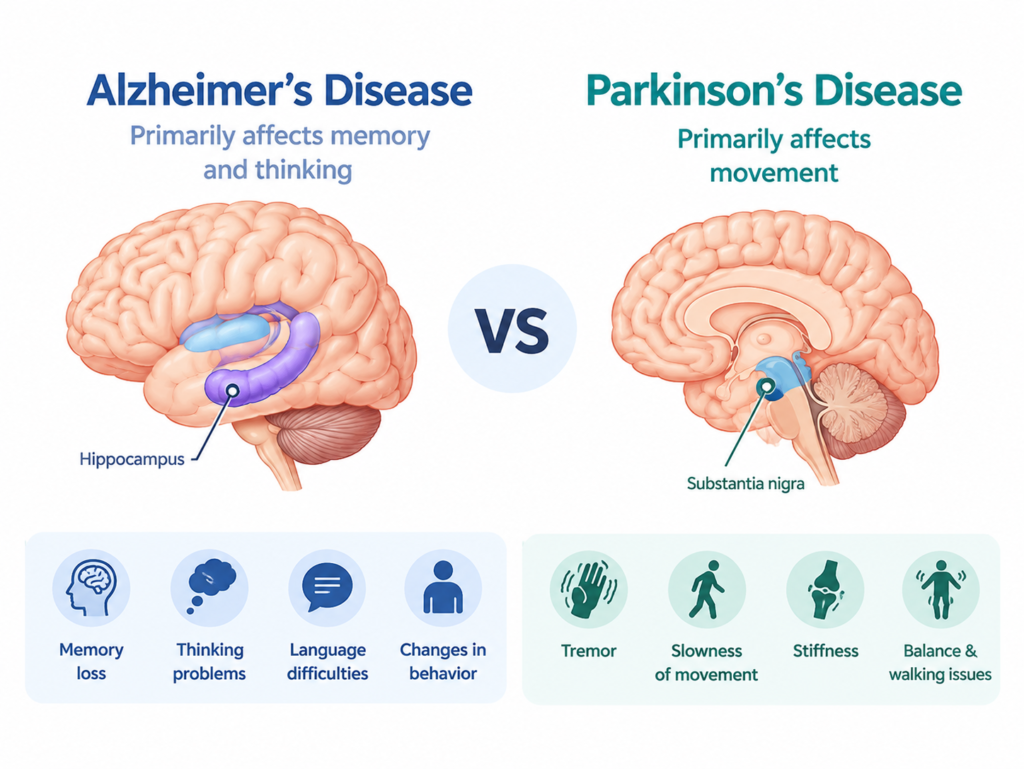
Eventually, Parkinson’s disease is usually recognised through its motor symptoms. These include:
- Bradykinesia — unusually slow movement
- Resting tremor — rhythmic shaking, often beginning on one side
- Rigidity — muscle stiffness or resistance to movement
- Gait and balance problems
Symptoms commonly begin asymmetrically, affecting one side of the body more than the other. Some people with Parkinson’s disease, however, never develop a prominent tremor.
1. Bradykinesia
Bradykinesia means slowness of movement and is a central feature of Parkinson’s disease.
It may initially be subtle. A person might:
- take longer to get dressed
- walk more slowly
- take smaller steps
- have difficulty starting a movement
- take longer to turn around
- notice that one arm does not swing normally while walking
Small movements can also become progressively slower and less automatic. Tasks such as buttoning clothes, writing or using utensils may become more difficult.
A related feature is micrographia, in which handwriting becomes unusually small and cramped.
2. Resting tremor
The typical Parkinson’s tremor is a resting tremor. It occurs when the affected body part is relaxed and may become less noticeable when the person deliberately uses that limb.
It often begins in one hand or arm and may produce a characteristic rhythmic movement of the fingers and thumb. The tremor can become more noticeable with stress or emotional tension.
However, not everyone with Parkinson’s disease develops a prominent tremor.
3. Rigidity
Rigidity refers to increased resistance when a limb is moved.
People may describe their muscles as feeling stiff, tight or difficult to move. Rigidity can affect the arms, legs, neck or trunk and may contribute to discomfort or pain.
It can also interfere with normal movement. For example, reduced arm movement on one side while walking may be noticeable before other symptoms become obvious.
4. Changes in walking and balance
As Parkinson’s progresses, walking can become increasingly difficult.
A person may develop:
- shorter steps
- a stooped posture
- reduced arm swing
- difficulty turning
- freezing of gait, where the feet temporarily seem “stuck” to the floor
- increasing difficulty maintaining balance
Parkinson’s disease does not look exactly the same in every person. Motor symptoms are only part of Parkinson’s disease. Non-motor symptoms can occur alongside or even before the classic movement symptoms.
References
Sveinbjornsdottir S. The clinical symptoms of Parkinson’s disease. J Neurochem. 2016;139 Suppl 1:318-324. doi:10.1111/jnc.13691.
Jankovic J. Parkinson’s disease: clinical features and diagnosis. J Neurol Neurosurg Psychiatry. 2008;79(4):368-376. doi:10.1136/jnnp.2007.131045.
Poewe W. Non-motor symptoms in Parkinson’s disease. Eur J Neurol. 2008;15 Suppl 1:14-20. doi:10.1111/j.1468-1331.2008.02056.x.
Chaudhuri KR, Healy DG, Schapira AHV. Non-motor symptoms of Parkinson’s disease: diagnosis and management. Lancet Neurol. 2006;5(3):235-245. doi:10.1016/S1474-4422(06)70373-8.
Bloem BR, Okun MS, Klein C. Parkinson’s disease. Lancet. 2021;397(10291):2284-2303. doi:10.1016/S0140-6736(21)00218-X.
World Health Organization. Parkinson disease [Internet]. Geneva: World Health Organization; 2023 [cited 2026 Sep 16].
Pingback: Alzheimer's Disease and Parkinson's Disease: 20 Major Differences - Disease Buddy