
Multidrug-resistant tuberculosis (MDR-TB) is a form of tuberculosis caused by Mycobacterium tuberculosis strains that are resistant to at least the two most powerful first-line TB medicines, isoniazid and rifampicin. It is dangerous because it is harder to treat, requires longer and more complex treatment, and can spread between people, making drug-resistant TB a major global public health threat.
How many people are affected by TB worldwide?
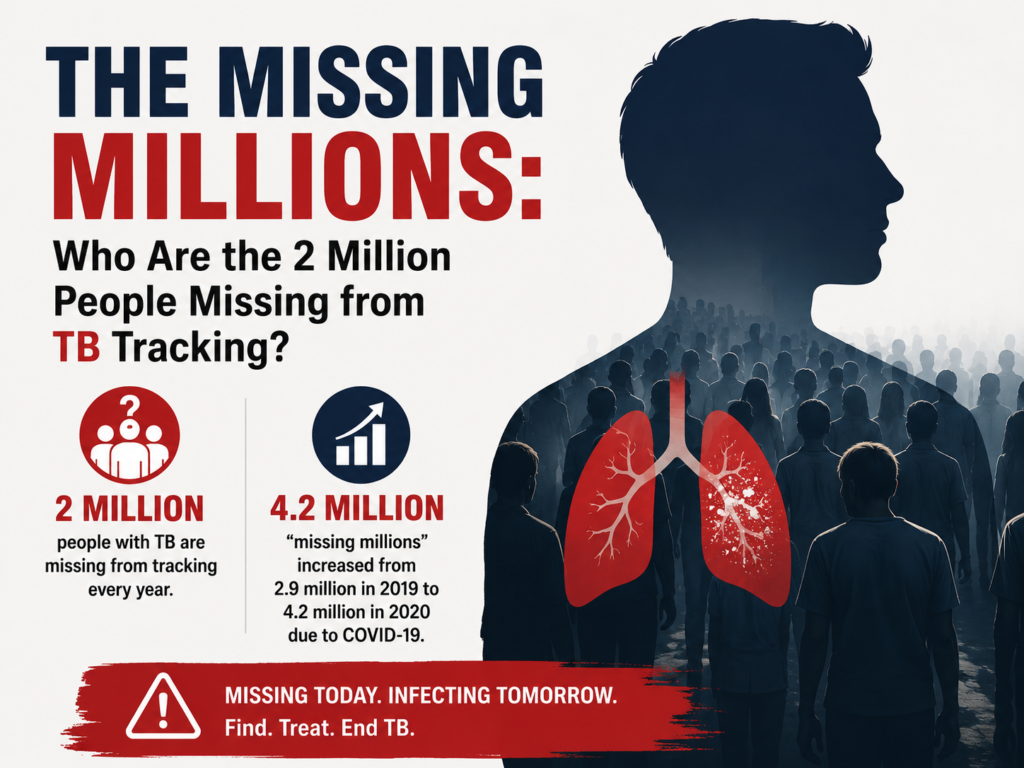
In 2024, an estimated number of 10.7 million people worldwide were infected by tuberculosis, which included 5.8 million men, 3.7 million women, and 1.2 million children. Out of these, 8.3 million people were reported as newly diagnosed with TB, representing about 78% of the estimated 10.7 million people, while 2.4 million people, ‘the missing millions,’ still remain undaignosed. Despite being preventable and curable, TB remains the world’s leading cause of death, resulting in an estimated 1.23 million deaths in 2024.
Approximately 1.7 billion people are latently infected with Mycobacterium tuberculosis, the bacteria that cause tuberculosis. However, 83 million lives have been estimated to be saved by global TB control efforts since 2000.

What is MDR-TB (Multidrug-Resistant Tuberculosis)?
Currently, tuberculosis is a major contributor to antimicrobial resistance-related mortality. MDR-TB is tuberculosis caused by Mycobacterium tuberculosis strains that are resistant to at leaset isoniazid and rifampicin, the two most important first-line anti-TB drugs.
According to WHO estimate, 390,000 people developed MDR-TB in 2024, causing 150,000 deaths. There is a decline of the estimated proportion of new TB cases with MDR-TB from 4.7% in 2015 to 3.2% in 2024. However, it remains a major risk for drug resistance from previous TB treatment, even though the global trend has improved.
History of MDR-TB
An uneven distribution of resistant was reported in the early global MDR-TB literature. A review showed that MDR-TB had a median prevalence of about 1% across 64 surveyed countries and geographical sites.

Historical evidence suggests that MDR-TB did not appear suddenly. It emerged as a large reservoir of TB infection, with uneven treatment created an environment for drug-resistant strains. A survey conducted in China between 1979 and 2010 showed that the prevalence and mortality of active pulmonary TB has decreased. However, once supposed to be only prevalent in specific geographical regions, the drug-resistant TB emerged globally in the 1990s.
A national survey, later in 2007, found that MDR-TB affected 5.7% of new TB patients and 25.6% of previously treated TB patients. The global averages at the time were 3.5% among new TB cases and 18% among retreatment cases. In 2017, China ranked second among high MDR-TB burden countries, accounting for 13% of the global MDR-TB burden.
Which country has the largest MDR-TB?
Four countries account for more than half of the world’s estimated MDR-TB incident cases. According to a data in 2024, India remained top with 32% cases, China 7.1%, Philippines 7.15%, and Russia 6.7%.

European Region had a much higher estimate of 23% among new TB cases in 2024, and about 2% in the WHO African Region and Eastern Mediterranean Region. However, the estimated MDR-TB proportion ranged from 5.6% in the Eastern Mediterranean Region to 51% in the Eurpoean region, among previously treated cases.
What is the Treatment Success Rate of MDR-TB?
A major improvement can be seen in MDR-TB treatment outcome globally. The treatment success rate for people enrolled on MDR-TB treatment in 2022 was 71%, which was an improvement from 68% in 2021, 64% in 2020, and 50% in 2012.
However, the rate is still lower than treatment success rate for drug-susceptible TB. A variety of factors affect MDR-TB treatment making it more complex, due to drug-susceptibility testing, monitoring, and stronger follow-up systems.
How to diagnose and treat MDR-TB?
The proper treatment of MDR-TB is not possible unless it is diagnosed. A WHO report showed that rapid molecular testing coverage for TB diagnosis increased from 48% in 2023 to 54% in 2024.
As the standard smear microscopy cannot detect drug resistance, the diagnosis of MDR-TB is a challenge globally. Culture-based drug susceptibility testing can detect resistance, but it is slower and more technically demanding. Moreover, advanced detection molecular tools and tests such as Xpert MTB/RIF and line probe assays, that can detect TB, remains limitedly available in many high-burden settings.
What is XDR-TB?
Extensively drug-resistant tuberculosis (XDR-TB) is one of the most severe forms of drug-resistant tuberculosis caused by strains of Mycobacterium tuberculosis that have developed resistance to multiple anti-TB medicines. Historically, XDR-TB has been associated with high mortality, with some studies reporting death rates ranging from approximately 20% to over 50%, especially in settings with limited treatment options.
According to the updated World Health Organization (WHO) definition, XDR-TB refers to TB that meets the criteria for multidrug-resistant or rifampicin-resistant TB (MDR/RR-TB) and is additionally resistant to any fluoroquinolone and at least one Group A drug, such as bedaquiline or linezolid. This extensive drug resistance greatly limits available treatment options, making management more complex and increasing the risk of poor treatment outcomes.
XDR-TB can arise through inadequate or incomplete treatment, inappropriate use of anti-TB medicines, or transmission of already resistant strains. Early detection through rapid molecular testing, accurate drug susceptibility testing, and access to effective treatment regimens are essential to prevent the spread of XDR-TB and reduce its impact on global tuberculosis control efforts.
Frequently Asked Questions (FAQs)
1. Is MDR-TB contagious?
Yes. MDR-TB can spread through the air when an infected person coughs, sneezes, or talks.
2. Can MDR-TB be cured?
Yes. MDR-TB can be cured with longer, specialized treatment using effective medicines.
3. How is MDR-TB diagnosed?
MDR-TB is diagnosed through laboratory tests that detect TB bacteria and drug resistance.
4. What causes drug resistance?
Drug resistance can develop due to incomplete treatment, incorrect medication use, or transmission of resistant TB strains.
5. Which countries have the highest MDR-TB burden?
Countries in Asia, Africa, and Eastern Europe report some of the highest MDR-TB burdens globally.
Reference
Dheda, K., Perumal, T., Moultrie, H., Perumal, R., Esmail, A., Scott, A. J., Udwadia, Z., Chang, K. C., Peter, J., Pooran, A., von Delft, A., von Delft, D., Joe, P., McCabe, R., Saunders, M. J., Furin, J., & Pai, M. (2024). Multidrug-resistant tuberculosis. Nature Reviews Disease Primers, 10, Article 22. https://doi.org/10.1038/s41572-024-00504-2
Espinal, M. A. (2003). The global situation of MDR-TB. The Lancet Infectious Diseases, 3(1), 44–51. https://doi.org/10.1016/S1473-3099(02)00558-6
Ormerod, L. P. (2005). Multidrug-resistant tuberculosis (MDR-TB): Epidemiology, prevention and treatment. British Medical Bulletin, 73–74(1), 17–24. https://doi.org/10.1093/bmb/ldh047
World Health Organization. (2025). Tuberculosis. https://www.who.int/news-room/fact-sheets/detail/tuberculosis
World Health Organization. (2025). Global tuberculosis report 2025: Drug-resistant TB. https://www.who.int/teams/global-programme-on-tuberculosis-and-lung-health/tb-reports/global-tuberculosis-report-2025/tb-disease-burden/1-3-drug-resistant-tb
World Health Organization. (2025). Global tuberculosis report 2025: Drug-resistant TB treatment. https://www.who.int/teams/global-programme-on-tuberculosis-and-lung-health/tb-reports/global-tuberculosis-report-2025/tb-diagnosis-and-treatment/2-4-drug-resistant-tb-treatment
World Health Organization. (2025). Global tuberculosis report 2025: Factsheet. https://cdn.who.int/media/docs/default-source/global-tuberculosis-report-2025/global-tb-report-2025_factsheet.pdf
World Health Organization. (2025). Global tuberculosis report 2025: TB prevention and screening. https://www.who.int/teams/global-programme-on-tuberculosis-and-lung-health/tb-reports/global-tuberculosis-report-2025/tb-prevention-and-screening
University of Minnesota Center for Infectious Disease Research and Policy. (2025). WHO cites progress against TB globally, warns about reduced funding. CIDRAP. https://www.cidrap.umn.edu/tuberculosis/who-cites-progress-against-tb-globally-warns-about-reduced-funding
Zhou, Y., Anthony, R., Wang, S., Ou, X., Liu, D., Zhao, Y., & van Soolingen, D. (2020). The epidemic of multidrug resistant tuberculosis in China in historical and phylogenetic perspectives. Journal of Infection, 80(4), 444–453. https://doi.org/10.1016/j.jinf.2019.11.022
Zhao, Y., Xu, S., Wang, L., Chin, D. P., Wang, S., Jiang, G., Xia, H., Zhou, Y., Li, Q., Ou, X., Pang, Y., Song, Y., Zhao, B., Zhang, H., He, G., Guo, J., Wang, Y., & National Tuberculosis Drug Resistance Survey Group. (2012). National survey of drug-resistant tuberculosis in China. New England Journal of Medicine, 366(23), 2161–2170. https://doi.org/10.1056/NEJMoa1108789
Long, Q., Qu, Y., & Lucas, H. (2016). Drug-resistant tuberculosis control in China: Progress and challenges. Infectious Diseases of Poverty, 5, Article 9. https://doi.org/10.1186/s40249-016-0103-3

Pingback: The Missing Millions: Who Are the 2 Million People Missing from TB Tracking? – Disease Buddy