
Tuberculosis (TB) is often described as a disease that can be prevented and cured with relatively inexpensive medicines. However, the cost of TB and TB financing extends far beyond the price of antibiotics for millions of families.
A patient may receive TB medicines free of charge through a national programme and still lose months of income, pay for transportation to clinics, purchase additional medicines and food, or require another household member to stop working as a caregiver. The result is a paradox at the centre of the global TB response: care can be medically free while treatment remains economically devastating.
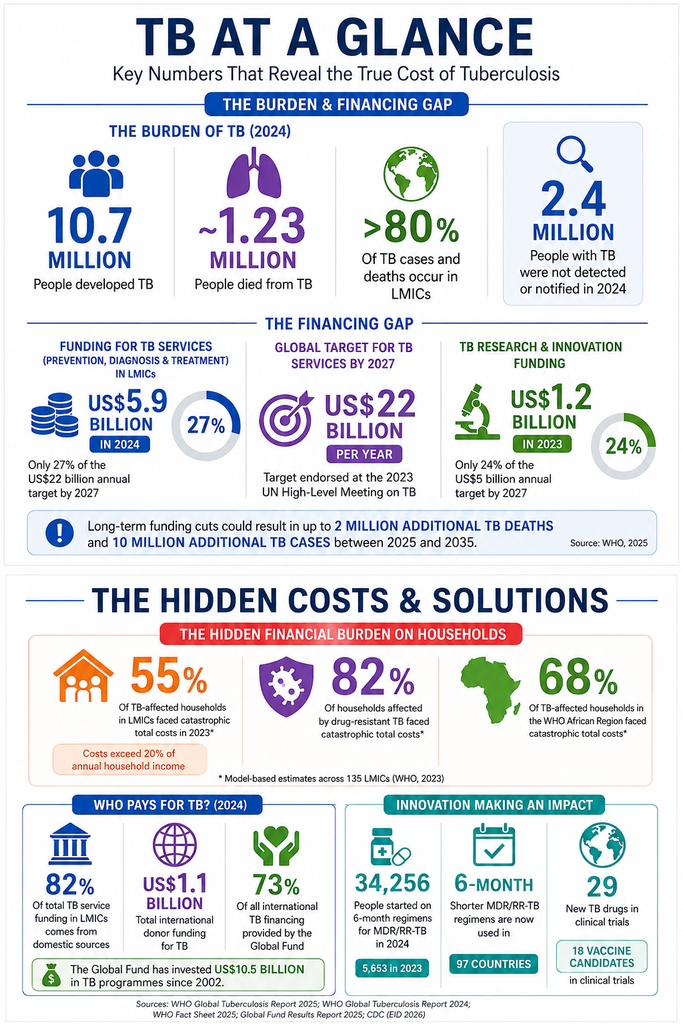
In 2024, an estimated 10.7 million people developed TB and approximately 1.23 million died from the disease. More than 80% of TB cases and deaths occur in low- and middle-income countries (LMICs), where households are least able to handle this economic burden.
The global financing gap
At the 2023 United Nations High-Level Meeting on TB, countries committed to mobilizing at least US$22 billion every year by 2027 for TB prevention, diagnosis, treatment and care. A separate target of US$5 billion annually by 2027 was established for TB research.
Yet the resources available remain far below those ambitions.
| Indicator | Latest figure | Global target |
| TB prevention, diagnosis & treatment funding, 2024 | US$5.9 billion | US$22 billion/year by 2027 |
| Funding as proportion of target | 27% | 100% |
| TB research funding, 2023 | US$1.2 billion | US$5 billion/year |
| Estimated TB cases, 2024 | 10.7 million | – |
| Estimated TB deaths, 2024 | ~1.23 million | – |
WHO reports that the US$5.9 billion available in 2024 represented only 27% of the US$22 billion target. Funding has also remained relatively stagnant as it was approximately US$6 billion annually between 2020 and 2024, rather than moving rapidly towards the 2027 target.
Research investment is similarly inadequate. Only US$1.2 billion was invested in TB research and innovation in 2023, approximately 24% of the US$5 billion annual target.
This TB financing gap matters because TB control depends on much more than supplying existing medicines. New vaccines, faster diagnostics, shorter treatment regimens and better models of patient-centred care require sustained investment.
WHO reported in 2025 that 63 TB diagnostic tests were in development, 29 drugs were in clinical trials and 18 vaccine candidates were in clinical trials, including six in Phase III.
The funding problem therefore has two dimensions: insufficient money to deliver existing services and insufficient investment to develop the tools needed to change the trajectory of the epidemic.
Who pays for TB care?
The financing aspect is more complicated than inadequate funding.
In 2024, approximately 82% of TB service funding in low- and middle-income countries (LMICs) came from domestic sources, while international donor funding was approximately US$1.1 billion. However, the overall domestic figure is strongly influenced by large economies such as Brazil, China, India, the Russian Federation and South Africa. For poorer countries with limited fiscal capacity, international financing can therefore be disproportionately important.
The Global Fund to Fight AIDS, Tuberculosis and Malaria reports that it provides approximately 73% of all international TB financing. By June 2025, it had invested US$10.5 billion in TB prevention and treatment programmes and another US$8.6 billion in TB/HIV programmes since its creation.
If international funding is compromised, countries that have limited domestic fiscal space may struggle to maintain diagnostics, medicines, laboratory capacity, community health workers and other components of TB programmes.
WHO warned in 2025 that long-term reductions in international donor funding could have major consequences, with modelling suggesting that sustained funding cuts could result in up to 2 million additional TB deaths and 10 million additional TB cases between 2025 and 2035.
The hidden price of “free” TB treatment
This is one of the most hidden and serious context about “free TB treatment”, which can create a misleading impression.
Providing medicines without charging patients removes one important cost, but it does not eliminate the financial consequences of becoming ill.
WHO defines the costs faced by TB-affected households across three broad categories:
- Direct medical costs – payments for consultations, tests, medicines and other healthcare.
- Direct non-medical costs – transportation, accommodation, food and other expenses associated with accessing care.
- Indirect costs – lost income and productivity caused by illness, disability, unemployment or caregiving.
WHO defines catastrophic TB-related costs as total costs exceeding 20% of annual household income or expenditure.
WHO’s latest analysis of national TB patient-cost surveys found that the proportion of TB-affected households experiencing catastrophic total costs ranged from 13% in El Salvador to 92% in the Solomon Islands.
Across the countries included in the analysis, the pooled average was 49%. For people affected by drug-resistant TB, the pooled average was dramatically higher at 82%.
WHO’s model-based estimate covering 135 LMICs produced an even broader picture: approximately 55% of people treated for TB and their households experienced catastrophic total costs in 2023.
The burden was particularly severe in the WHO African Region, where the model estimated that approximately 68% of affected households faced catastrophic costs.
The financing gap is also an economic investment gap
TB itself generates economic losses through premature mortality, reduced productivity, unemployment, caregiving requirements and household asset depletion.
The Global Fund’s modelling illustrates the potential return from stronger investment. Its 2025 investment case projects that an US$18 billion replenishment could help reduce new TB cases by 26% and TB deaths by 57% between 2023 and 2029 in countries where it invests, while helping provide treatment to tens of millions of people.
Investment in TB therefore affects both health and economy as:
- Preventing disease prevents treatment costs.
- Preventing illness preserves workers’ incomes.
- Preventing deaths preserves household productivity.
- Protecting households from catastrophic costs reduces the likelihood that families will fall deeper into poverty.
A new definition of “free treatment”
The global TB response needs to reconsider what it means when it says treatment is “free.”
A truly financially accessible TB programme should ask more than:
“Did the patient receive the medicines without paying?”
It should also ask:
- Could the patient afford to travel to the clinic?
- Could they afford food during treatment?
- Did they lose their job or income?
- Did another household member have to stop working?
- Did the family borrow money?
- Did they sell productive assets?
- Did children leave school?
- Did the household fall below the poverty line?
If the answer to these questions is frequently yes, then treatment may be clinically free but economically unaffordable.
References
World Health Organization. Global Tuberculosis Report 2025. Geneva: WHO; 2025.
World Health Organization. Financing for TB prevention, diagnostic and treatment services. Global Tuberculosis Report 2025.
World Health Organization. Costs faced by TB-affected households, social protection and human rights. Global Tuberculosis Report 2024.
Portnoy A, Yamanaka T, Nguhiu P, Nishikiori N, Garcia Baena I, Floyd K, et al. Costs incurred by people receiving tuberculosis treatment in low-income and middle-income countries: a meta-regression analysis. Lancet Glob Health. 2023;11.
Tanimura T, Jaramillo E, Weil D, Raviglione M, Lönnroth K. Financial burden for tuberculosis patients in low- and middle-income countries: a systematic review. Eur Respir J. 2014;43(6):1763-1775.
Sahu M, Subart IG, Johnson KB, et al. Tracking total spending on tuberculosis by source and function in 135 low-income and middle-income countries, 2000–17: a financial modelling study. Lancet Infect Dis. 2020;20(8):929-942.
Viney K, Islam T, Hoa NB, Morishita F, Lönnroth K. The financial burden of tuberculosis for patients in the Western-Pacific region. Trop Med Infect Dis. 2019;4(2):94.
World Health Organization. Tuberculosis fact sheet. 2025.
Centers for Disease Control and Prevention. Emerging Infectious Diseases: Projected Effects of Changing Global Tuberculosis Epidemiology on Mycobacterium tuberculosis Immunoreactivity Prevalence, 2024–2050. 2026.
Global Fund to Fight AIDS, Tuberculosis and Malaria. Tuberculosis. 2025.
Global Fund to Fight AIDS, Tuberculosis and Malaria. Results Report 2025.
Jiang WX, Long Q, Lucas H, et al. Impact of an innovative financing and payment model on tuberculosis patients’ financial burden: Is tuberculosis care more affordable for the poor? Infect Dis Poverty. 2019;8:21.
Long Q, Jiang W, Dong D, et al. A new financing model for tuberculosis care in China: challenges of policy development and lessons learned from implementation. Int J Environ Res Public Health. 2020;17(4):1400.
Pingback: The Missing Millions: Who Are the Hidden 2 Million People Missing from TB Tracking? - Disease Buddy