
Cholera is one of the most consequential diseases in the history of public health. For centuries, severe diarrhoeal illnesses resembling cholera were reported in different parts of the world, but the disease became a global threat in the nineteenth century when repeated pandemics spread from the Indian subcontinent across Asia, the Middle East, Europe, Africa and the Americas.
Before the Pandemics
The precise ancient history of cholera remains uncertain. Historical accounts describe illnesses with severe diarrhoea and vomiting, but it is difficult to determine retrospectively whether these illnesses were actually cholera because similar symptoms occur in many gastrointestinal diseases.
Dhiman Barua notes that disagreement about the early history of cholera partly reflects the difficulty of defining the disease clinically before its causative organism was known. Nevertheless, historical evidence points particularly strongly to the Indian subcontinent, where cholera appears to have existed endemically for a long period.
The term cholera itself has a long history. It is derived from the Greek chole, meaning bile, although the word was historically applied to several gastrointestinal illnesses rather than exclusively to the disease we now recognize as cholera.
Before modern microbiology, outbreaks were frequently interpreted through the miasma theory—the belief that disease was caused by poisonous or contaminated air. Cholera was therefore often associated with foul smells, bad weather and environmental conditions rather than contaminated water.
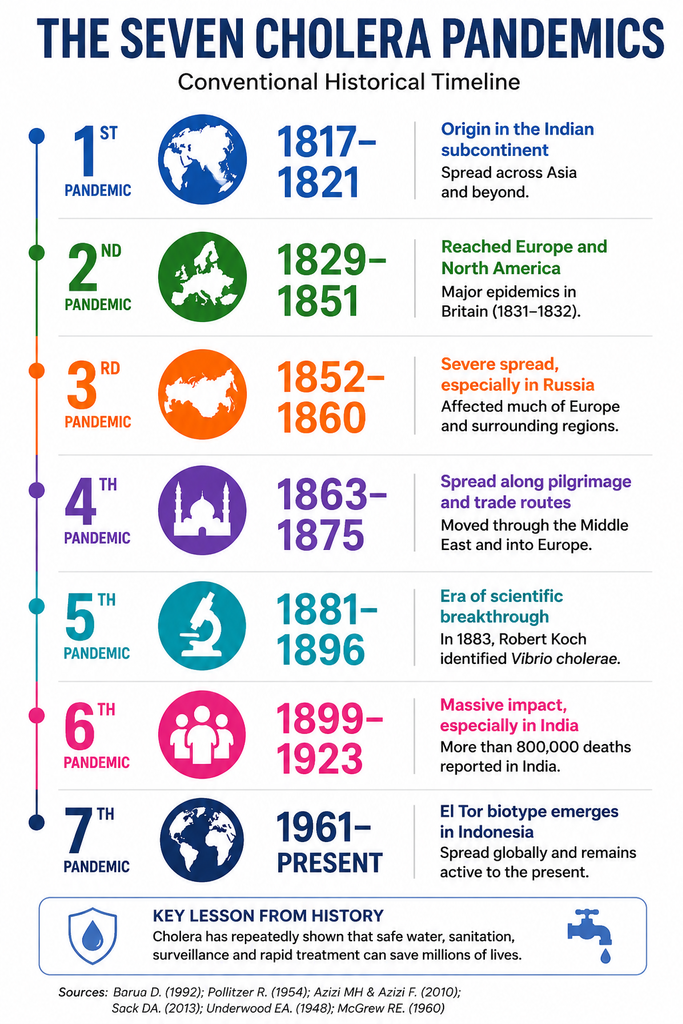
The First Cholera Pandemic (1817-1824)
- Origin: Jessore (Bengal), August 1817, is widely cited as the starting point.
- Spread: Across India, then to Southeast Asia, the Middle East, and beyond by the early 1820s.
- Deaths: Precise totals are uncertain. Estimates range from 1–2 million in British India alone, with very large numbers also in China, Indonesia (≈100,000 in Java), and elsewhere.
The Second Cholera Pandemic (1829-1851)
- Start: Often dated from 1826 in India, reaching Russia by 1830 and Europe/North America in the early 1830s.
- Britain: First major epidemic in 1831–1832, with roughly 22,000 deaths in England and Wales and about 9,600 in Scotland; London alone saw approximately 6,500 deaths in 1832.
- Later waves in Britain: 1848–49 caused about 53,000 deaths in England and Wales (London ~14,137); 1853–54 caused about 20,000 deaths in England and Wales (London ~10,738).
John Snow and the 1854 Broad Street Outbreak
Perhaps the most famous episode in cholera history occurred in London in 1854.
At the time, many physicians still supported miasmatic explanations for cholera. British physician John Snow, however, proposed that cholera was transmitted through contaminated water.
During the 1854 outbreak in London’s Soho district, Snow mapped cases around the Broad Street water pump and identified a striking concentration of cases among people using the pump’s water.
His investigation became a landmark in epidemiology because he used the geographical distribution of disease cases to investigate a possible source of transmission.
Snow’s work did not immediately convince everyone, but it helped establish the importance of contaminated water in cholera transmission and became one of the classic examples of epidemiological investigation. Historical accounts also describe his earlier work on the 1849 London outbreak and his publication On the Mode of Communication of Cholera in 1849 and 1855.
The Third Cholera Pandemic (1852-1860)
- Pattern: Severe international spread, notably in Russia and Europe; continued reinforcement of the water/sanitation link.
- Numbers: Less consistently quantified in global summaries, but UK figures above (1853–54) fall within this period.
Filippo Pacini and the Discovery of the Cholera organism
An important but sometimes overlooked figure in cholera history was the Italian anatomist Filippo Pacini.
In 1854, Pacini identified microscopic organisms associated with cholera and described them in detail. His observations represented an important early step toward identifying the biological cause of the disease.
However, Pacini’s work did not immediately receive the recognition that it deserved.
The acceptance of the bacterial cause of cholera would come later in the nineteenth century, particularly through the work of Robert Koch.
The Fourth Cholera Pandemic (1863-1875)
- Origin and routes: Again from Bengal; spread via trade and pilgrimage (including to Mecca) into the Middle East, Europe, and beyond.
- Significance: Strengthened international quarantine efforts, though water/sanitation remained the core issue.
The Fifth Cholera Pandemic (1881-1896) and Koch’s Discovery
- Koch’s work: In August 1883 Koch investigated cholera in Alexandria, Egypt, then moved to Calcutta, India. He isolated Vibrio cholerae in pure culture on 7 January 1884 and reported it in February 1884.
- Impact: Marked the transition to germ‑theory–based understanding and bacteriological diagnosis. Cholera was no longer simply a mysterious disease associated with bad air or environmental conditions. It could now be understood as an infectious disease caused by a specific microorganism.
The Sixth Cholera Pandemic (1899-1923)
- Origin: Indian subcontinent; spread to the Middle East, North Africa, Eastern Europe, Russia.
- India deaths: Multiple sources state >800,000 cholera deaths in India during this pandemic.
The Seventh Cholera Pandemic (1961-Present)
- Start: 1961, Sulawesi (Indonesia), caused by V. cholerae O1, El Tor biotype; spread across Asia, the Middle East, Africa, and later Latin America.
- Persistence: Unlike earlier pandemics, this one has continued for decades, becoming endemic in many parts of sub‑Saharan Africa.
- Global burden (modern): Sack (2013) cites an estimated 2.8 million cholera cases per year and >100,000 deaths annually, with under‑reporting acknowledged.
Latin America and the Return of Epidemic Cholera
Another major milestone occurred in Latin America in 1991.
After decades without widespread epidemic cholera in much of the region, cholera re-emerged with major outbreaks.
The historical review by Azizi and Azizi records thousands of deaths in Africa and Latin America during the 1991 period, demonstrating that cholera remained capable of causing substantial epidemics even after the development of modern microbiology and treatment.
The fight against infectious disease is not only about discovering pathogens. It is also about building societies in which those pathogens have fewer opportunities to spread.
From the first pandemic in 1817 to the continuing seventh pandemic, cholera has repeatedly demonstrated the same principle: safe water, sanitation, surveillance and rapid treatment can save lives on a massive scale.
References
Barua, D. (1992). “History of Cholera.” In Cholera, edited by Dhiman Barua and William B. Greenough III, pp. 1–36, Springer.
Pollitzer, R. (1954). “Cholera studies: 1. History of the disease.”Bulletin of the World Health Organization, 10(3):421–461.
Azizi, M.H. & Azizi, F. (2010). “History of Cholera Outbreaks in Iran during the 19th and 20th Centuries.”Middle East Journal of Digestive Diseases, 2(1):51–55.
Sack, D.A. (2013). “A new era in the history of cholera: the road to elimination.”International Journal of Epidemiology, 42(6):1537–1540.
Underwood, E.A. (1948). “The History of Cholera in Great Britain.”Proceedings of the Royal Society of Medicine, 41(3):165–173.
McGrew, R.E. (1960). “The First Cholera Epidemic and Social History.”Bulletin of the History of Medicine, 34(1):61–73.
Pingback: Disease Outbreaks After Floods and Natural Disasters: Evidence From Around the World - Disease Buddy
Pingback: How Much Does Cholera Really Cost a Family? The Hidden Economic Burden of Cholera - Disease Buddy