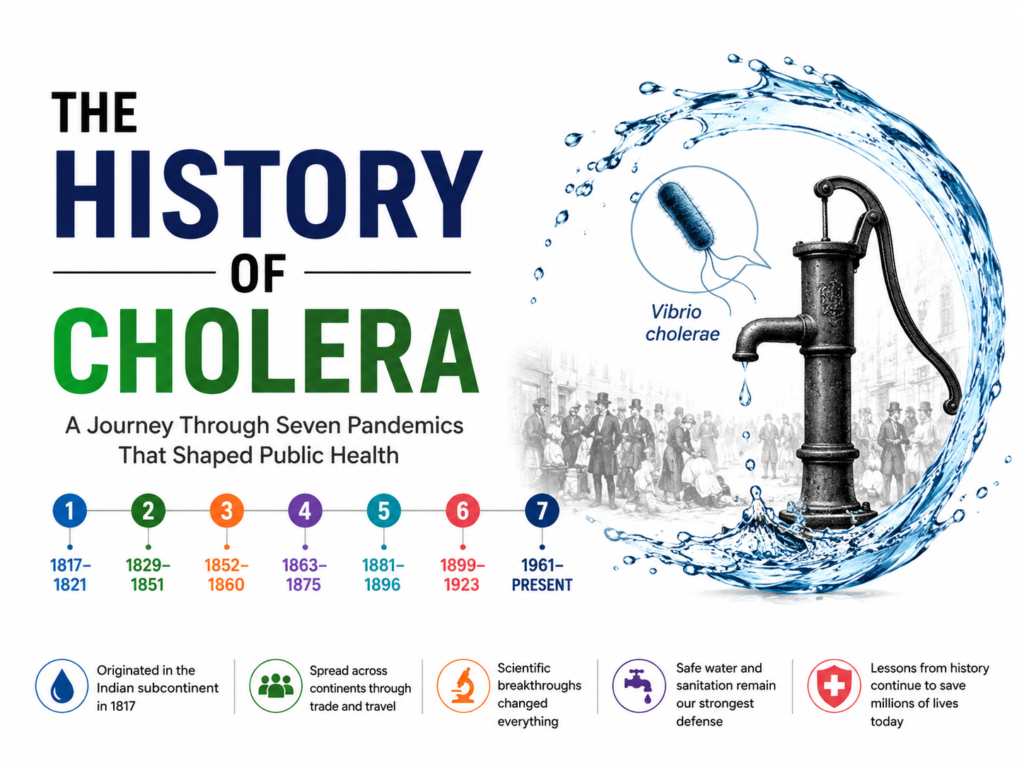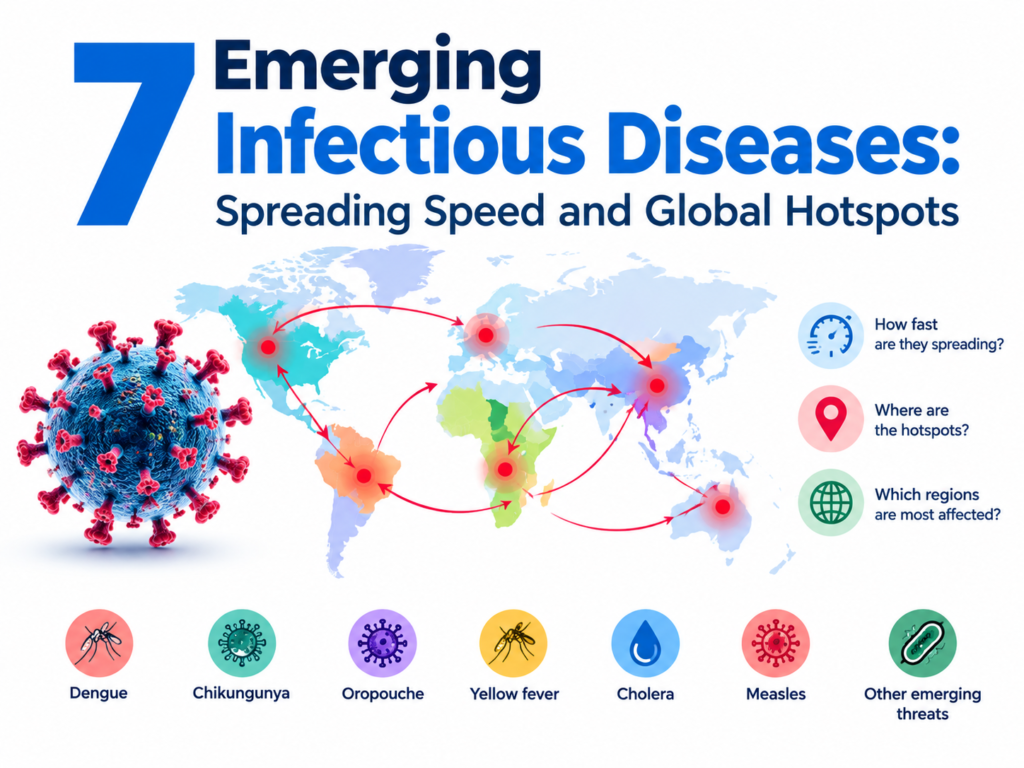
Cholera is often described as a disease of contaminated water and inadequate sanitation. However, the economic cost of cholera is often neglected. These costs become particularly important during large outbreaks, when health systems are already under pressure.
The World Health Organization (WHO) currently estimates that cholera causes approximately 1.3–4.0 million cases and 21,000–143,000 deaths worldwide each year.
In 2024, 60 countries reported more than 560,000 cholera cases and more than 6,000 deaths to WHO. This represented a slight increase in reported cases but a sharp increase in deaths compared with 2023, when more than 535,000 cases and approximately 4,000 deaths were reported.
The situation became even more concerning in 2025. WHO reported 451,499 cholera cases and 7,870 deaths from 47 countries, making 2025 the year with the highest number of cholera deaths reported to WHO since 1999. Seven countries, namely Angola, Bangladesh, the Democratic Republic of the Congo, Nigeria, South Sudan, Sudan and Yemen, accounted for approximately 90% of reported global cases and deaths.
What does a cholera case actually cost?
The major component of cost of cholera is the healthcare costs.
Most cholera cases can be treated with oral rehydration, while severe dehydration requires rapid intravenous treatment. CDC notes that with timely rehydration therapy, more than 99% of cholera patients survive.
This means that effective treatment can keep the medical cost of an individual case relatively low compared with many other serious diseases.
The cost to families can be substantial
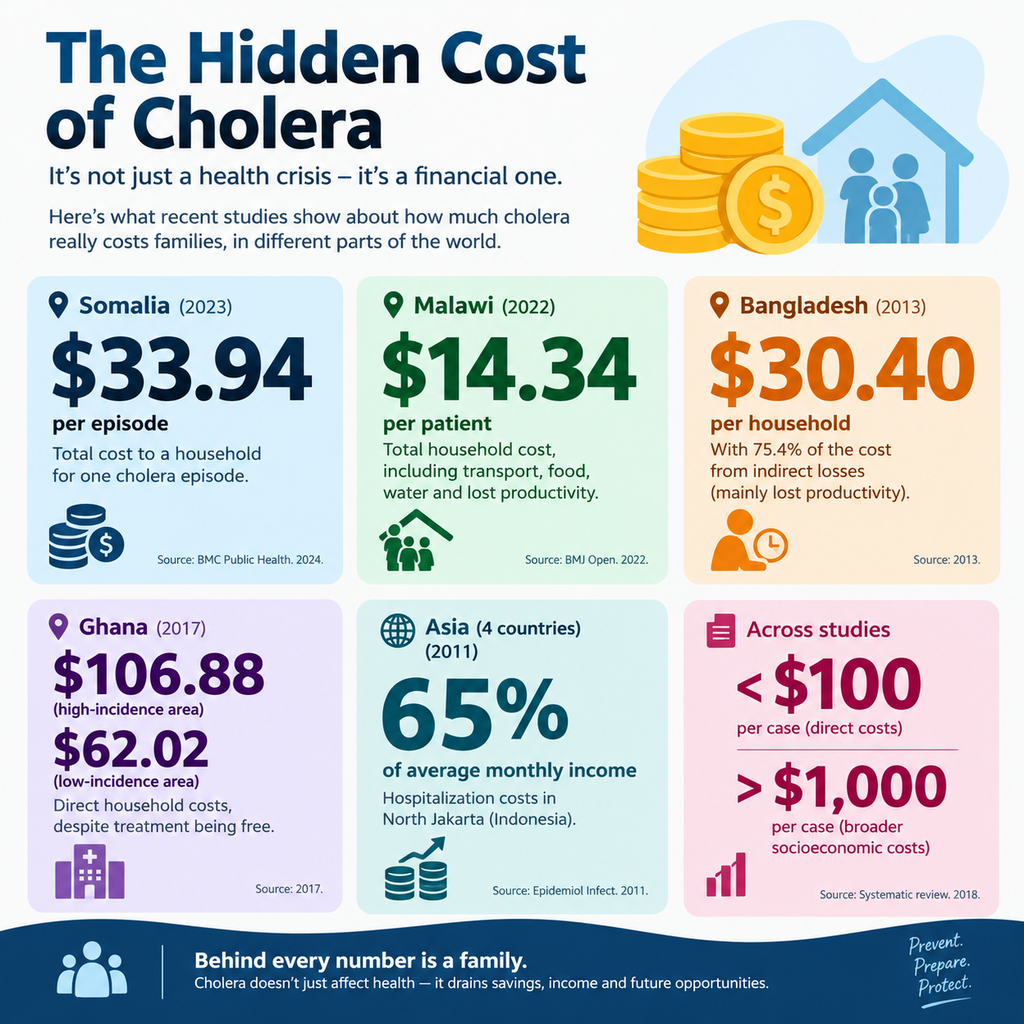
Families can face expenses, transportation, food, medicines or lost wages, even when the healthcare system absorbs much of the treatment cost.
A study of endemic cholera in Bangladesh, India, Indonesia and Mozambique illustrates this hidden burden.
The study found that the total cost of cholera cases to households and health systems varied considerably by setting.
For example:
- Severe cholera treatment cost approximately US$32 in Matlab, Bangladesh
- and US$47 in Beira, Mozambique
- In community-based studies in Kolkata and North Jakarta, the total cost of a cholera episode ranged from approximately US$28 to US$206, depending largely on whether hospitalization was required.
For hospitalized cases, the patient’s cost of illness represented approximately 21% of average monthly income in Kolkata and 65% in North Jakarta.
Furthermore, a study in Bangladesh examined 394 laboratory-confirmed hospitalized cholera cases. The average household cost of a cholera episode was: US$30.40
But the distribution was striking:
- US$7.40 (24.6%) — direct costs
- US$23.00 (75.4%) — indirect costs.
Therefore, roughly three-quarters of the household burden came from lost income and productivity rather than direct expenditure.
A treatment episode costing tens or hundreds of dollars may look relatively inexpensive from a national-health-budget perspective. But for a low-income household, the same expenditure can represent a large proportion of monthly income.
Clear overview of household burden from a study in Somalia
Researchers studied 400 patients treated at five cholera treatment centres during October and November 2023.
They estimated that the average household cost of a cholera episode was:
| Cost component | Average cost per episode |
| Direct household costs | US$17.12 |
| Indirect household costs | US$16.82 |
| Total household cost | US$33.94 |
| Health-facility cost | US$82.65 |
| Combined household + facility cost | US$116.59 |
The average hospital stay was 3.08 days.
The economic burden was not evenly distributed. 61.8% of households used family savings to pay for the cholera episode, while 14.5% borrowed money.
The economic cost of cholera is not limited to what governments spend on treatment.
Malawi: when treatment is free, families still pay
Somalia is not an isolated example.
A prospective study in Nsanje District, southern Malawi, followed 40 laboratory-confirmed cholera patients between 2016 and 2020. Cholera treatment at government health centres was provided free of charge.
Despite free treatment, the average cost of a cholera episode to the household was:
More than half of this amount came from direct non-medical expenses, particularly food, water and transportation.
The breakdown was:
| Cost | Average per patient |
| Direct medical costs | US$0.31 |
| Direct non-medical costs | US$8.30 |
| Productivity losses | up to US$13.72 |
| Overall observed cost | US$14.34 |
This study gives us one of the clearest demonstrations of the hidden-cost problem.
Only US$0.31 of the observed average household cost was medical. The much larger component was everything surrounding the treatment.
In Malawi, patient transportation averaged approximately US$1.84, while food/water for patients and caregivers together added roughly US$2.56 per episode.
In Zambia, a study of cholera patients in Lusaka found that transportation was the most commonly reported non-medical expense during hospitalization.
Among the 189 patients interviewed:
- 56.1% incurred transport costs
- 14.8% incurred food and beverage costs
- 12.2% incurred communication costs
By contrast, only:
- 1.1% reported consultation costs
- 0.5% reported drug/supply costs
- 1.1% reported laboratory costs.
Zambia: the cost continues after discharge
Approximately 70.9% of patients stayed in hospital for one to three days, but 45% reported another one to three days of inactivity after discharge.
That means the economic effect of cholera does not necessarily end when the patient leaves the treatment centre.
A patient may be medically discharged but still be:
- too weak to work
- unable to run a business
- unable to perform normal household duties
- dependent on another family member
For households relying on daily earnings, those additional days can matter.
Similarly, a study of cholera patients in Lusaka, Zambia found that transportation was the most commonly reported non-medical expense during hospitalization.
Among the 189 patients interviewed:
- 56.1% incurred transport costs
- 14.8% incurred food and beverage costs
- 12.2% incurred communication costs
By contrast, only:
- 1.1% reported consultation costs
- 0.5% reported drug/supply costs
- 1.1% reported laboratory costs.
Ghana: even “free” cholera treatment can have a household price
Ghana provides another African perspective.
During the country’s major 2014 cholera outbreak, researchers surveyed 418 affected households in two districts.
The average direct household cost was:
- US$106.88 in the high-incidence area
- US$62.02 in the low-incidence area.
In the high-incidence area, direct costs included:
- treatment: 49.49%
- admission: 23.47%
- transportation: 12.63%
- food: 12.09%
- first aid: 2.32%.
This study is particularly interesting because cholera treatment during the outbreak had been declared free, yet households still reported substantial costs.
Asia’s economic burden: Nearly a billion when premature deaths are counted
A 2025 study examined 14 Asian countries, which included Bangladesh, Bhutan, India, Nepal, Afghanistan, Cambodia, Indonesia, Laos, Malaysia, Myanmar, the Philippines, Thailand, Timor-Leste and Iran.
The model estimated approximately:
- 851,396 cholera cases
- 25,482 deaths
in 2015.
By comparison, only 59,591 cases and 28 deaths had been reported to WHO by those countries that year, demonstrating the enormous uncertainty created by underdiagnosis and underreporting.
The estimated economic burden was:
| Component | Estimated 2015 cost |
| Lost productivity from illness | US$12.2 million |
| Public health system costs | US$8.6 million |
| Out-of-pocket costs | US$20.2 million |
| Subtotal | US$41 million |
| Productivity losses from premature deaths | US$946.0 million |
| Total economic burden | US$987.1 million |
Without valuing productivity lost because of premature deaths, the estimated burden was US$41 million. After adding premature mortality, it became approximately US$987 million. That is about 24 times larger.
Africa: a larger burden when productivity is included
A model-based analysis of 44 African countries estimated that approximately 1.01 million cholera cases in 2015 generated about US$130 million in economic burden from illness and treatment.
When approximately 38,104 estimated cholera deaths were included, the estimated economic burden increased to approximately:
US$1 billion.
The result is highly sensitive to the number of infections, hospitalizations, workdays lost and the method used to value premature deaths.
The economic consequences of cholera extend far beyond healthcare spending.
Interesting Contrast in the Americas
Cholera was historically a major economic problem in Latin America, but the pattern today is very different.
Haiti’s cholera epidemic and cost
Haiti’s cholera epidemic, which began in 2010, provides one of the largest examples. A 2022 analysis by Haiti’s Ministry of Public Health and Population and Université Quisqueya estimated 824,523 suspected cases and 9,648 deaths between October 2010 and 2021.
Using Haiti-specific cost estimates, the estimated cost of hospitalization and convalescence was approximately:
- US$94.61 per child
- US$113.91 per adult
producing an estimated total of approximately US$91.6 million for the reported caseload under that methodology.
Peru: families changed their spending because of cholera
The 1991 cholera epidemic in Peru offers one of the clearest historical examples of a hidden household cost.
A Pan American Health Organization analysis found that two-thirds of surveyed families changed their normal consumption patterns to cope with the disease.
Some families sacrificed spending on:
- food
- children’s education
while increasing spending on:
- water
- fuel
- disease-related needs.
The wider economic impact was also substantial.
The estimated aggregate net loss associated with the epidemic was approximately: US$495.3 million
with approximately US$232.5 million equivalent to nearly 1% of Peru’s 1991 GDP, excluding an additional estimated US$233.8 million in future production losses.
Families do not simply spend more when cholera occurs, they may have to spend less on other essentials.
References
Cost of Cholera for Households and Health Facilities, Somalia. BMC Public Health. 2024.
The cost of cholera in Southern Malawi: a prospective cost-of-illness study. BMJ Open. 2022;12:e052337.
Economic burden of cholera in a high-risk urban setting in Bangladesh. 2013.
Household costs of cholera in an outbreak setting in Ghana. 2017.
Costs of illness due to endemic cholera. Epidemiol Infect. 2011.