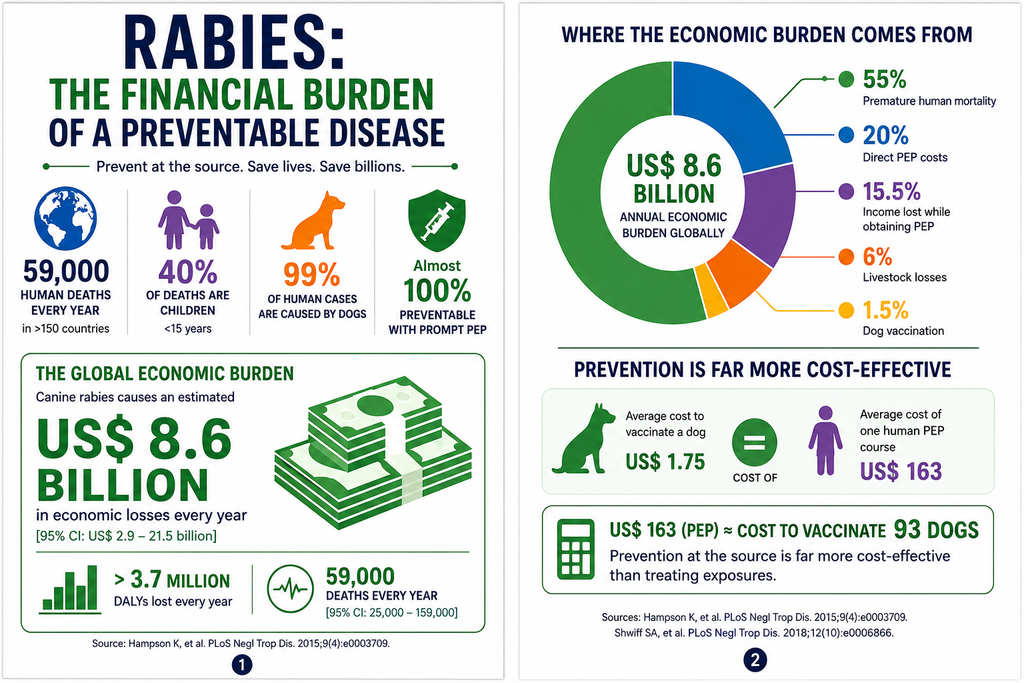
Rabies is one of the clearest examples of a disease in which prevention can be economically more rational than treatment. However, it continues to cause an estimated 59,000 human deaths every year across more than 150 countries, with approximately 95% of deaths occurring in Africa and Asia. WHO estimates that around 40% of rabies deaths occur among children younger than 15 years. Dogs remain the principal source of human infection, accounting for approximately 99% of human rabies cases.
The economic significance of rabies extends far beyond the cost of treating infected patients. The economic burden includes premature mortality and lost productivity, post-exposure prophylaxis (PEP), transportation and other household expenses, livestock losses, surveillance, vaccination and public-health response. A landmark global economic analysis estimated that canine rabies causes approximately US$8.6 billion in economic losses every year, in addition to more than 3.7 million disability-adjusted life years (DALYs).
The US$8.6 billion annual economic burden
Hampson et al. estimated that the global annual economic burden of endemic canine rabies is approximately US$8.6 billion.
The composition of this economic burden is particularly important:
| Component | Approx. share of economic burden |
| Premature human mortality | 55% |
| Direct PEP costs | 20% |
| Lost income while obtaining PEP | 15.5% |
| Livestock losses | 6% |
| Dog vaccination | 1.5% |
This distribution exposes the central economic problem of rabies. The largest costs arise after transmission has already occurred, while comparatively little of the total economic burden is associated with preventing transmission through dog vaccination.
The financial cost of PEP
PEP is a major component of rabies expenditure.
The global Hampson model estimated that direct PEP costs represent approximately 20% of the total economic burden, while an additional 15.5% results from income lost while people seek PEP.
For an exposed individual, the financial pathway may include:
vaccine + immunoglobulin + wound care + transportation + accommodation + food + lost working time + caregiver time
Consequently, even when governments subsidise or provide rabies vaccines, patients may still experience significant out-of-pocket and indirect costs.
A country-level example: Viet Nam
Shwiff et al. estimated that canine rabies generated more than US$719 million in economic losses in Viet Nam between 2005 and 2014. Approximately 92% of this burden was associated with PEP-related costs.
The contrast between prevention and treatment is striking. The estimated average cost of vaccinating a dog was approximately US$1.75, whereas the average cost of a human PEP course was approximately US$163.
70% dog vaccination coverage
WHO identifies mass dog vaccination as the most cost-effective strategy for preventing human rabies and states that vaccinating at least 70% of dogs in at-risk areas is the accepted target for interrupting transmission.
This is particularly important because dogs are responsible for approximately 99% of human rabies cases.
The economic logic is therefore straightforward:
Vaccinate dogs → reduce canine transmission → reduce human exposures → reduce PEP demand → reduce household expenditure → prevent deaths and productivity losses.
Dog vaccination consequently has benefits that extend well beyond the veterinary sector.
The household financial burden
Research from Ethiopia demonstrated that many bite victims face substantial costs associated with seeking PEP. Beyene et al. estimated an annual national burden of approximately 96,657 people exposed to rabies and 2,871 human deaths, based on their modelling of dog-bite victims and underreporting. The study estimated approximately US$2 million in annual national PEP costs. [8]
The study also demonstrated that access and treatment-seeking behaviour are important economic determinants. Many people, particularly in rural communities, did not seek care at health facilities and instead relied on traditional or spiritual treatment.
The economic problem therefore becomes circular:
Low income → reduced access to healthcare → delayed or absent PEP → greater risk of death → loss of household income and productivity.
More recent evidence from Northwest Ethiopia illustrates how the indirect costs of rabies can exceed direct medical expenses.
A 2025 economic analysis reported that transportation and accommodation represented a major component of household costs associated with seeking PEP, with an estimated average annual cost of approximately US$108.22 for these expenses. The estimated PEP cost itself was approximately US$27.03 per household.
The United States: a high-cost, low-mortality model
The United States provides a useful contrast with endemic low- and middle-income countries.
CDC reports that approximately 1.4 million Americans receive healthcare each year for a possible rabies exposure, while around 100,000 people receive PEP. Despite the large number of potential exposures, fewer than 10 people die from rabies annually in the United States.
Historical CDC analysis estimated that during 2017–2018 approximately 55,000 people per year were treated for potential rabies exposure. The average cost of PEP was estimated at approximately US$3,800, with a range of US$1,200–6,500, excluding hospital treatment and wound-care costs. This translated to an estimated US$209 million in annual PEP expenditure, with a range of approximately US$66–358 million.
These figures demonstrate that even countries with very low human rabies mortality can face substantial financial costs from exposure management.
CDC also estimated that rabies-related public-health emergency response activities cost approximately US$7.6 million annually, with an estimated range of US$2.6–12.9 million.
The U.S. experience therefore illustrates an important principle:
Eliminating canine rabies does not eliminate all rabies-related expenditure.
However, successful canine rabies control can dramatically reduce the human mortality burden. CDC notes that elimination of the canine rabies virus variant in the United States through canine vaccination contributed to a tenfold reduction in reported human rabies cases between 1938 and 2018.
Large financial burden of rabies carried by Asia
WHO estimates approximately 35,172 human rabies deaths annually in Asia, with India accounting for approximately 59.9% of rabies deaths in the region and around 35% of global deaths. WHO estimates that PEP expenditure in Asia can reach approximately US$1.5 billion annually.
Consequently, reducing canine transmission can potentially reduce both mortality and recurring PEP expenditure
A different economic problem in Africa
WHO estimates approximately 21,476 human deaths from dog-mediated rabies each year in Africa. The region spends comparatively less on PEP but experiences a higher economic cost from human mortality.
A lower PEP expenditure does not necessarily mean a lower economic burden.
It can instead reflect:
limited access to PEP → fewer people receive treatment → more preventable deaths → greater productivity loss.
How to prevent economic loss from rabies?
The evidence points toward a clear economic hierarchy.
1. Prevent transmission at source
Mass dog vaccination is the most cost-effective strategy identified by WHO for preventing human rabies. Achieving approximately 70% vaccination coverage in dog populations is the accepted target for interrupting transmission. [7]
2. Maintain accessible PEP
PEP remains essential because no vaccination programme provides complete protection against every exposure. Prompt PEP can prevent death following exposure. [1,4,5]
3. Reduce financial barriers
Treatment must be physically and financially accessible. Otherwise, households may delay or abandon PEP because of transportation, accommodation, lost income or other costs.
4. Integrate human and animal health financing
Because investment in animal vaccination generates savings in human healthcare and household productivity, rabies financing should be approached through a One Health framework.
5. Strengthen surveillance
Better surveillance improves resource allocation and helps countries determine where vaccination, PEP and public-health interventions will produce the greatest economic return.
References
World Health Organization. Rabies [Internet]. Geneva: WHO; 2024 Jun 5. WHO Rabies Fact Sheet
World Health Organization. Rabies: health topic [Internet]. Geneva: WHO. WHO Rabies Health Topic
Hampson K, Coudeville L, Lembo T, Sambo M, Kieffer A, Attlan M, et al. Estimating the global burden of endemic canine rabies. PLoS Negl Trop Dis. 2015;9(4):e0003709. doi:10.1371/journal.pntd.0003709.
World Health Organization. Human rabies prevention and management [Internet]. Geneva: WHO. WHO: Human rabies prevention and management
Centers for Disease Control and Prevention. Rabies Post-exposure Prophylaxis Guidance [Internet]. Atlanta: CDC; 2025 Jul 15. CDC Rabies PEP Guidance
Shwiff SA, Brown VR, Dao TT, Elser J, Trung HX, Tien NN, et al. Estimating the economic impact of canine rabies to Viet Nam 2005–2014. PLoS Negl Trop Dis. 2018;12(10):e0006866. doi:10.1371/journal.pntd.0006866.
World Health Organization. Vaccinating against rabies to save lives [Internet]. Geneva: WHO. WHO: Vaccinating against rabies to save lives
Beyene TJ, Mourits MCM, Revie CW, Hogeveen H. Estimating the burden of rabies in Ethiopia by tracing dog bite victims. PLoS One. 2018;13(2):e0192313. doi:10.1371/journal.pone.0192313.
Selleck M, Koppes P, Jareb C. The economic landscape of global rabies: a scoping review and future directions. Trop Med Infect Dis. 2025;10(8):222. doi:10.3390/tropicalmed10080222. [The Northwest Ethiopia economic study supplied in the original source set was also used for the household-cost estimates.]
Centers for Disease Control and Prevention. Rabies in the United States: Protecting Public Health [Internet]. Atlanta: CDC; 2025 Sep 30. CDC: Rabies in the United States
Dyer JL, Wallace R, Orciari L, Hightower A, Yager P, Blanton JD. Rabies surveillance in the United States during 2017. J Am Vet Med Assoc. 2018;253(12):1555-1568; and CDC historical economic analysis of rabies PEP and public-health response.
Centers for Disease Control and Prevention. Vital Signs: Trends in Human Rabies Deaths and Exposures — United States, 1938–2018. MMWR Morb Mortal Wkly Rep. 2019;68:524-528.
World Health Organization. Epidemiology and burden of rabies [Internet]. Geneva: WHO. WHO: Epidemiology and burden of rabies