
Timeline of History of Rabies Virus
- Ancient history of rabies
- The origin of the name rabies
- 1804: Experimental transmission of rabies
- 1881: Galtier and experimental immunization
- 1885: Louis Pasteur develops the first successful rabies vaccination
- 1903: Identification of rabies as a virus
- 1960s: Visibility of rabies virus
- 1970s: Emergence of modern human rabies vaccines
- 2000s: Rabies research enters the genomic era
Rabies is one of the oldest infectious diseases known to humans. For thousands of years, people have feared the disease because of its dramatic neurological symptoms and almost inevitable death once clinical signs appear.
The history of rabies stretches from ancient Mesopotamia to the molecular era of modern virology.
Ancient history of rabies
Rabies has been associated with humans and dogs for thousands of years. Historical evidence suggests that descriptions of rabies-like disease appeared in ancient Mesopotamia, with the Eshnunna laws, dating to around the 23rd century BCE, often cited as one of the earliest references to rabies.
The disease was also described by ancient Greek writers. Democritus, around the 5th century BCE, provided an early description of rabies in animals. Later, Celsus, writing in the first century CE, recognized that humans could also develop the disease following exposure to an infected animal.
The origin of the name rabies
The word rabies is related to the Latin rabere, meaning “to rage” or “to become furious.” The Greek term lyssa, meaning madness or frenzy, also contributed to the scientific terminology used for the disease and to the name of the viral genus Lyssavirus.
1804: Experimental transmission of rabies
One of the important early scientific milestones occurred in 1804, when German scientist Georg Gottlob Zinke demonstrated experimentally that rabies could be transmitted from the saliva of a rabid dog to another animal.
This was significant because it moved rabies research away from purely observational descriptions toward experimental investigation.
1881: Galtier and experimental immunization
Before Pasteur’s famous experiments, the French veterinarian Pierre-Victor Galtier had already made important contributions to rabies research.
In 1881, Galtier demonstrated experimental immunization against rabies in sheep. His work helped establish the idea that exposure to rabies material could potentially induce protection rather than simply cause disease.
1885: Louis Pasteur develops the first successful rabies vaccination
In 1885, French scientist Louis Pasteur, together with colleagues including Émile Roux, discovered that repeated laboratory passage of the virus could alter its properties and that infected rabbit spinal cord tissue could be progressively dried to reduce its virulence.
This work eventually led to an experimental vaccine.
On 6 July 1885, nine-year-old Joseph Meister was brought to Pasteur after being severely bitten by a rabid dog.
At the time, Pasteur was not a physician, and his proposed treatment had never been tested in a human under these circumstances. Nevertheless, the severity of the exposure meant that the child was considered at extremely high risk of developing rabies.
Pasteur and his collaborators decided to proceed.
Meister received a series of injections made from progressively less attenuated rabies-infected rabbit spinal cord preparations. He survived without developing rabies.
This became the first successful human post-exposure rabies vaccination.
The achievement transformed infectious-disease prevention.
Joseph Meister and the beginning of post-exposure prophylaxis
Joseph Meister’s treatment became a landmark in medical history because Pasteur was effectively attempting to prevent a fatal viral disease after exposure had already occurred.
The treatment was repeated successfully in other patients.
In October 1885, Jean-Baptiste Jupille, a 15-year-old shepherd who had been severely bitten while attempting to protect children from a rabid dog, also received Pasteur’s treatment and survived.
The success of these cases rapidly increased international demand for rabies treatment.
Patients began travelling to Paris from different countries to receive Pasteur’s treatment. The growing demand contributed to the establishment of a dedicated rabies vaccination centre and ultimately played a role in the creation of the Institut Pasteur, inaugurated in 1888.
1903: Identification of rabies as a virus
Although Pasteur had developed a successful vaccine, scientists still did not fully understand what caused rabies.
A major breakthrough occurred in 1903 as researchers demonstrated that the infectious agent responsible for rabies was a filterable agent, meaning it could pass through filters that retained bacteria.
1903: Discovery of Negri bodies
Italian scientist Adelchi Negri examined the brains of rabies-infected animals and identified distinctive structures inside nerve cells.
These structures became known as Negri bodies. Negri initially believed that they were protozoan parasites and therefore did not correctly identify their nature. However, for decades, microscopic detection of Negri bodies was an important method of diagnosing rabies.
1930s: Understanding the size and biology of the virus
By the 1930s, filtration and experimental studies had provided additional information about the physical properties of the virus.
In 1936, successful in-vitro cultivation of fixed rabies virus was reported, providing an important foundation for later laboratory research and vaccine development.
1940s: Cultivation of rabies virus in cell
A further milestone came in 1942, when researchers successfully isolated and cultivated street rabies virus in primary chick-embryo cell cultures.
This represented an important step toward modern rabies virology because scientists could begin studying the virus in controlled cellular systems.
1950s: A new era of rabies diagnosis
In 1958, Goldwasser and Kissling reported the use of fluorescent-antibody staining for rabies. The technique made it possible to detect rabies virus antigen more rapidly and reliably than many earlier approaches.
Fluorescent antibody testing became an important tool in rabies diagnosis and surveillance.
1960s: Visibility of rabies virus
The development of electron microscopy allowed scientists to study the physical structure of rabies virus.
The virus was observed using electron microscopy in the early 1960s, revealing its characteristic bullet-shaped morphology. Rabies virus was subsequently recognized as a member of the Rhabdoviridae family. Modern classification places rabies virus within the genus Lyssavirus.
The virus is an enveloped, negative-sense, single-stranded RNA virus. Its genome encodes five major structural proteins, including the nucleoprotein, phosphoprotein, matrix protein, glycoprotein and RNA-dependent RNA polymerase.
1960s-1970s: Replacement of early nerve-tissue vaccines by safer vaccines
Pasteur’s original vaccine was revolutionary but had significant limitations, such as neurological complications and standardization difficulty.
Scientists therefore began developing vaccines using embryonated eggs and tissue culture systems.
During the mid-twentieth century, several different vaccine platforms were investigated, including duck-embryo vaccines and vaccines produced using hamster, chick-embryo and other cell cultures.
1970s: Emergence of modern human rabies vaccines
By the 1970s, researchers were increasingly able to produce purified rabies vaccines using cell culture rather than animal nervous tissue.
Human diploid cell vaccines and other modern tissue-culture vaccines subsequently became important components of rabies prevention. These vaccines were safer and more standardized than the older nerve-tissue vaccines.
1971: Emergence of oral rabies vaccination
An oral rabies vaccine for wildlife was developed in 1971, opening a new approach to controlling rabies in animals that were difficult or dangerous to capture and vaccinate individually.
Rather than attempting to vaccinate every wild animal by injection, vaccine-containing baits could be distributed in areas where rabies was circulating.
Spread of rabies through wildlife reservoirs
During the twentieth century, researchers increasingly recognized that rabies was not simply a disease of domestic dogs.
Different rabies virus variants became associated with different animal reservoirs.
In North America, wildlife species such as raccoons, skunks, foxes and bats became important reservoirs or hosts for different rabies virus lineages. In parts of Latin America, vampire bats play an important role in maintaining rabies virus and transmitting it to livestock and occasionally humans.
This discovery fundamentally changed the understanding of rabies epidemiology.
1980s-1990s: The beginning of molecular rabies research
In 1983, the first clone of a rabies virus gene was reported. This opened new possibilities for studying viral genes, replication, pathogenesis and evolution.
By 1988, researchers had completed the sequence of the rabies virus genome, including the L gene and its associated regions.
During the 1990s, genetic analysis increasingly became part of rabies surveillance.
Researchers could distinguish different viral variants based on their genetic characteristics and associate particular variants with geographical regions and reservoir species.
This helped scientists understand how rabies spreads between populations.
2000s: Rabies research enters the genomic era
Genetic data could be combined with geographical and epidemiological information to reconstruct how rabies virus lineages spread across landscapes.
This helped establish rabies as an important model for phylodynamics, the study of how pathogen populations change over time and space.
Modern molecular surveillance can identify relationships between viral variants and help investigators understand whether cases represent local transmission, introduction from another region or spillover from wildlife.
Rabies vaccination: A global public-health strategy
WHO estimates that approximately 59,000 people die from rabies each year, with the overwhelming majority of deaths occurring in Africa and Asia. Children account for a substantial proportion of these deaths.
The continuing burden is not primarily due to a lack of effective vaccines.
Instead, major challenges include inadequate dog vaccination coverage, limited access to post-exposure prophylaxis, shortages of rabies immunoglobulin, limited surveillance and difficulties reaching rural communities.
In 2015, international organizations and partners established an ambitious global goal: to eliminate human deaths from dog-mediated rabies by 2030.
The strategy became known as “Zero by 30.”
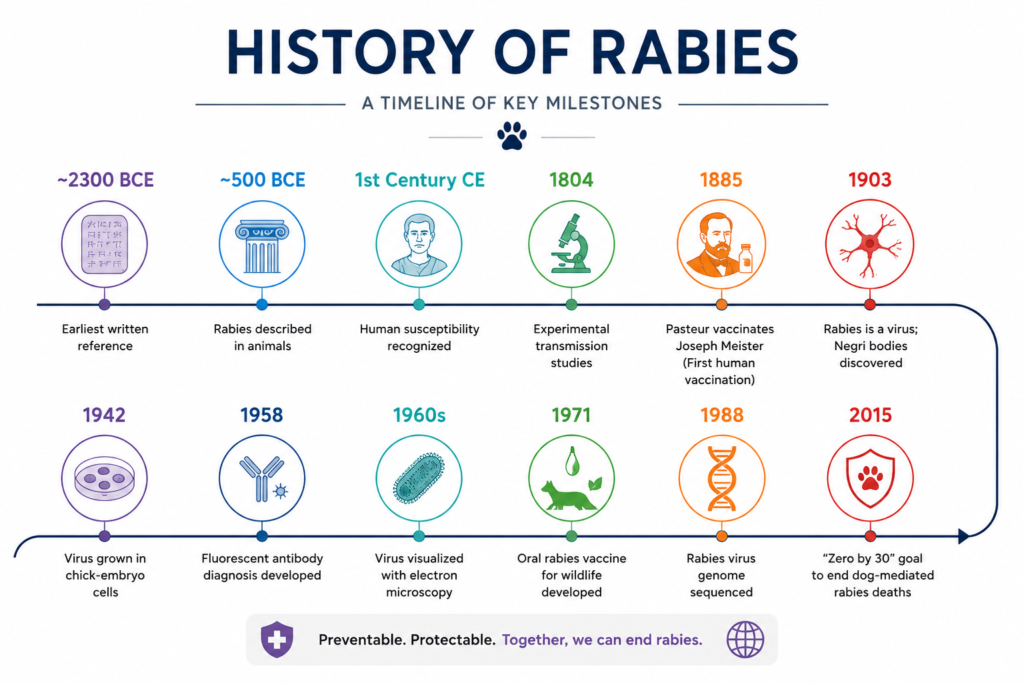
The history of rabies in numbers: Timeline
| Year | Historical milestone |
| ~ 23rd century BCE | One of the earliest possible written references to rabies |
| ~ 500 BCE | Democritus describes rabies in animals |
| 1st century CE | Celsus recognizes human susceptibility |
| 1804 | Zinke performs experimental rabies transmission studies |
| 1881 | Galtier demonstrates experimental immunization |
| 1885 | Pasteur successfully vaccinates Joseph Meister |
| 1888 | Institut Pasteur is inaugurated |
| 1903 | Rabies is demonstrated to be caused by a filterable virus; Negri bodies described |
| 1936 | In-vitro cultivation of fixed rabies virus reported |
| 1942 | Street rabies virus cultivated in chick-embryo cells |
| 1958 | Fluorescent-antibody diagnosis introduced |
| 1960s | Rabies virus structure and RNA nature investigated with modern microscopy and molecular methods |
| 1971 | Oral wildlife rabies vaccination developed |
| 1983 | First rabies virus gene clone reported |
| 1988 | Rabies virus genome sequence completed |
| 2015 | Global “Zero by 30” strategy established |
| 2020s | Global elimination efforts continue |
References
Fisher CR, Streicker DG, Schnell MJ. The spread and evolution of rabies virus: conquering new frontiers.Nature Reviews Microbiology. 2018;16:241–255.
Velasco-Villa A, et al. History of rabies in the United States and the spread and evolution of rabies virus.Antiviral Research. 2017.
Tarantola A. Four thousand years of concepts relating to rabies in animals and humans, its prevention and its cure.Tropical Medicine and Infectious Disease. 2017.
Adedeji AO, et al. An overview of rabies: History, epidemiology, control and possible elimination.African Journal of Microbiology Research. 2010.
History of Rabies Research.Rabies: Scientific Basis of the Disease and Its Management. Elsevier.
Developments in Rabies Vaccines: The Path Traversed from Pasteur to the Modern Era of Immunization.
World Health Organization. Rabies.
World Health Organization. Zero by 30: The Global Strategic Plan to End Human Deaths from Dog-Mediated Rabies by 2030.
Centers for Disease Control and Prevention. Historical Perspectives: Pasteur and the Modern Era of Immunization.
Institut Pasteur. The history of the first rabies vaccination in 1885.

Pingback: Rabies: Economic and Financial Burden: The Surprising Cost of a Preventable Disease - Disease Buddy
Pingback: Why is Rabies Rare in Europe but Still Common in Parts of Asia and Africa? The Numbers Behind the Difference - Disease Buddy