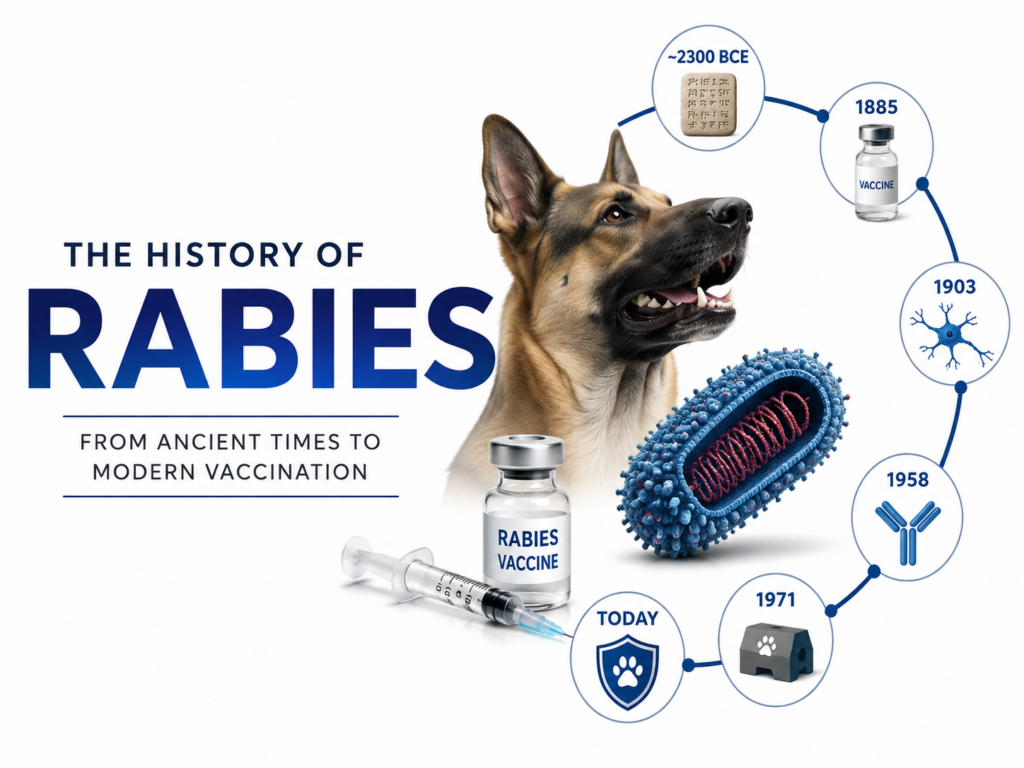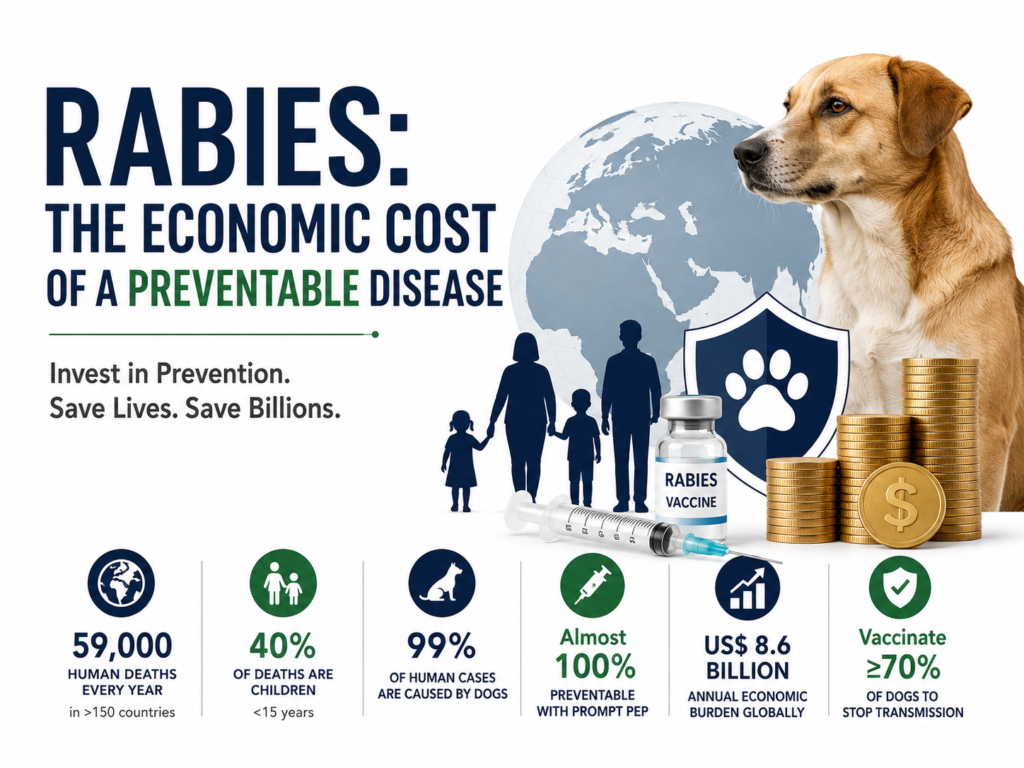
Rabies is one of the world’s deadliest infectious diseases, yet its distribution is remarkably uneven. While human rabies has become extremely rare in most of Europe, tens of thousands of people still die every year in parts of Asia and Africa.
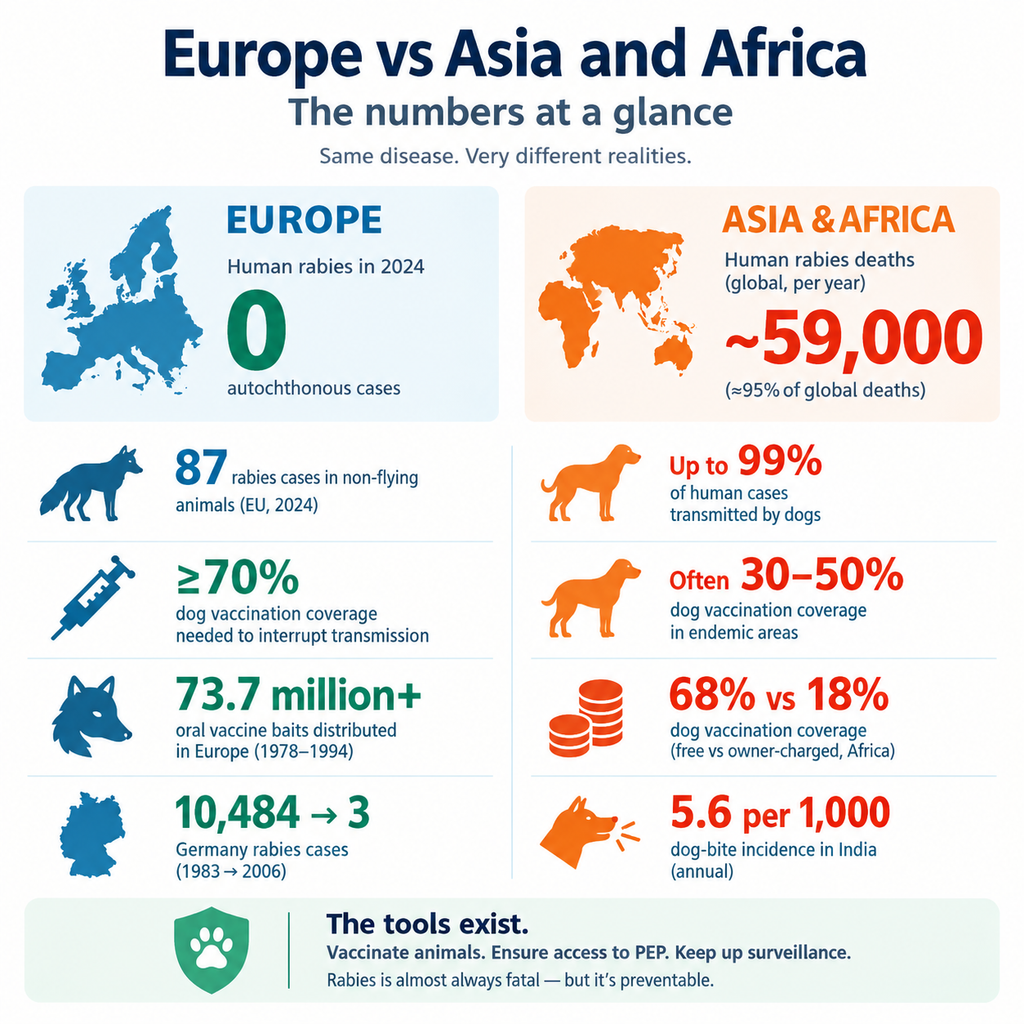
A 2015 modelling study of The World Health Organization (WHO) estimates that rabies causes about 59,000 human deaths every year, with approximately 95% occurring in Africa and Asia. Up to 99% of human rabies infections are transmitted by dogs, making control of the dog population and dog vaccination central to preventing human deaths.
But how did rabies become rare in much of Europe while remaining a major public-health problem in parts of Asia and Africa?
Europe has not completely eliminated rabies
In 2024, the European Union reported no autochthonous human rabies cases. However, animal surveillance identified 89 rabies cases through passive surveillance, including infections in wildlife and domestic animals.
| Animal/setting | EU findings in 2024 |
| Autochthonous human rabies | 0 cases |
| Autochthonous rabies in non-flying animals | 87 cases |
| Total cases reported through passive surveillance, including imported/other lyssavirus cases | 89 |
| Positive foxes | 48 |
| Positive dogs | 14 |
| Positive cats | 7 |
| Positive bats with lyssaviruses | 44 |
Most of the terrestrial rabies cases were concentrated in a small number of countries. Poland reported 43 autochthonous cases, Romania 25, Hungary 18, and Slovakia 1.
Europe has achieved very low transmission, but it is not a single rabies-free zone.
Asia and Africa carry most of the global burden
A major modelling study estimated approximately 59,000 human rabies deaths per year globally. Of these estimated deaths:
- 59.6% occurred in Asia
- 36.4% occurred in Africa
- Less than 0.05% occurred in the Americas
India alone was estimated to account for approximately 35% of global human rabies deaths in that analysis.
WHO’s more recent estimates similarly place approximately 95% of human rabies deaths in Africa and Asia, producing one of the most striking geographical contrasts in infectious disease.
Europe attached rabies at its source
One of the most important differences is that European programmes did not rely only on treating humans after they were bitten. They increasingly targeted the animal reservoirs of the virus.
In much of Europe, especially historically, the red fox was a major reservoir of terrestrial rabies. Traditional approaches such as killing or trapping animals were difficult to sustain over large geographic areas. The development of oral rabies vaccination (ORV) changed the strategy. Instead of catching every fox and injecting it, vaccine-containing baits could be distributed across large areas.
European countries began using ORV in the late 1970s. Switzerland started the first European programme in 1978, and Germany began field trials in 1983. Between 1978 and 1994, more than 73.73 million vaccine baits were distributed across approximately 4.9 million sq. km.
A review covering 1978-2014 later found that 30 European countries implemented ORV programmes and that 10 countries successfully eliminated fox- and raccoon-dog-mediated rabies using these programmes.
It was a long-term, coordinated intervention involving:
- repeated vaccination
- vaccine-bait distribution
- surveillance
- monitoring of vaccination effectiveness
- cross-border cooperation
- adaptation to wildlife ecology
Germany shows what sustained vaccination can achieve
Germany began field trials of oral fox vaccination in 1983.
At that time, Germany recorded: 10,484 rabies cases
By 2006, the number had fallen to: 3 cases
That is a decline of more than 99.9% in reported cases over the period described in the study.
Rabies transmission can collapse when vaccination is repeatedly applied to the reservoir population over a sufficiently large geographic area.
The cost of vaccination can change the coverage dramatically
One of the most interesting systematic reviewe examined 16 peer-reviewed studies covering dog vaccination programmes across Africa.
The researchers found a major difference between vaccination programmes that were free to dog owners and programmes in which owners were charged.
Dog vaccination coverage
| Programme type | Mean vaccination coverage |
| Free vaccination | 68% |
| Owner-charged vaccination | 18% |
| WHO target | 70% |
The difference was statistically significant. The problem could therefore involve how vaccination programmes are financed and delivered, not simply whether dogs can be physically reached.
Human treatment is another major difference
Vaccinating dogs prevents exposure.
But what happens after someone is bitten?
A person exposed to a potentially rabid animal can receive post-exposure prophylaxis (PEP), which can prevent rabies from developing when administered appropriately and promptly. The access to PEP is not equal everywhere.
A study of 23 countries in Asia and Africa examined the availability and procurement of rabies vaccine.
The results showed:
- 9 of 23 countries (39%) provided rabies vaccine free in the public sector and reported consistent availability.
- 10 of 23 (43%) required some or all patients to pay for vaccine in the public sector.
- In those countries, the reported cost was approximately US$6.60–20 per dose.
- In the remaining 4 countries (17%), vaccine was officially free but frequently unavailable, meaning patients sometimes had to purchase it themselves.
- Only 5 countries in the assessment exclusively used the dose-sparing intradermal route.
India shows how exposure and treatment interact
India provides an important example because it has a very large population exposed to dog-mediated rabies.
A recent community-based study covering 2022–2023 estimated an annual dog-bite incidence of:
5.6 dog bites per 1,000 people
The same study found:
- 20.5% of people bitten by dogs did not receive anti-rabies vaccine.
- 66.2% received at least three vaccine doses.
- Among people who received one dose, 49.1% did not complete the full vaccination course.
- The study estimated approximately 5,726 human rabies deaths annually in India, with a 95% uncertainty interval of 3,967–7,350. [9]
The numbers show why rabies elimination requires more than simply making a vaccine available.
Why hasn’t the European model simply been repeated everywhere?
1. Sustained vaccination coverage
Dog vaccination needs to reach a sufficiently high proportion of the population and be repeated as the dog population changes.
2. Financing
The African systematic review showed that vaccination coverage was dramatically higher when campaigns were provided free of charge than when owners were charged.
3. PEP availability
Even where vaccines exist, patients may face cost, stock shortages, travel distances or difficulties completing treatment.
4. Surveillance
Without reliable surveillance, infected animals and human cases may be missed.
5. Dog population dynamics
New puppies enter the population continuously, meaning vaccination coverage can fall after a successful campaign unless campaigns are repeated.
6. Geography and borders
Rabies does not respect national borders. A country can control its own dog population but remain exposed to infected animals entering from neighbouring endemic areas.
7. Healthcare access
Rural populations may live far from facilities that provide PEP.
8. Public awareness
A person who does not recognise a potentially dangerous bite or delays seeking treatment may miss an opportunity for prevention.
WHO therefore recommends a One Health approach, combining animal vaccination, dog population management, bite prevention, PEP, surveillance and community awareness.
References
World Health Organization. Rabies. WHO; 2026. Available from: WHO Rabies fact sheet.
European Food Safety Authority; European Centre for Disease Prevention and Control. The European Union One Health 2024 Zoonoses Report. EFSA Journal. 2025;23. doi:10.2903/j.efsa.2025.9759.
Hampson K, Coudeville L, Lembo T, et al. Estimating the global burden of endemic canine rabies. PLoS Negl Trop Dis. 2015;9(4). doi:10.1371/journal.pntd.0003709.
Stöhr K, Meslin FX. Progress and setbacks in the oral immunisation of foxes against rabies in Europe. Vet Rec. 1996;139(2):32–35. doi:10.1136/vr.139.2.32.
Freuling CM, Hampson K, Selhorst T, et al. Spatio-temporal use of oral rabies vaccines in fox rabies elimination programmes in Europe. PLoS Neglected Tropical Diseases. 2015;9(8):e0003953. doi:10.1371/journal.pntd.0003953.
Müller T, Bätza HJ, Freuling C, et al. Elimination of terrestrial rabies in Germany using oral vaccination of foxes. Berliner und Münchener Tierärztliche Wochenschrift. 2012;125(5–6):178–190.
Jibat T, Hogeveen H, Mourits MCM. Review on dog rabies vaccination coverage in Africa: a question of dog accessibility or cost recovery? PLoS Negl Trop Dis. 2015;9(2). doi:10.1371/journal.pntd.0003447.
Undurraga EA, Blaya JA, Etheve J, et al. Overview of rabies post-exposure prophylaxis access, procurement and distribution in selected countries in Asia and Africa, 2017–2018. Vaccine. 2019;37(Suppl 1):A6–A13. doi:10.1016/j.vaccine.2019.04.024.
Jeromie Wesley Vivian Thangaraj et al. Estimates of the burden of human rabies deaths and animal bites in India, 2022–23: a community-based cross-sectional survey and probability decision-tree modelling study. Lancet Infect Dis. 2025;25(1):126–134, DOI 10.1016/S1473-3099(24)00490-0