
West Nile virus (WNV) is a mosquito-borne virus that has been circulating for decades. First identified in Uganda in 1937, West Nile virus was initially associated mainly with relatively mild febrile illness in parts of Africa, the Middle East and Europe. By the 1990s, however, outbreaks of severe neurological disease began drawing greater attention to the virus.
The unexpected appearance of West Nile virus in New York City in 1999 marked a major turning point. Within only a few years, the virus had spread across much of North America, causing large outbreaks in humans, horses and birds.
1937: First discovery in Uganda
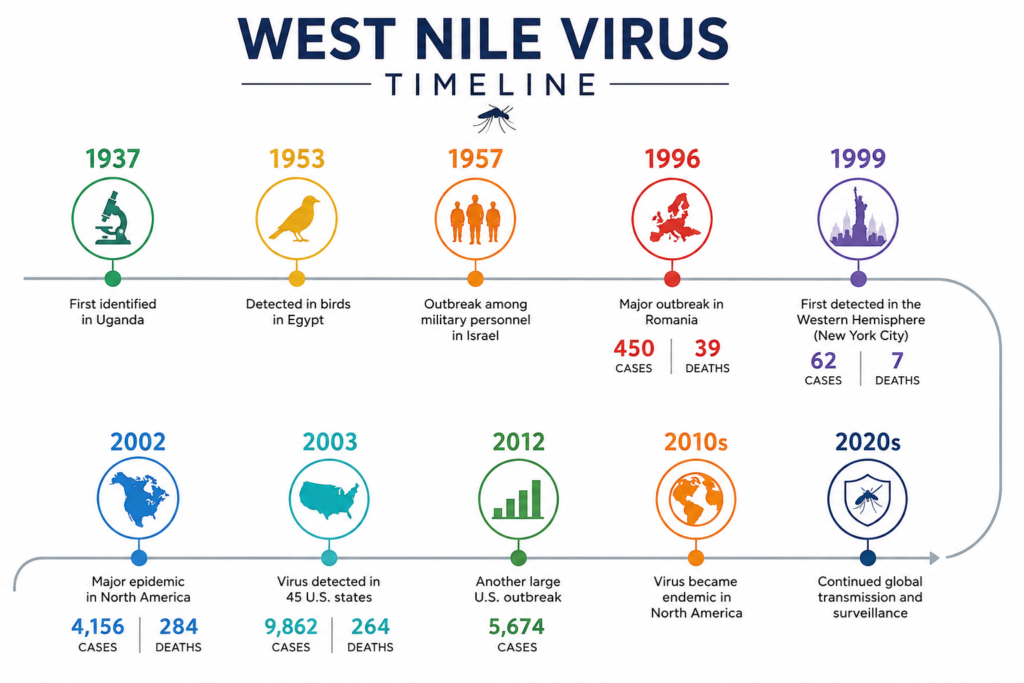
West Nile virus was first isolated in 1937 from the blood of a woman with a febrile illness in the West Nile district of Uganda.
The virus belongs to the Flaviviridae family and the Flavivirus genus, which also includes viruses such as dengue, yellow fever and Japanese encephalitis virus. It is primarily maintained in nature through a cycle involving birds and mosquitoes. Humans and horses can become infected when bitten by an infected mosquito, but they generally do not produce enough virus in their blood to continue the transmission cycle.
1940s-1950s: Recognition beyond Uganda
In the early 1950s, researchers detected West Nile virus in birds in the Nile Delta of Egypt, providing important evidence of its relationship with avian hosts. WHO notes that the virus was identified in birds such as crows and pigeons in the region in 1953.
Several outbreaks occurred in Israel during the following decades. A 1957 outbreak among military personnel demonstrated that infection could sometimes involve the nervous system, although severe neurological disease was still considered relatively uncommon.
1960s-1980s: A relatively overlooked virus
For several decades, West Nile virus continued to circulate in parts of Africa, Europe and Asia without attracting the level of international attention seen today.
The virus was generally regarded as a relatively minor human pathogen. Many infections were asymptomatic, while symptomatic infections often resembled an uncomplicated viral fever.
1996: The Romanian outbreak changes the picture
In Romania, an outbreak of viral meningitis and meningoencephalitis began in Bucharest during the summer. Initially, the cause was uncertain. Hundreds of people became ill, and older adults were disproportionately affected.
Investigations eventually confirmed West Nile virus as the cause. By late September, WHO reported 450 cases of viral meningitis during the outbreak and 39 deaths. Laboratory investigations confirmed West Nile virus infection in a large proportion of the patients tested.
Further investigation showed that the outbreak was not restricted to Bucharest. West Nile virus infections were identified in several areas of Romania, with cases involving meningitis, meningoencephalitis and encephalitis. Culex pipiens was implicated as an important mosquito vector.
The Romanian outbreak demonstrated that West Nile virus could cause substantial outbreaks of serious neurological disease in Europe.
1997-1998: Increasing activity in Europe and Israel
During the mid-1990s, a more neurovirulent lineage 1 virus became associated with outbreaks involving humans, birds and horses in parts of Europe, Russia and Israel.
Israel experienced particularly important outbreaks during this period.
1999: West Nile virus arrives in New York
The most important event in the modern history of West Nile virus occurred in 1999, when the virus appeared in New York City.
In late August, physicians began reporting patients with encephalitis in Queens. Initially, investigators suspected St. Louis encephalitis virus, another mosquito-borne flavivirus capable of causing neurological disease.
Birds began dying in the New York area, including birds at the Bronx Zoo. Investigators eventually identified West Nile virus in the birds and in patients affected by the outbreak. Genetic analysis showed that the virus was closely related to a strain circulating in Israel in 1998.
West Nile virus had therefore been introduced into the Western Hemisphere for the first known time. The initial New York outbreak resulted in 62 confirmed human cases and 7 deaths. Investigators later estimated that thousands of people may actually have been infected because most infections did not cause obvious illness.
Why the 1999 outbreak was so important
Before 1999, the virus had never been detected in the Western Hemisphere. After its introduction, it did not disappear. Instead, it survived the winter and began spreading to new areas.
The outbreak also demonstrated the importance of monitoring humans, mosquitoes, birds and horses simultaneously.
2000-2001: West Nile virus begins spreading
During 2000, human cases remained concentrated mainly in the northeastern United States. By 2001, however, the virus had spread along the eastern United States, with cases reported from multiple states.
The combination of competent mosquito vectors, susceptible bird populations and suitable environmental conditions allowed the virus to establish a sustainable transmission cycle.
2002: A major epidemic across North America
In 2002, the United States recorded 4,156 reported human cases and 284 deaths. Cases were detected as far west as Texas and Montana, while Canada also reported hundreds of cases. More than 15,000 equine cases were reported during the epidemic.
West Nile virus was found to have been transmitted through contaminated blood donations and organ transplantation. Transplacental transmission was also documented. These discoveries resulted in major changes to blood safety practices and the introduction of screening measures for donated blood.
2003-2010: Continued expansion
West Nile virus continued spreading rapidly in 2003.
The virus was detected across 45 U.S. states, with 9,862 reported cases and 264 deaths.
The number of cases fluctuated considerably from year to year rather than following a simple upward trend. This variation reflected factors such as temperature, rainfall, mosquito abundance, bird populations and other ecological conditions.
The CDC’s ArboNET system integrated information on human disease with data involving mosquitoes, birds, horses and other surveillance indicators. Monitoring bird deaths could sometimes provide an early warning of virus activity before human cases were identified.
2012: Another major U.S. outbreak
One of the most notable outbreak occurred in 2012, when the CDC recorded 5,674 reported human cases, including a large number of neuroinvasive infections.
The recurrence of large outbreaks demonstrated that the virus had become an established part of the North American ecosystem rather than a temporary outbreak associated with its initial introduction.
2020s: A continuing global public-health concern
In the United States, CDC surveillance data show thousands of reported human infections in several recent years, including 2,911 cases in 2021, 2,628 in 2023 and 1,808 in 2024.
In Europe, West Nile virus continues to cause seasonal outbreaks, particularly in southern and eastern regions.
In March 2025, researchers reported detection of West Nile virus RNA fragments in two pools of Aedes vexans mosquitoes collected in Nottinghamshire in 2023. UK authorities emphasized that this finding did not necessarily demonstrate ongoing transmission, but it represented the first evidence of West Nile virus detected in mosquitoes in the UK.
Major developments in History of West Nile virus
| Period | Major Development |
| 1937 | Virus first isolated from a woman in Uganda |
| 1950s | Virus detected in birds and increasingly recognized in the Middle East |
| 1960s-1980s | Continued circulation but relatively limited international attention |
| 1996 | Major outbreak of neurological disease in Romania |
| 1997-1998 | Severe outbreaks involving humans, birds and horses in Europe and Israel |
| 1999 | West Nile virus detected for the first time in the Western Hemisphere in New York |
| 2000-2001 | Virus begins spreading across the eastern United States |
| 2002 | Major North American epidemic; blood and organ transmission recognized |
| 2003 | Extensive spread across the United States; veterinary vaccine licensed |
| 2010s | Virus becomes established and endemic in North America |
| 2020s | Continued seasonal transmission and periodic outbreaks worldwide |
References
World Health Organization. West Nile virus – Fact sheet.
World Health Organization. Viral meningitis in Romania, 1996 – West Nile virus outbreak reports.
Ronca SE, Ruff JC, Murray KO. A 20-year historical review of West Nile virus since its initial emergence in North America.PLoS Neglected Tropical Diseases. 2021;15(5).
Roehrig JT. West Nile Virus in the United States — A Historical Perspective.Viruses. 2013;5(12):3088–3108.
Hayes EB, et al. Epidemiology and Transmission Dynamics of West Nile Virus Disease.Emerging Infectious Diseases. 2005.
Centers for Disease Control and Prevention. Historic Data (1999–2025): West Nile Virus.
UK Health Security Agency / GOV.UK. West Nile virus: epidemiology, diagnosis and prevention.