
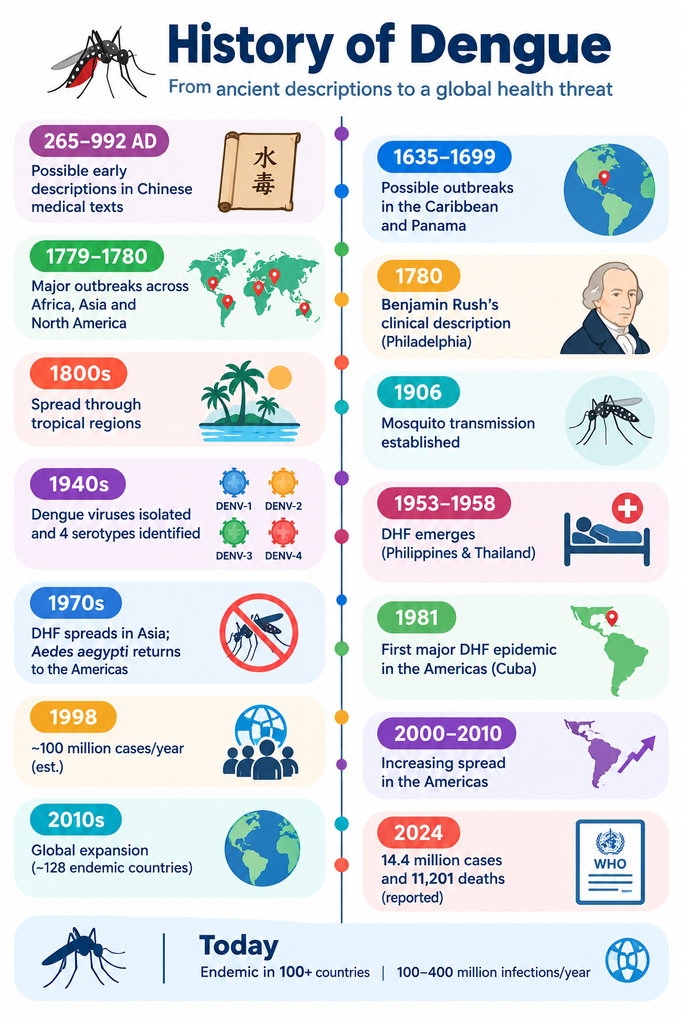
Dengue is now one of the world’s most important mosquito-borne viral diseases. The history of dengue stretches from poorly understood fever outbreaks to a global disease involving 4 virus serotypes, 100-400 million infections annually, and more than 14 million reported cases in 2024.
Early History of Dengue: Before 1700
The exact origin of dengue remains uncertain.
One of the earliest possible descriptions comes from a Chinese medical encyclopedia. The work was first compiled during the Jin Dynasty (265–420 AD) and later edited in 610 AD and 992 AD. It described an illness called “water poison”, which was associated with flying insects near water.
However, it is impossible to confirm that these historical descriptions were actually dengue.
Other possible dengue-like outbreaks were reported much later:
- 1635 — French West Indies: an outbreak may have been dengue.
- 1699 — Panama: another dengue-like illness was reported.
- These early reports cannot be definitively attributed to dengue because laboratory confirmation was impossible.
History of Dengue in three continents: 1779-1780
Dengue-like epidemics were reported almost simultaneously in:
- Africa
- Asia
- North America
This geographic pattern suggests that dengue viruses and their mosquito vectors were already widely distributed across tropical regions more than 200 years ago.
In 1779, an epidemic described as kidinga pepo occurred in Cairo, Egypt.
Another outbreak occurred in Batavia, now Jakarta, Indonesia. The Indonesian physician David Bylon became ill during the outbreak and provided an important clinical description of the disease, including:
- Sudden high fever
- Severe joint and limb pain
- Headache
- Muscle pain
- Joint stiffness
- Swelling of the ankles
The best-known early clinical description came from Benjamin Rush during an epidemic in Philadelphia, United States, in 1780.
Rush described:
- Severe headache
- Eye pain
- Back and limb pain
- Fever
- Nausea and vomiting
- Extreme muscle and joint pain
The illness became known as “breakbone fever” because of the intense pain.
The Philadelphia epidemic is generally regarded as the earliest well-documented clinical description of dengue.
Spread of Dengue through the Tropics: 1800s
Major outbreaks were reported in:
- Spain — 1793
- Peru — 1818
- India and Suez — 1825
- United States, Mexico, Caribbean and South America — 1826–1828
- Arabia — 1835
- India — 1836 and 1844
- Egypt — 1845
- Brazil — 1845–1849
- Bermuda — 1837
- Hawaii — 1903
Historical records show that epidemics often occurred at intervals of 10–40 years.
Why outbreaks were initially separated by decades
Before modern aviation and rapid international travel, dengue transmission was strongly constrained by geography.
The disease could persist in tropical urban populations, but movement between distant cities was relatively slow.
As a result:
infected people + infected mosquitoes + ships → new urban outbreaks
This helped produce large but widely separated epidemics. The situation changed dramatically during the 20th century.
Dengue becomes a Scientific Problem: 1900s
In 1906, experiments provided strong evidence that the mosquito Aedes aegypti could transmit dengue. This was an important turning point because dengue was no longer viewed simply as an unexplained tropical fever.
It became understood as a mosquito-borne infectious disease. The recognition of Aedes aegypti as the major vector eventually made mosquito control a central part of dengue prevention.
Identification of the Virus: 1940s
The Second World War produced major ecological and demographic changes across Asia and the Pacific.
Large military movements, rapid urbanization, population displacement and disruption of mosquito-control programmes created ideal conditions for dengue transmission. The result was a major expansion of dengue transmission after the war.
During the 1940s, dengue viruses were successfully isolated. By this period, researchers began distinguishing different dengue viruses rather than considering dengue a single uniform infection.
Four major serotypes were eventually established:
- DENV-1
- DENV-2
- DENV-3
- DENV-4
Infection with one serotype provides long-term immunity against that serotype, but not complete protection against the other three.
The Emergence of Dengue Haemorrhagic Fever
The first recognized epidemic of what became known as dengue haemorrhagic fever (DHF) occurred in Manila, Philippines, in 1953–1954.
Children developed:
- High fever
- Bleeding
- Thrombocytopenia
- Plasma leakage
- Shock
In September 1954, a report described 21 severe cases among children living in or around Manila. The disease was initially called Philippine haemorrhagic fever.
Dengue viruses were isolated during the Manila epidemic. DENV-2, DENV-3 and DENV-4 were identified in the Philippines in 1956.
A similar severe disease appeared in Thailand in 1958. This was called Thai haemorrhagic fever. DENV-1 was isolated in Thailand in 1958, completing recognition of the four major dengue serotypes.
Dengue becomes endemic in Southeast Asia: 1960s-1970s
Following its emergence in the Philippines and Thailand, DHF(Dengue Haemorrhagic Fever) spread throughout Southeast Asia.
Between 1953 and 1964, DHF was reported in:
- India
- Malaysia
- Philippines
- Singapore
- Thailand
- Vietnam
By the mid-1970s, DHF had become an important cause of childhood hospitalization and death in Southeast Asia.
Between 1975 and 1978, reported DHF hospitalizations and deaths included:
| Country | Hospitalizations | Deaths |
| Burma | 17,251 | 772 |
| Indonesia | 21,818 | 916 |
| Thailand | 71,312 | 1,676 |
Dengue in the Americas
In 1947, the Americas began a large-scale campaign to eradicate Aedes aegypti.The campaign was remarkably successful. By 1962, Aedes aegypti had been eradicated from 18 continental countries.
Dengue transmission consequently declined dramatically across much of the region. But the success did not last.
The eradication programme weakened during the 1970s. Aedes aegypti began reinvading countries where it had previously been eliminated.
The first major DHF epidemic in the Americas occurred in Cuba in 1981. The epidemic was associated with DENV-2, following earlier circulation of DENV-1.
DHF was no longer primarily a Southeast Asian problem. It had become an emerging threat in the Americas as well. Between 1981 and 1997, laboratory-confirmed DHF was reported by 24 countries in the Americas.
Hyperendemic Dengue: 1980s-1990s
During the 1980s and 1990s, several regions began experiencing hyperendemic dengue.
Hyperendemicity means that multiple dengue serotypes circulate simultaneously in the same population.
This matters because infection with one serotype does not provide permanent protection against the other serotypes.
The Americas experienced the introduction or reintroduction of several serotypes:
- DENV-1 — 1977
- New DENV-2 strain — 1981
- DENV-4 — 1981
- New DENV-3 strain — 1994
Dengue becomes a major Global Infectious Disease
By 1998, dengue had reached a major global scale.
Estimates at the time suggested approximately:
- 100 million dengue fever cases/year
- 500,000 DHF cases/year
- 25,000 deaths/year
Dengue was considered the most important tropical infectious disease after malaria.
The resurgence was associated with several factors:
- Rapid urbanization
- Population growth
- Increased international travel
- Inadequate mosquito control
- Expansion of Aedes aegypti
- Increased circulation of multiple serotypes
- Weak public-health infrastructure
A Rapidly Expanding Dengue Epidemic: 2000-2010
The history of dengue in the Americas between 2000 and 2010 was characterized by increasing geographic dispersion of both Aedes aegypti and dengue viruses.
In 2010 alone, the Americas reported:
- >1.7 million dengue cases
- 50,235 severe cases
- 1,185 deaths
By the 2010s, dengue was established across much of:
- Southeast Asia
- South Asia
- Latin America
- The Caribbean
- Pacific Islands
- Parts of Africa
- The Eastern Mediterranean
WHO estimates indicate that approximately 390 million dengue virus infections occur each year, with around 96 million clinically apparent infections.
WHO also reported that dengue expanded from fewer than 10 known endemic countries in the 1960s to approximately 128 endemic countries in later estimates.
Dengue Reaches Record Levels: 2020s
WHO reported a dramatic increase in dengue cases over the previous two decades.
Reported cases increased from 505,430 cases in 2000 to 14.6 million cases in 2024.
The year 2024 became a historic milestone.
WHO received approximately:
- 14.43 million reported cases
- 7.72 million laboratory-confirmed cases
- 52,738 severe cases
- 11,201 deaths
More than 100 countries reported dengue transmission.
The Americas accounted for more than 90% of reported global cases.
Brazil alone reported:
- >10 million cases
- 6,321 deaths
The Current Situation of Dengue
Dengue is now endemic in more than 100 countries.
- 100–400 million infections/year
- Approximately half of the world’s population at risk
- Around 5.6 billion people potentially living in areas at risk
- Approximately 100 million symptomatic infections annually
The disease is transmitted primarily by:
Aedes aegypti
with Aedes albopictus also contributing to transmission.
Dengue has also expanded into areas where sustained transmission was historically uncommon, including parts of Europe.
References
Gubler DJ. Dengue/dengue haemorrhagic fever: history and current status. In: Novartis Foundation Symposium 277: Dengue and dengue haemorrhagic fever. Chichester: John Wiley & Sons; 2006. p. 3-16. doi:10.1002/0470058005.ch2.
Brathwaite Dick O, San Martín JL, Montoya RH, del Diego J, Zambrano B, Dayan GH. The history of dengue outbreaks in the Americas. Am J Trop Med Hyg. 2012;87(4):584-593. doi:10.4269/ajtmh.2012.11-0770.
Murray NAE, Quam MB, Wilder-Smith A. Epidemiology of dengue: past, present and future prospects. Clin Epidemiol. 2013;5:299-309. doi:10.2147/CLEP.S34440.
Centers for Disease Control and Prevention. Reappearance of chikungunya, formerly called dengue, in the Americas. Emerg Infect Dis. 2015;21(4). Available from: CDC Emerging Infectious Diseases.
World Health Organization. Dengue and severe dengue [Internet]. Geneva: World Health Organization; 2025 [cited 2026 Sep 6]. Available from: WHO Dengue and severe dengue
World Health Organization. Dengue: global situation, surveillance and progress – 2024 update. Wkly Epidemiol Rec. 2025;100(52):665-678.
Guzman MG, Harris E. Dengue. Lancet. 2015;385(9966):453-465.
Simmons CP, Farrar JJ, Nguyen vV, Wills B. Dengue. N Engl J Med. 2012;366(15):1423-1432.
Gubler DJ. Dengue, urbanization and globalization: the unholy trinity of the 21st century. Trop Med Health. 2011;39(4 Suppl):3-11.
Pingback: Disease Outbreaks After Floods and Natural Disasters: Evidence From Around the World - Disease Buddy
Pingback: Dengue: Introduction, History, Symptoms, Diagnosis and Treatment - Disease Buddy
Pingback: The Economics of Dengue: How Much Does Dengue Really Cost? - Disease Buddy
Pingback: The History of Chikungunya: From a 1952 Outbreak in Tanzania to a Global Mosquito-Borne Threat - Disease Buddy
Pingback: Dengue and Chikungunya: 15 Key Differences - Disease Buddy