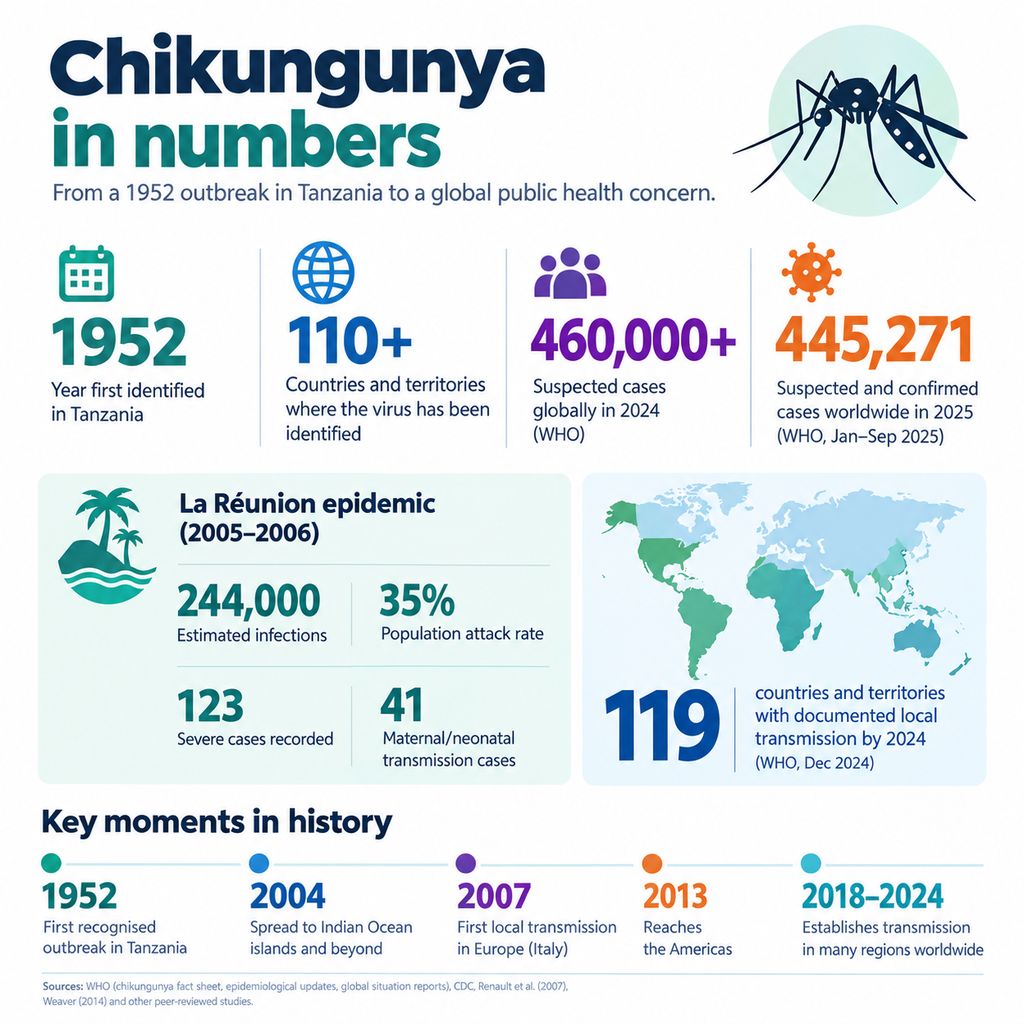
Chikungunya was once considered a disease largely confined to parts of Africa and Asia. Today, it is a global public health concern, with transmission documented across more than 110 countries and territories.
The history of chikungunya dates back to 1952. First identified in Tanzania in 1952, chikungunya has been associated with major outbreaks in the Indian Ocean, South Asia, Southeast Asia, Europe and the Americas. Its expansion has been shaped by international travel, the distribution of mosquito vectors, viral evolution and the vulnerability of populations without prior immunity.
Before 1952: Recognising the disease before identifying the virus
Historical accounts have described epidemics of fever, rash and joint pain in India and elsewhere during the nineteenth century. However, retrospective clinical descriptions cannot establish with certainty that every such outbreak was caused by chikungunya virus.
Chikungunya is particularly difficult to recognise clinically because its early symptoms overlap with dengue and other mosquito-borne illnesses.
The virus belongs to the genus Alphavirus within the family Togaviridae. It is transmitted primarily by infected female Aedes aegypti and Aedes albopictus mosquitoes. Its name comes from the Kimakonde language of southern Tanzania and refers to the contorted or bent posture associated with severe joint pain.
1952-1953: The first recognised outbreak in Tanzania
The modern scientific history of chikungunya began during an outbreak of fever and joint pain in what is now the United Republic of Tanzania in 1952. The virus was isolated during the 1952–1953 period from human and mosquito samples, establishing a specific viral cause for the illness.
At the time, chikungunya could be confused with dengue because both diseases can produce fever, rash and other overlapping symptoms. Identifying the virus was therefore a crucial step towards distinguishing chikungunya from other febrile illnesses.
Researchers subsequently identified chikungunya in other parts of Africa and Asia. For much of the second half of the twentieth century, reported outbreaks were comparatively sporadic, and the disease received less international attention than some other major infectious diseases.
1960s-1990s: Outbreaks across Asia and the limits of surveillance
Thailand experienced an urban outbreak in 1967, while India reported outbreaks during the 1970s. Indonesia also reported renewed activity in 1999 after a period of relative quiet.
Surveillance systems differed between countries, laboratory confirmation was not consistently available, and clinical overlap with dengue made case identification difficult. Consequently, the absence of reported outbreaks does not necessarily mean that transmission had completely stopped.
Chikungunya epidemics have also displayed irregular patterns. Some locations have experienced periods of limited activity followed by renewed outbreaks.
2004: A turning point in global history of Chikungunya
A major change occurred in 2004, when an outbreak was identified in coastal Kenya. This event marked the beginning of a new period of more frequent and geographically extensive chikungunya epidemics.
The outbreak spread beyond mainland Africa into islands of the Indian Ocean, including the Comoros, Mayotte, Mauritius and Réunion. The movement of infected people helped introduce the virus to new locations, where local mosquito populations enabled further transmission.
The scale of the subsequent epidemics was influenced by more than international travel. Researchers identified genetic changes in some circulating virus strains that improved their ability to use Aedes albopictus, commonly known as the Asian tiger mosquito, as a vector.
One particularly studied mutation, known as E1-A226V, increased transmission efficiency in Aedes albopictus under relevant experimental conditions. This mattered because the mosquito was established in places where Aedes aegypti was less common or absent.
The mutation did not mean that all chikungunya strains behaved identically, nor that viral genetics alone explained the epidemic. Vector abundance, climate, human movement and population immunity also influenced transmission.
2005-2006: the devastating epidemic on Reunion Island
The epidemic on Réunion Island, a French territory in the Indian Ocean, became one of the defining events in chikungunya’s history. The outbreak began in 2005 and expanded dramatically towards the end of that year and into early 2006.
By April 2006, surveillance estimates indicated approximately 244,000 infections, representing an attack rate of around 35% of the island’s population. The investigation recorded 123 severe cases and 41 instances of maternal or neonatal transmission. Chikungunya was mentioned on 203 death certificates, although that figure should not automatically be interpreted as 203 deaths definitively caused by the virus.
Researchers used multiple surveillance approaches to estimate the burden, and the final totals depended on the case definition and estimation method. The epidemic accelerated scientific investigation into viral evolution, mosquito transmission, clinical complications and the long-term effects of infection.
2006-2012: India, Europe and the wider Asian region
India experienced a major resurgence during 2006, with transmission continuing into subsequent years in different locations. The outbreak highlighted the challenges of controlling a mosquito-borne disease in densely populated settings where vector mosquitoes, urban environments and susceptible populations can support transmission.
In 2007, Italy recorded the first recognised locally acquired chikungunya outbreak in Europe, in the Emilia-Romagna region. More than 200 cases were confirmed in the outbreak investigation. The event was associated with an infected traveller returning from an affected area and local transmission by Aedes albopictus. Public health authorities also introduced blood-donation precautions in the affected areas.
France reported another episode of local transmission in 2010. These events reinforced the need for European surveillance to consider not only infections acquired abroad but also the possibility of local transmission.
2013-2017: Chikungunya reaches the Americas
In December 2013, locally acquired chikungunya transmission was identified in the Caribbean. This marked the beginning of sustained regional spread in the Americas, rather than the detection of isolated infections in travellers returning from affected countries.
The virus spread through the Caribbean and into Central and South America. In 2014, local transmission was also identified in parts of the United States, including Florida, Texas and Puerto Rico. The outbreak period generated a substantial number of reported infections across the region.
The United States provides a useful example of the distinction between imported and locally acquired infection. According to the CDC, before 2006, chikungunya was rarely identified in US travellers. During 2006–2013, an average of 28 people per year tested positive for recent infection. In contrast, during the major 2014 epidemic, the CDC recorded 2,799 travel-associated cases in US states and 4,659 locally acquired cases in US territories. These figures use different surveillance categories and should not be added together as if they represented a single, uniform population.
The American epidemic also reinforced the importance of monitoring chikungunya alongside dengue and Zika.
2018-2024: a geographically established disease
A 2017 review, Global expansion of chikungunya virus: mapping the 64-year history of chikungunya, examined the virus’s geographical spread and genetic diversity. It discussed four recognised genotypes or lineages: West African, East/Central/South African (ECSA), Asian and Indian Ocean lineage. These distinctions are useful for understanding viral evolution and historical spread, although genetic lineage alone does not determine the size or severity of an outbreak.
The World Health Organization’s June 2025 epidemiological update reported that, by December 2024, 119 countries and territories had documented local transmission of chikungunya. WHO also reported more than 460,000 suspected cases globally during 2024.
2025: Renewed outbreaks and a warning for global surveillance
In an outbreak update published on 3 October 2025, WHO reported 445,271 suspected and confirmed cases and 155 deaths across 40 countries between 1 January and 30 September 2025. These figures included both locally acquired and imported infections.
The regional picture was uneven. WHO reported substantial increases in some countries, while other regions had fewer cases than in 2024. The figures therefore indicated local resurgence and emergence in particular locations rather than a uniform increase everywhere.
The update also identified a continuing risk: 27 additional countries and territories had established populations of competent Aedes aegypti or Aedes albopictus mosquitoes but had not yet documented local chikungunya transmission as of the reporting period.
Why Chikungunya remains a public health concern
Although chikungunya is rarely fatal, its impact cannot be measured by mortality alone. The acute illness can cause fever and severe joint pain, and some people experience persistent pain or disability after the initial infection.
The historical record demonstrates that large outbreaks may affect a substantial proportion of a local population within a short period. Réunion’s estimated 35% attack rate during 2005–2006 illustrates the potential scale of an epidemic under favourable transmission conditions.
The history of chikungunya shows that preparedness cannot depend solely on whether a country has experienced a major epidemic in the past. A location with suitable vectors and a susceptible population may remain vulnerable even after years without recognised local transmission.
Preventing future epidemics will require continued investment in vector control, diagnostics, surveillance, public communication and appropriate vaccination strategies. The historical pattern makes one point clear: a disease that was once considered geographically limited can become a global challenge when ecological and epidemiological conditions change.
References
1. Renault P, Solet JL, Sissoko D, et al. A major epidemic of chikungunya virus infection on Réunion Island, France, 2005–2006. American Journal of Tropical Medicine and Hygiene. 2007;77(4):727–731. PubMed record.
2. Weaver SC. Arrival of Chikungunya Virus in the New World: Prospects for Spread and Impact on Public Health. PLOS Neglected Tropical Diseases. 2014;8(6):e2921. Full article.
3. Chikungunya: Evolutionary history and recent epidemic spread. Research article supplied by the user. ScienceDirect.
4. Global expansion of chikungunya virus: mapping the 64-year history. International Journal of Infectious Diseases. 2017. PubMed record.
5. González-Sánchez JA, Ramírez-Arroyo GF. Chikungunya Virus: History, Geographic Distribution, Clinical Picture, and Treatment. Puerto Rico Health Sciences Journal. 2018;37(4):187–194. PubMed record.
6. Vairo F, Haider N, Kock R, et al. Chikungunya: Epidemiology, Pathogenesis, Clinical Features, Management, and Prevention. Infectious Disease Clinics of North America. 2019;33(4):1003–1025. PubMed record.
7. Jupp PG, McIntosh BM. Chikungunya Virus Disease. In: The Arboviruses. Taylor & Francis chapter.
8. A scoping review of Chikungunya virus infection: epidemiology, clinical characteristics, viral co-circulation complications, and control. PubMed record.
9. Chikungunya fever: an epidemiological review of a re-emerging infectious disease. PubMed record.
10. Genome Microevolution of Chikungunya Viruses Causing the Indian Ocean Outbreak. PLOS Medicine. Full article.