

What is Dengue?
Dengue is a globally significant mosquito-borne viral infection caused by four closely related serotypes (DENV-1 to DENV-4). While more than half of the global population is at risk, mainly in tropical and subtropical regions, the disease burden remains high, with about 390 million infections annually but comparatively fewer deaths (up to 36,000).
History of Dengue
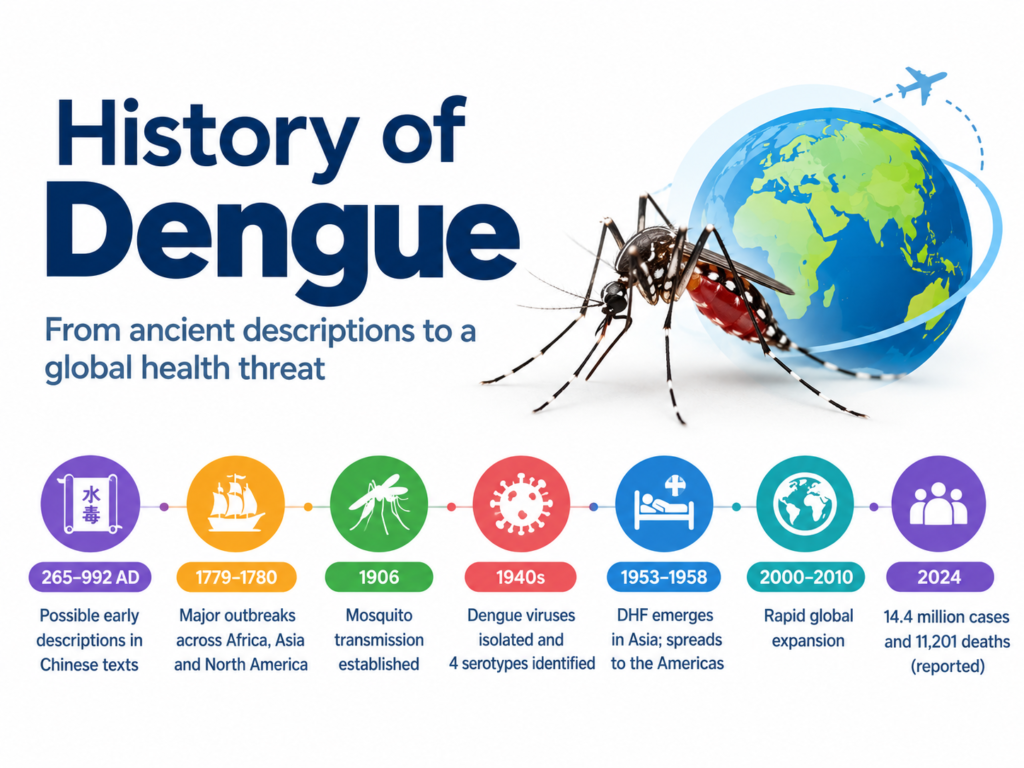
Dengue-like illness has a long history, with descriptions compatible with dengue fever traced to Chinese medical records from the Chin Dynasty (265–420 AD). Similar illnesses were subsequently reported in the Caribbean and the Americas during the 17th century, followed by increasingly frequent epidemics across Asia, Africa and North America during the 18th century. The expansion of maritime trade and movement of people and mosquitoes contributed to the wider geographic dissemination of dengue. Historical evidence suggests that the virus evolved from sylvatic transmission cycles involving non-human primates and forest-dwelling Aedes mosquitoes, before establishing an urban transmission cycle involving humans and Aedes aegypti. This transition appears to have occurred gradually over several centuries, particularly in Asia.
Modern understanding of dengue developed substantially during the 20th century. Dengue virus was first isolated in the 1940s, and four antigenically distinct serotypes—DENV-1, DENV-2, DENV-3 and DENV-4—were subsequently recognized. Molecular studies indicate that these four human-associated serotypes evolved independently from ancestral sylvatic viruses, with their evolutionary histories shaped by changes in mosquito vectors, vertebrate hosts and human populations. By the latter half of the 20th century, dengue had shifted from relatively sporadic outbreaks to sustained transmission and hyperendemicity, particularly in rapidly urbanizing tropical and subtropical regions.
Evolution and present context
Dengue’s evolution has been closely linked to its ability to move between ecological and epidemiological settings. Genetic evidence suggests that the four serotypes have a relatively recent evolutionary history, emerging roughly 1,000 years ago, while sustained endemic transmission among humans developed much more recently. Continued viral diversification within the four serotypes, together with the movement of different lineages through human populations, has contributed to the complex patterns of dengue transmission and disease severity observed today. At present, dengue is no longer confined to a small number of endemic areas: its expansion is being driven by urbanization, population growth, international travel and trade, climate change, and the geographic expansion of Aedes aegypti and Aedes albopictus. Consequently, dengue has become one of the world’s most important mosquito-borne viral diseases, with transmission reported across all WHO regions and endemicity in more than 125 countries. Current estimates suggest that hundreds of millions of dengue infections occur globally each year, although surveillance limitations mean the true burden remains uncertain.
How is Dengue Spread?
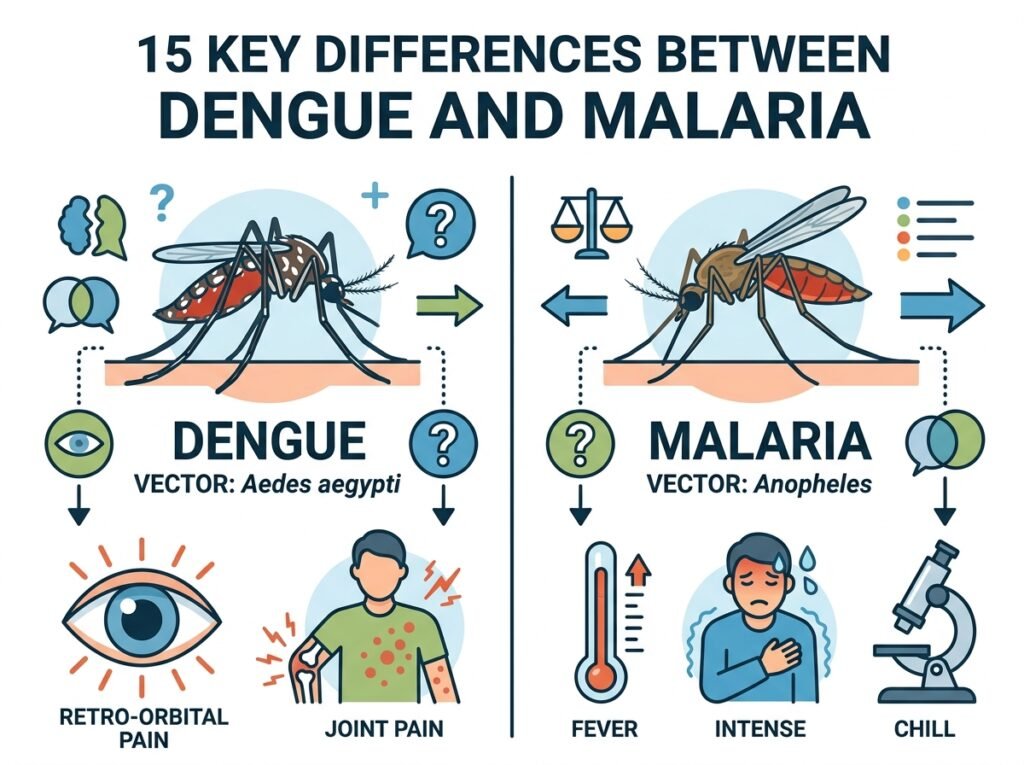
Aedes aegypti plays a central role in dengue transmission, with its habitat closely linked to human environments. Unlike many vectors, it thrives in and around homes by breeding in small, stagnant water containers, increasing human–mosquito contact. Transmission occurs in a cyclical pattern: the mosquito acquires the virus from an infected individual and subsequently spreads it through later bites. This close association between vector ecology and domestic settings makes dengue control highly dependent on household-level prevention strategies. (Source: WMP)

Symptoms of Dengue
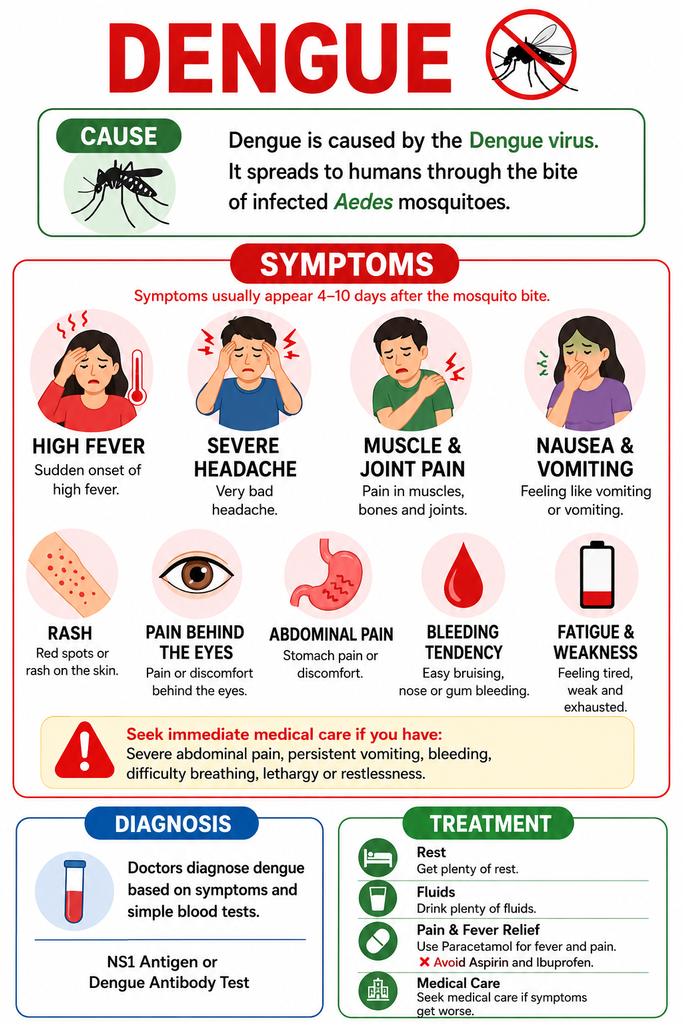
Dengue typically presents as a self-limiting illness, with most individuals experiencing mild or no symptoms and recovering within 1–2 weeks. Symptomatic cases usually begin 4–10 days after infection and last 2–7 days. However, secondary infections increase the risk of progression to severe dengue, which can be life-threatening.
Common symptoms:
- High fever (up to 40°C)
- Severe headache
- Pain behind the eyes
- Muscle and joint pain
- Nausea and/or vomiting
- Swollen glands
- Skin rash (blotchy, flat or slightly raised, often widespread)
Warning signs of severe dengue (often after fever subsides):
- Severe abdominal pain
- Persistent vomiting
- Rapid breathing
- Bleeding (gums or nose)
- Fatigue and restlessness
- Blood in vomit or stool
- Intense thirst
- Pale, cold skin
- General weakness
Overall, while dengue is often mild, the transition to severe disease—particularly in repeat infections—requires prompt clinical attention to prevent fatal outcomes.
Diagnostics and Treatment of Dengue
Methods such as NAATs, ELISAs, and rapid diagnostic tests differ in availability, quality, and performance across settings. As there is no specific antiviral treatment, care is primarily supportive, with paracetamol recommended for symptom relief, while NSAIDs like ibuprofen and aspirin are avoided due to bleeding risks.
Recent Updates
Dengue has shown a marked global increase in incidence over recent decades, with reported cases rising from 505,430 in 2000 to 14.6 million in 2024, reflecting its expanding public health impact (WHO). More recently, transmission remains widespread, as 78 countries/territories reported cases between January and March 2026, indicating continued global circulation (ECDC).
However, early 2026 data suggest a relative decline compared to the previous year, with over 500,000 cases and more than 100 deaths reported globally as of 23 March 2026—lower than the same period in 2025 (Communicable disease threats report, 22–28 March 2025, week 13). Overall, while long-term trends show significant growth, short-term data indicate possible fluctuations in transmission intensity.
References
https://www.nhs.uk/conditions/dengue/
https://www.who.int/news-room/fact-sheets/detail/dengue-and-severe-dengue
https://www.pirbright.ac.uk/our-science/viruses/dengue-virus
https://www.cdc.gov/dengue/index.html
Pingback: Oropouche Virus: The Emerging Tropical Diseae Expanding Beyond the Amazon – Disease Buddy
Pingback: Disease Outbreaks After Floods and Natural Disasters: Evidence From Around the World - Disease Buddy
Pingback: History of Dengue: From Ancient Descriptions to a Global Health Threat - Disease Buddy
Pingback: The Economics of Dengue: How Much Does Dengue Really Cost? - Disease Buddy