Infectious diseases are not increasing at the same rate everywhere. While some diseases are showing major growth in particular regions, others are declining globally but experiencing sharp local outbreaks.
Recent surveillance data show particularly important increases in dengue and other mosquito-borne infections, measles, malaria and cholera, alongside the geographic expansion of emerging infections such as Oropouche and chikungunya.
1. Dengue: The Americas Have Become the Global Epicentre
Dengue has experienced one of the most dramatic increases among mosquito-borne diseases. WHO reported that globally recorded dengue cases increased from 505,430 in 2000 to more than 14.6 million in 2024. More than 12,000 dengue-related deaths were reported in 2024, the highest annual number of reported cases ever recorded.
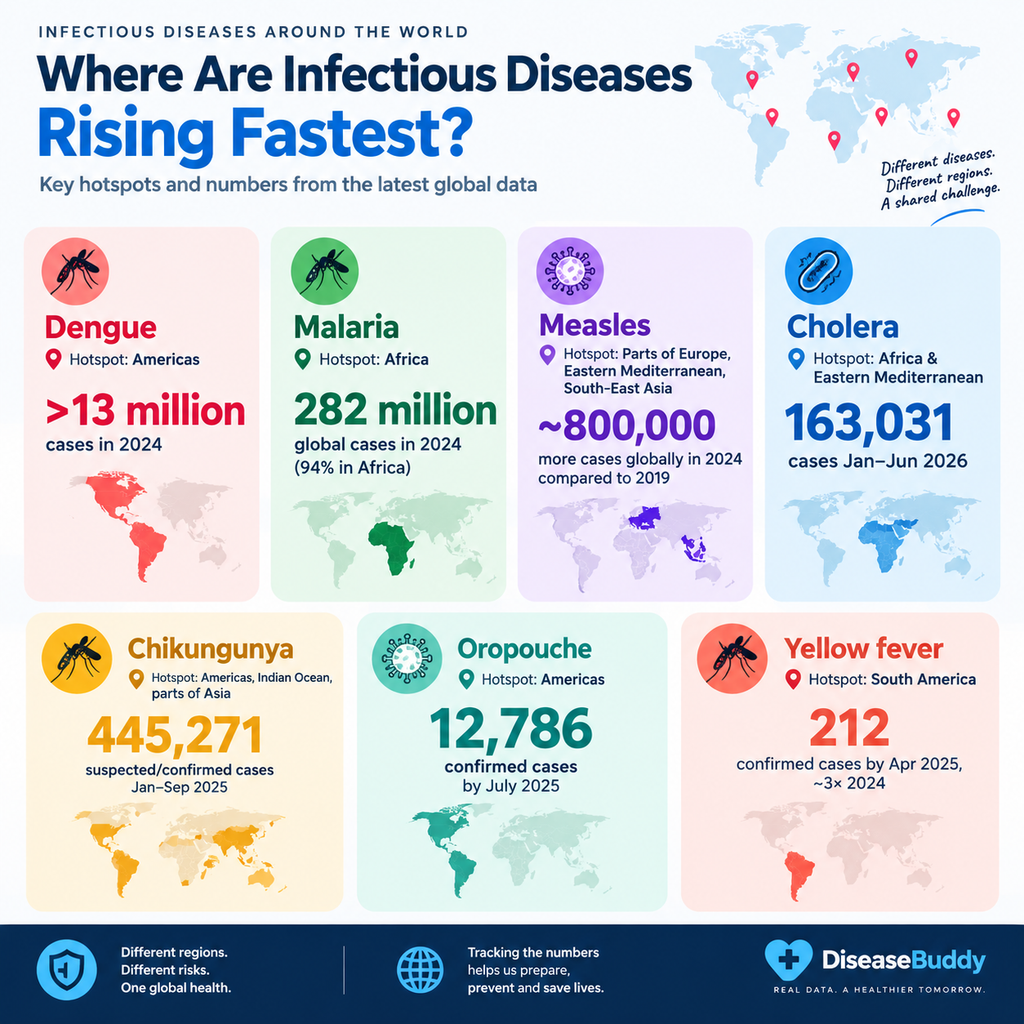
The Americas have been particularly important in this increase. In 2024, the region reported more than 13 million dengue cases, representing the overwhelming majority of the global reported total.
However, the trend has changed in 2026. By epidemiological week 35 of 2026, the Americas had reported approximately 1.66 million suspected dengue cases, which was 57% lower than the corresponding period in 2025 and 64% below the five-year average.
Dengue’s long-term expansion is associated with factors including the geographic spread of Aedes mosquitoes, urbanization, climate conditions, population movement and improved detection and reporting.
2. Malaria: Africa Continues to Carry the Greatest Burden
Malaria is another disease where the global numbers remain enormous.
WHO estimates that 282 million malaria cases occurred in 2024, approximately 9 million more than in 2023. The number of malaria deaths also increased, from approximately 598,000 in 2023 to 610,000 in 2024.
The concern is more about the geographical concentration of the disease. The WHO African Region accounted for approximately 94% of global malaria cases and 95% of malaria deaths in 2024. Five countries, the Democratic Republic of the Congo, Ethiopia, Mozambique, Nigeria and Uganda, together accounted for more than half of global malaria cases.
Between 2015 and 2024, malaria case incidence increased from 59 to 64 cases per 1,000 people at risk, despite substantial progress in prevention and treatment. At the same time, the malaria mortality rate declined from 14.9 to 13.8 deaths per 100,000 people at risk.
So malaria is not simply becoming uniformly more lethal. Rather, population growth and continued transmission are contributing to a larger number of cases and deaths even while mortality rates have improved.
3. Measles: A Major Resurgence in Several Regions
Measles provides one of the clearest examples of a vaccine-preventable disease returning after years of progress.
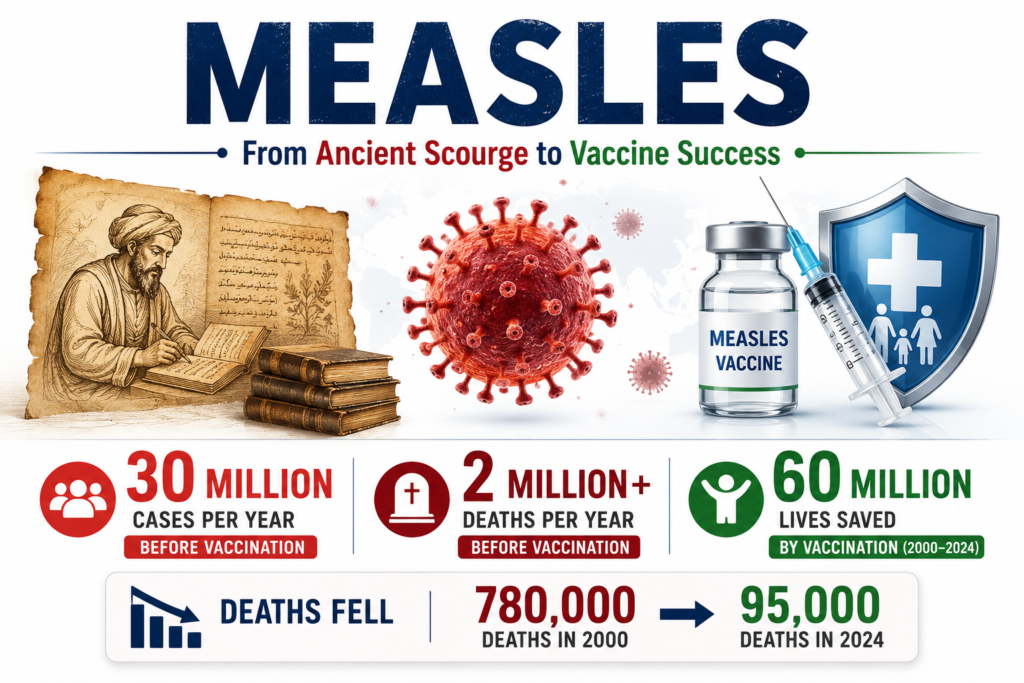
WHO estimated approximately 11 million measles infections in 2024. Although global measles deaths were 88% lower in 2024 than in 2000, cases have increased substantially compared with the pre-pandemic period.
The regional differences are particularly interesting.
Compared with 2019, measles cases in 2024 increased by:
| WHO region | Change in measles cases |
| Eastern Mediterranean | +86% |
| Europe | +47% |
| South-East Asia | +42% |
| Africa | ~40% |
However, this cannot be concluded as a “global rise” of measles. Some regions have experienced substantial increases while others have reduced transmission.
Europe illustrates the volatility particularly well. EU/EEA countries reported 35,212 measles cases in 2024, compared with 3,973 in 2023, an approximately 786% increase in reported cases in one year.
The number subsequently declined. ECDC recorded 2,339 cases across the EU/EEA during August 2025–July 2026, although several countries continued to experience outbreaks. Bulgaria is a notable example: it reported only 2 measles cases in 2025, but had recorded 555 cases by the end of August 2026.
4. Cholera: Africa and the Eastern Mediterranean Remain Major Hotspots
Cholera is showing a different geographical pattern.
WHO reported more than 560,000 cholera cases from 60 countries in 2024, compared with more than 535,000 in 2023. Reported deaths increased sharply, from approximately 4,000 to more than 6,000.
In 2026, the largest burden has continued to occur in Africa and the Eastern Mediterranean.
Between 1 January and 28 June 2026:
- 163,031 cholera cases were reported
- 1,686 deaths were reported
- Africa accounted for 90,049 cases
- The Eastern Mediterranean accounted for 72,032 cases
Interestingly, this represents a 49.5% decrease in cases compared with the same period of 2025.
But the disease remains highly volatile. During June 2026 alone, WHO recorded 47,758 new cases, a 60% increase from May.
The increase was associated particularly with a major surge in Borno State, Nigeria, where conflict, population displacement, inadequate sanitation and rainfall increased transmission risk.
5. Chikungunya: Expansion Across Multiple Continents
WHO reported 445,271 suspected and confirmed chikungunya cases from 40 countries during January–September 2025, including 155 deaths.
The largest numbers were concentrated in the Americas, but substantial outbreaks were also reported elsewhere.
In La Reunion, France, weekly chikungunya cases increased from approximately 30 at the end of 2024 to around 4,000 during the week of 10–16 March 2025. By early May, more than 47,500 confirmed cases had been reported on the island.
Similarly, China’s Guangdong Province recorded 16,452 locally transmitted cases by September 2025, which WHO described as the country’s largest documented chikungunya outbreak.
6. Oropouche: An Emerging Infection Expanding Beyond Its Historical Range
During 2024, 16,239 confirmed cases of Oropouche virus were reported in the Americas, including cases in 11 countries and one territory.
By epidemiological week 30 of 2025, 12,786 confirmed cases had already been reported across 11 countries. Brazil accounted for 11,888 cases, while Panama reported 501 and Peru 330.
WHO has highlighted possible contributors to the geographic expansion, including deforestation, climate-related factors and urbanization, although the relative contribution of individual factors remains an area of investigation.
7. Yellow Fever: A Sharp Increase in the Americas
Between late December 2024 and late April 2025, 212 confirmed yellow fever cases and 85 deaths were reported in five countries in the Americas.
That was approximately three times the 61 confirmed cases reported during 2024.
Cases were reported in:
- Brazil
- Colombia
- Peru
- Bolivia
- Ecuador
An important feature was that cases were being detected outside the traditional Amazonian areas, including São Paulo in Brazil and Tolima in Colombia.
Where are infectious diseases rising fastest?
While Malaria and Dengue dominates the number of cases and deaths, the remaining diseases remain equally important because of their prevalence in particular geographical region.
Africa: The largest burden for several major infections
Africa remains central to the global infectious-disease burden.
It accounted for approximately 94% of malaria cases, 95% of malaria deaths, and a large proportion of recent cholera cases.
However, Africa is not experiencing increases in every disease. The WHO’s 2024 measles data, for example, showed a 40% decline in measles cases compared with 2019.
The Americas: Major hotspot for mosquito-borne diseases
The Americas have experienced extraordinary dengue transmission, with more than 13 million dengue cases reported in 2024.
The region has also become an important centre for chikungunya and Oropouche, while yellow fever has increased sharply in parts of South America.
But dengue surveillance demonstrates why current trends matter: the Americas’ 2026 dengue total was 57% below the corresponding period of 2025 by week 35.
Europe: Re-emergence of vaccine-preventable infections
Rather than carrying the world’s largest absolute burden of malaria or cholera, parts of Europe have experienced resurgences of measles and other vaccine-preventable infections.
The EU/EEA’s measles increase from 3,973 cases in 2023 to 35,212 in 2024 illustrates how quickly transmission can return when population immunity is insufficient.
Asia and the Middle East: Major regional hotspots
South-East Asia remains a major centre of TB and malaria transmission, while the Eastern Mediterranean has recently accounted for a large share of cholera cases.
In June 2026, the Eastern Mediterranean recorded 19,729 cholera/AWD cases, compared with 27,954 in Africa.
Perhaps the most important conclusion is that case numbers alone do not tell the whole story. A disease may appear to rise because transmission has increased, because surveillance has improved, because testing has expanded, or because reporting systems have changed.
References
WHO — Dengue global burden and trends
WHO — World Malaria Report 2025WHO — Global measles trends
WHO — Global cholera surveillance
WHO — Chikungunya global situation