
Introduction and Early Historical Observations (Ancient Times)
Imagine losing control of your own body step by step, without knowing why. A progressive neurodegenerative disorder primarily affecting movement, which also involves in cognition, mood, sleep, and autonomic body functions like respiration, breathing etc. Today, we know this reality as Parkinson’s disease, a fast-growing neurological condition affecting millions globally. But it’s history spans thousands of years, before it was officially recognized.
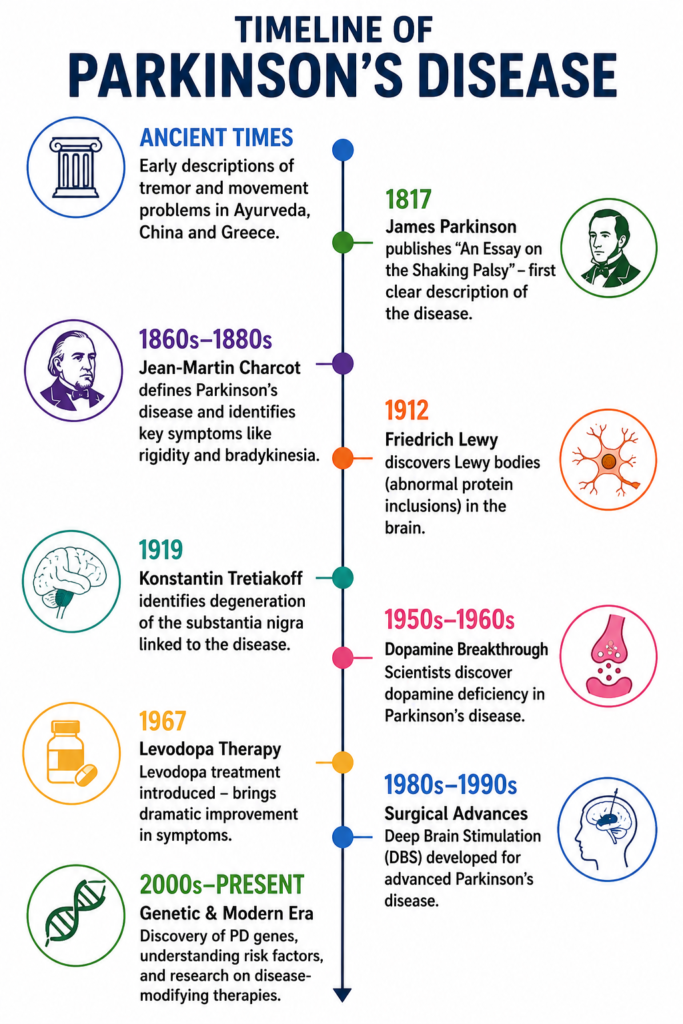
In Ayurvedic medicine, a condition known as Kampavata was described, characterized by tremor, stiffness, and slowed movement. Some historical interpretations suggest that herbal medicines used in Ayurveda, particularly Mucuna pruriens, may have contained natural levodopa-like compounds, indirectly influencing motor symptoms. Similarly, ancient Chinese medical texts described aging individuals with shaking, reduced mobility, and postural instability, which closely resemble Parkinson’s disease symptoms.
In ancient Greek medicine, Hippocrates and later Galen classified tremors as a part of broader humoral imbalances, within broader categories of “shaking disorders”. They did not distinguish between different neurological conditions. Thomas Sydenham, also known as the “English Hippocrates,” in the 18th century, emphasized disease classification based on observation. However, even during this period tremor, rigidity, and movement were described separately and Parkinson’s disease was still not clearly defined.
The Scientific Recognition of the Disease (1810-1960s)
In 1817, English physician James Parkinson published his landmark work An Essay on the Shaking Palsy, which proved to be a major turning point of Parkinson’s disease recognition. In this detailed clinical monograph, he described six individuals, three of whom he examined personally and three observed in public. A consistent patter of symptoms was observed, including resting tremor, stooped posture, slow movement, and progressive loss of mobility. Importantly, he noted that the condition worsened over time and significantly affected daily life. However, the condition was still referred to as “shaking palsy” for decades even after James Parkinson.
French neurologist Jean-Martin Charcot significantly refined its clinical features and emphasized that tremor alone was insufficient for diagnosis. In the late 19th century, he introduced key concepts such as bradykinesia (slowness of movement) and rigidity, and also distinguished Parkinson’s disease from other movement disorders like essential tremor and multiple sclerosis. It was Charcot who formally named the condition “Parkinson’s disease” in honor of James Parkinson.
In 1912, Friedrich Lewy discovered abnormal protein inclusions in the brains of affected individuals, later known as Lewy bodies, which became one of the pathological hallmarks of the disease. Furthermore, Konstantin Tretiakoff made a critical discovery by identifying degeration in the substantia nigra, a region of the brain responsible for movement control, in 1919.
By the mid-20th century, researchers were beginning to understand that Parkinson’s disease was not simply a motor disorder but a degenerative brain condition involving specific neural pathways.
Dopamine Revolution and Modern Era (1960s-Present)
The most transformative discovery in Parkinson’s disease history occurred in the 1950s and 1960s with the identification of dopamine’s role in the brain. Arvid Carlsson and Oleh Hornykiewicz demonstrated that dopamine was not just a precursor molecule but a critical neurotransmitter involved in movement control. Building on this breakthrough, George Cotzias introduced high-dose levodopa therapy in 1967. Levodopa, a precursor of dopamine, could cross the blood-brain barrier and replenish dopamine levels.
In the late 20th century, deep brain stimulation (DBS) emerged as a major advancement, allowing electrical modulation of brain circuits to control symptoms in advanced disease. Modern research also emphasizes environmental risk factors such as pesticide exposure, head injury, and toxic chemicals, suggesting a complex gene-environment interaction.
According to the WHO, Parkinson’s disease is now the fastest-growing neurological disorder globally, with more than 8.5 million people affected. Current research focuses on disease-modifying tehrapies, including gene therapy, stem cell transplantation, immunotherapy targeting alpha-synuclein, and digital biomarkers using wearable technology. Artificial intelligence is also being explored for early detection based on movement partters and speech changes.
Despite major advances, there is still no cure for Parkinson’s disease. However, the trajectory of research suggests a shift from symptom control toward early diagnosis and potential neuroprotection in the future.
Parkinson’s disease shares some symptoms with other neurological disorders, making accurate diagnosis essential. You may also be interested in our articles on Alzheimer’s Disease to better understand the similarities and differences.
References
Carlsson, A. (2002). Treatments of Parkinson’s disease. Cold Spring Harbor Perspectives in Medicine, 1(1), a008862.
Goetz, C. G. (2011). The history of Parkinson’s disease: Early clinical descriptions and neurological therapies. Cold Spring Harbor Perspectives in Medicine, 1(1), a008862.
Lees, A. J., Hardy, J., & Revesz, T. (2009). Parkinson’s disease. The Lancet, 373(9680), 2055–2066. https://doi.org/10.1016/S0140-6736(09)60492-X
Lewy, F. H. (1912). Handbook of neurology (Original description of Lewy bodies).
Tretiakoff, C. (1919). Contribution à l’étude de l’anatomie pathologique du locus niger. University of Paris.
World Health Organization. (2023). Parkinson disease fact sheet. https://www.who.int/news-room/fact-sheets/detail/parkinson-disease
Hornykiewicz, O. (1966). Dopamine (3-hydroxytyramine) and brain function. Pharmacological Reviews.


Pingback: Parkinson’s Disease Symptoms Before the Tremor: What Can Appear Early? - Disease Buddy