
Alzheimer’s disease is a progressive neurogenerative disorder and the leading cause of dementia worldwide. It affects memory, cognition, and behavior, gradually leading to loss of independence.
Modern clinical definitions describe Alzheimer’s as a condition characterized by progressive brain cell death linked to amyloid-beta plaques and tau neurofibrillary tangles, which are considered its core pathological features.
According to the CDC, Alzheimer’s disease is most prevalent in adults over 60 years. It is a progressive, irreversible condition with symptoms of memory loss, confusion and difficulty performing daily tasks.
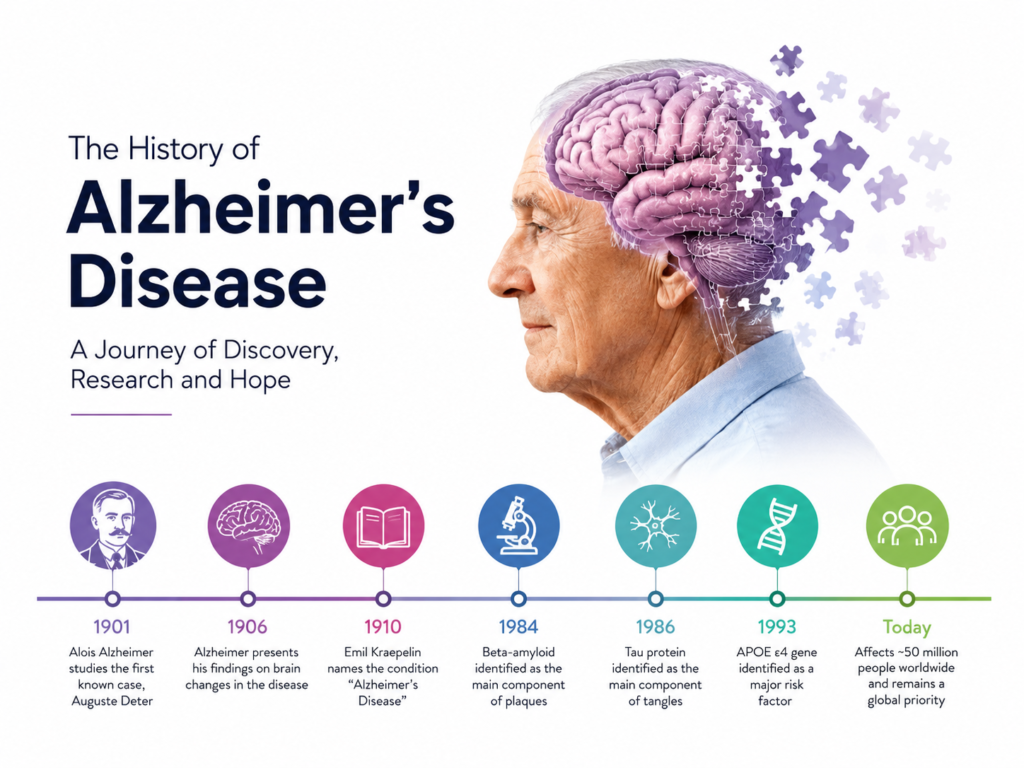
Discovery of Alzheimer’s Disease: 1906
In 1906, a German psychiatrist Dr. Alois Alzheimer examined a patient with severe memory loss and behavioral changes. After the patient’s death, he identified amyloid plaques, neurofibrillary tangles, and significant brain atrophy. These findings were the first evidence that dementia was linked to distinct structural brain changes rather than normal aging.
Later Emil Kraepelin formally named the condition “Alzheimer’s disease” in 1910, initially classifying it as a form of presenile dementia.
Major Pathological Discoveries (1980s-2000s)
Alzheimer’s research accelerated significantly in the late 20th century, with amyloid-beta protein identified as the main plaque component in 1984. Furthermore, in 1985, the discovery of tau protein as the main component of neurofibrillary tangles proved to be another major breakthrough in Alzheimer’s research.
During 1990s, genetic mutations linked to early-onset of Alzheimer’s were discovered. Similarly, development of brain imaging and biomarker-based diagnosis confirmed Alzheimer’s as a biological brain disease driven by protein misfolding and neuronal degeration.
Modern Understanding of Alzheimer’s Pathology
Currrent research shows Alzheimer’s is characterized by:
- Amyloid-beta plaque accumulation outside neurons
- Tau protein tangles inside neurons
- Synapse loss and brain atrophy in memory regions
These changes begin years before symptoms appear and spread progressively through the brain.
The disease typically starts in the hippocampus region, which is responsible for memory formation, and gradually spreads to other cortical areas.
Global Impact of Alzheimer’s Disease
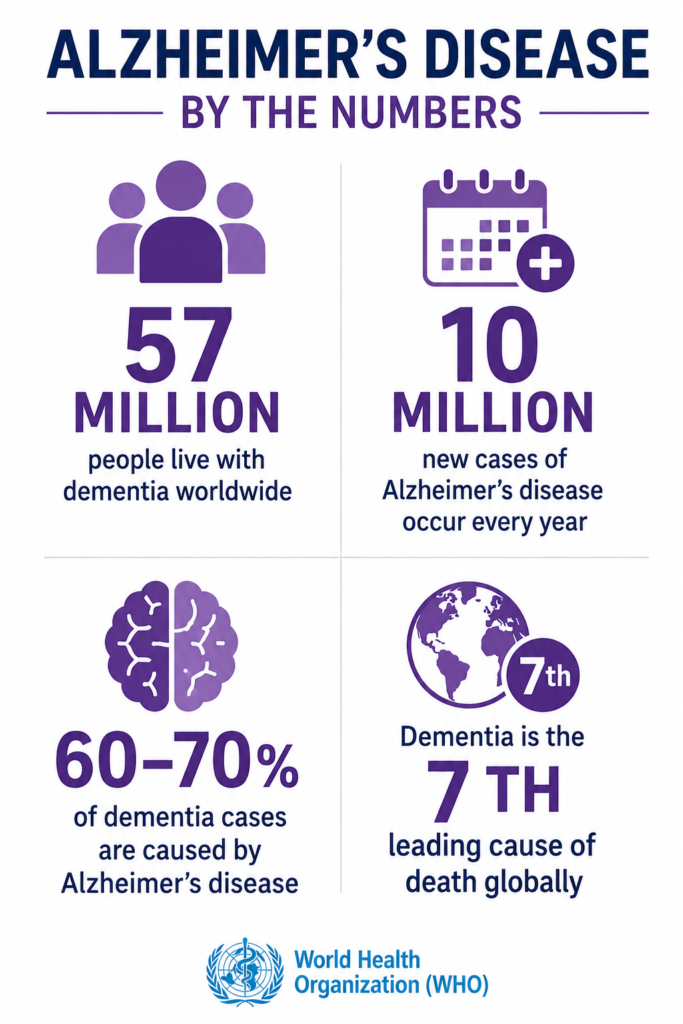
According to the World Health Organization (WHO), around 57 million people live with dementia worldwide. Nearly 10 million new cases of Alzheimer’s disease occur every year. Moreover, Alzheimer’s accounts for 60-70% of dementia cases, and as reported by WHO, dementia is the 7th leading cause of death globally.
Recent Research
Recent research emphasizes that Alzheimer’s likely results from interacting biological systems rather than a single pathway.
Similarly, a new dimention to an old mystery has been unfolded with scientists in University of California, Riverside found that amyloid plaques may not be the only cause, and the disease may involve a complex interaction between several biological factors.
References
Alzheimer, A. (1907). Über eine eigenartige Erkrankung der Hirnrinde [On a peculiar disease of the cerebral cortex].
Bird, T. D. (2018). Alzheimer disease overview. GeneReviews®. https://www.ncbi.nlm.nih.gov/books/NBK1161/
Centers for Disease Control and Prevention. (2024). Alzheimer’s disease. https://www.cdc.gov/alzheimers-dementia/about/alzheimers.html
Kiani, L., & Hodson, R. (2024). The history of Alzheimer’s disease. Nature Reviews Neurology. https://www.nature.com/articles/s41392-019-0063-8
Liu, P.-P., Xie, Y., Meng, X.-Y., et al. (2019). History and progress of hypotheses and clinical trials for Alzheimer’s disease. Signal Transduction and Targeted Therapy, 4(29). https://www.nature.com/articles/s41392-019-0063-8
Soria, A. C., et al. (2012). History and experience: The direction of Alzheimer’s research. Menopause, 19(7). https://journals.lww.com/menopausejournal/abstract/2012/07000/history_and_experience__the_direction_of.5.aspx
World Health Organization. (2023). Dementia fact sheet. https://www.who.int/news-room/fact-sheets/detail/dementia
ScienceDirect. (2021). History in perspective: How Alzheimer’s disease came to be where it is? Brain Research, 1758, 147342. https://www.sciencedirect.com/science/article/pii/S0006899321000676
KoreaMed Synapse. (n.d.). Article 1120231. https://synapse.koreamed.org/articles/1120231
EBSCOhost. (n.d.). Alzheimer’s disease related record. https://openurl.ebsco.com/EPDB%3Agcd%3A8%3A37709848/detailv2?sid=ebsco%3Aplink%3Ascholar&id=ebsco%3Agcd%3A12283926&crl=f&link_origin=scholar.google.co.uk
ScienceDirect. (2012). Alzheimer’s disease article. https://www.sciencedirect.com/science/article/pii/S0188440912003360
Journal of Alzheimer’s Disease. (2006). Special supplement article. https://journals.sagepub.com/doi/abs/10.3233/JAD-2006-9S302
Journal of Alzheimer’s Disease. (2012). Article 129044. https://journals.sagepub.com/doi/abs/10.3233/JAD-2012-129044
Menopause Journal. (2012). History and experience article. https://journals.lww.com/menopausejournal/abstract/2012/07000/history_and_experience__the_direction_of.5.aspx
Pingback: Scientists Rethink Alzheimer’s Disease Trigger as New Research Challenges Traditional Theory – Disease Buddy
Pingback: History of Parkinson’s Disease: From Ancient Observations to Modern Neuroscience – Disease Buddy