
Introduction
Legionnaires’ disease is a severe form of pneumonia caused by infection with Legionella bacteria. It belongs to a group of illnesses known as legionellosis, which also includes Pontiac fever, a milder respiratory illness without pneumonia. The disease gained worldwide attention after an outbreak of severe pneumonia among attendees of an American Legion convention in Philadelphia in 1976, later identified to have caused by Legionella pneumophila.
What Causes Legionnaires’ Disease?
Legionnaires’ disease is caused by exposure to Legionella bacteria, with Legionella pneumophila being responsible for most human infections. These bacteria are commonly found in natural water sources such as lakes, rivers, and soil. The problem doesn’t lie in the natural environments. Problems arise when Legionella grows in artificial water systems and spreads through contaminated droplets.
The main cause of infection is breathing in small contaminated water droplets (aerosols) containing the bacteria. Less commonly, infection can occur when contaminated water accidentally enters the lungs through aspiration, especially among vulnerable patients in healthcare settings.
Common Sources of Legionella Exposure
Large and complex water systems such as hospitals, hotels, hot water tanks, and cooling towers associated with air-conditioning systems provide favourable environments for Legionella growth.
Symptoms of Legionnaires’ Disease
Symptoms usually appear between 2 to 10 days after exposure. However, longer incubation periods have been reported during some outbreaks.
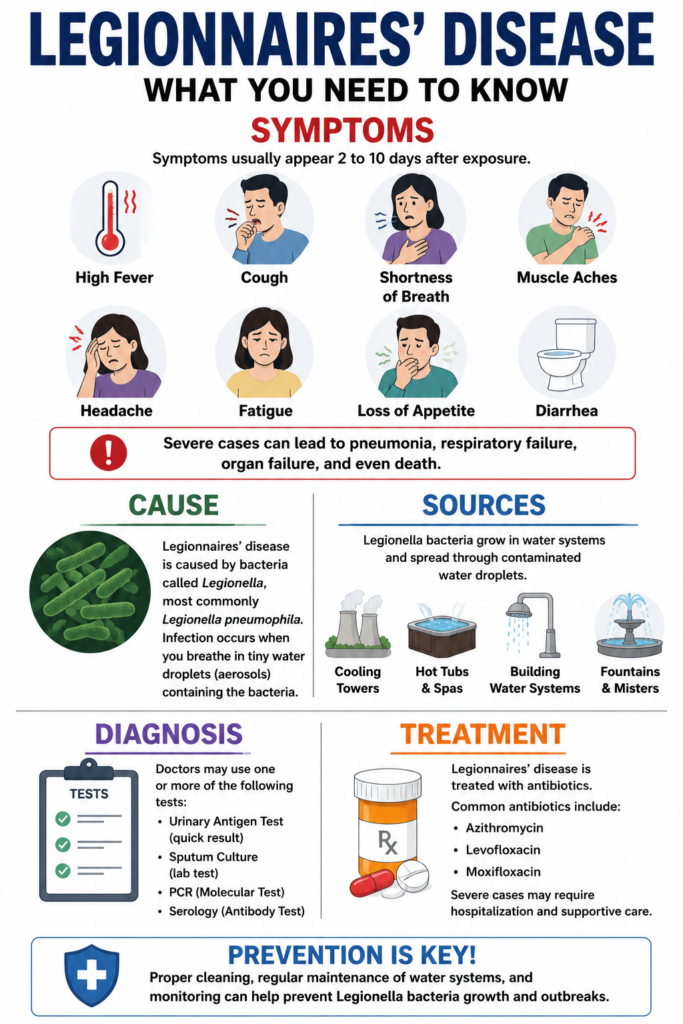
Common symptoms include:
- High fever
- Cough
- Shortness of breath
- Muscle aches
- Headache
- Fatigue
- Loss of appetite
While some patients may also experience diarrhoea and gastrointestinal symptoms, severe cases infection may result in respiratory failure, shock, and organ complications.
Difference Between Legionnaires’ Disease and Pontiac Fever
Legionella exposure can result in two main conditions:
| Feature | Legionnaires’ Disease | Pontiac Fever |
| Severity | Severe | Mild |
| Lung infection | Present | Absent |
| Main symptoms | Pneumonia, fever, cough | Flu-like illness |
| Treatment | Requires antibiotics | Usually resolves without antibiotics |
Diagnosis and Treatment
Pneumonia-like symptoms make it difficult to diagnose. The tests that can be used are:
- Urinary antigen testing
- Respiratory sample testing
- Molecular diagnostic methods
- Bacterial culture
Antibiotic treatment is required for Legionnaires’ disease, which depends on disease severity, patient characteristics, and clinical guidelines.
Prevention of Legionnaires’ Disease
Important prevention measures include:
- Regular cleaning and disinfection of water systems
- Proper maintenance of cooling towers
- Monitoring water temperatures
- Preventing stagnation in plumbing systems
- Maintaining hot tubs and spas safely
- Implementing water safety plans in healthcare facilities
No vaccine is available currently for Legionnaires’ disease.
Recent Outbreaks
A recent outbreak of Legionnaires’ disease was reported in New York City. A cluster of cases were identified in Manhattan, and the outbreak has increased rapidly from 2 confirmed cases to 23 confirmed cases within 4 days. 17 patients required hospitalisation, although no deaths have been yet reported.
Investigations suggested that contaminated cooling towers were the likely source of exposure, as these systems can release aerosolised water droplets containing Legionella bacteria. However, environmental testing was still ongoing to identify the exact source.
From waterborne infections like Legionnaires’ disease to other emerging and re-emerging diseases, microbial threats continue to shape global health. Discover more about different diseases, their causes, symptoms, diagnosis, and prevention through our comprehensive epidemiology and disease articles.
References
Durkee, A. (2026, July 6). Central Park visitors warned as NYC faces Legionnaires’ outbreak. Forbes.
Rudy, M. (2026, July 7). Deadly Legionnaires’ disease outbreak sparks concern in major US city: Know the symptoms. Fox News.
Ungar, L. (2026, July 7). Likely source of Legionnaires’ disease outbreak in New York identified as visitors are urged to watch for symptoms. The Independent.
Centers for Disease Control and Prevention. (2025). Clinical overview of Legionnaires’ disease. CDC. https://www.cdc.gov/legionella/hcp/clinical-overview/index.html
World Health Organization. (2022). Legionellosis. WHO. https://www.who.int/news-room/fact-sheets/detail/legionellosis
Yu, V. L. (2002). Legionella pneumophila (Legionnaires’ disease). Clinical Microbiology Reviews, 15(3), 506–526. https://doi.org/10.1128/CMR.15.3.506-526.2002
Phin, N., Parry-Ford, F., Harrison, T., Stagg, H. R., Zhang, N., Kumar, K., Lortholary, O., Zumla, A., & Abubakar, I. (2014). Epidemiology and clinical management of Legionnaires’ disease. The Lancet Infectious Diseases, 14(10), 1011–1021. https://doi.org/10.1016/S1473-3099(14)70713-0
Sabria, M., & Yu, V. L. (2002). Hospital-acquired legionellosis: Solutions for a preventable infection. The Lancet Infectious Diseases, 2(6), 368–373.

Pingback: History of Legionnaires’ Disease: Mysterious Outbreaks and Global Health Concern – Disease Buddy