Emergence of Highly Pathogenic H5N1: 1996-1997
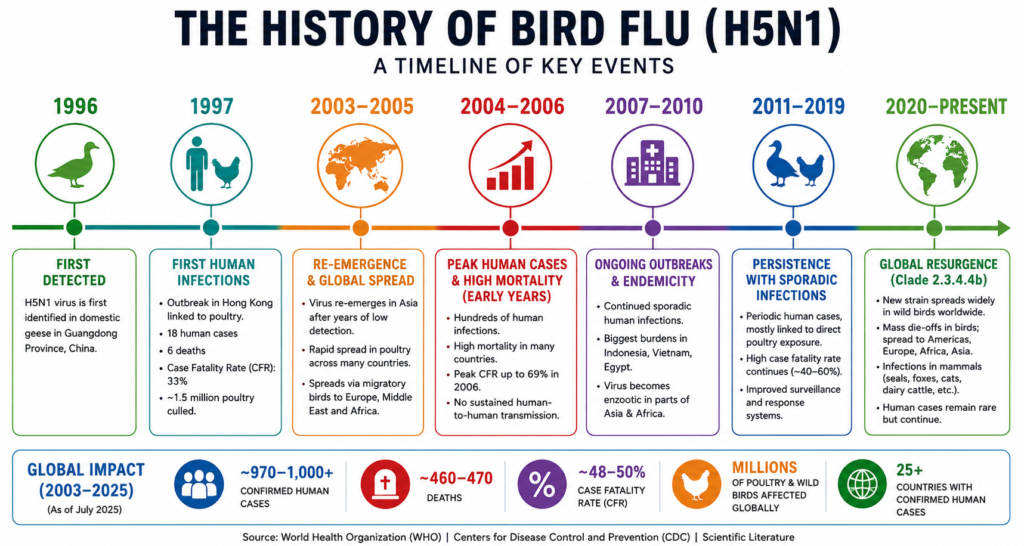
H5N1 virus was first identified in domestic geese in Guangdong, China, in 1996. An outbreak in 1997 in Hong Kong resulted in 6 deaths out of 18 human cases. It was the first documented zoonotic transmission from poultry to humans. Around 1.5 million birds were destroyed in Hong Kong as control measures, following the outbreak.
Re-emergence and Global Spread: 2003-2010
In 2003, the virus re-emerges in Asia after years of low detection. Rapid outbreaks in poultry across multiple countries, along with human infections begin to increase during 2003 to 2005. The virus started spreading via wild migratory birds and evolved into multiple genetic clades.
WHO confirmed global pattern, which included hundreds of human infections and high mortality rate of about 50% in early years from 2003 to 2010. During the time, the outbreaks were majorly occured in Indonesia, Vietnam, Thailand and Egypt. However, no sustained human-tohuman transmission was observed. With a case fatality rate of about 56%, as reported by the WHO, 205 laboratory cases emerged with 112 by the end of 2006. The increase in mortality rate was indicated by the emergence of new viral variants with higher pathogenicity, causing severe lung complications and acute respiratory distress.
Moreover, Indonesia became one of the regional epicenter for high fatality rate. During 2005-2009, more than 100 confirmed-cases were reported, followed by 60-80% case fatality rate. Similarly, Egypt sustained a long epidemic wave from 2006 to 2015. Unlike Asia, Egypt had a long slow-burning epidemic, which was linked to treatment timing, age distribution shifts and healthcare access differences. Initially, the death rate was low at about 10%, but later increased to 75% resulting in total of 112 deaths.
Endemic Persistence and Regionalization: 2010-2019
In mid 2010s, the virus became enzootic in parts of Asia and Africa with continued sporadic human infections. It was mostly linked to direct poultry exposure.
During the period, WHO cumulative pattern shows hundreds of cases globally with high fatality rate (~48-60%) depedning on region.
Global Resurgence: 2020-2024
A major genetic shift was observed which was highly transmissible in wild birds. A dominant global strain, H5N1 2.3.4.4b, emerged affecting millions of birds worldwide. It spreaded across Europe, Africa, Asia and Americas, and expanded to new host, mammals. 70 human cases were reported in the United States in early 2025. Similarly, 26 global human infections and 11 deaths were identified in mostly affected countries including Cambodia, India, Mexico, and Vietnam.
H5N1 bird flu virus is continuously evolving and spillover into mammals is in increasing pattern. Human infections remain rare but highly fatal. As it is already global enzootic in wild birds, pandemic risk persists if human-to-human transmission evolves.
References
World Health Organization. (2025). Cumulative number of confirmed human cases for avian influenza A(H5N1) reported to WHO (2003–2025). https://www.who.int
Centers for Disease Control and Prevention. (2025). Avian influenza (bird flu): Situation summary. https://www.cdc.gov/bird-flu
Wang, T. T., Parides, M. K., & Palese, P. (2012). Seroevidence for H5N1 influenza infections in humans: A meta-analysis. Science, 335(6075), 1463–1467. https://doi.org/10.1126/science.1208949
Krammer, F., Smith, G. J. D., Fouchier, R. A. M., et al. (2018). Influenza. Nature Reviews Disease Primers, 4, 3. https://doi.org/10.1038/s41572-018-0002-y
Long, J. S., Mistry, B., Haslam, S. M., & Barclay, W. S. (2019). Host and viral determinants of influenza A virus species specificity. Nature Reviews Microbiology, 17(2), 67–81. https://doi.org/10.1038/s41579-018-0115-z
Schrauwen, E. J. A., de Graaf, M., Herfst, S., et al. (2014). Determinants of virulence of influenza A virus. European Journal of Clinical Microbiology & Infectious Diseases, 33(4), 479–490. https://doi.org/10.1007/s10096-013-1998-4
Kang, M., Wang, L. F., Sun, B. W., et al. (2024). Zoonotic infections by avian influenza virus: Changing global epidemiology, investigation, and control. The Lancet Infectious Diseases, 24, e522–e531. https://doi.org/10.1016/S1473-3099(24)00000-0
Torchetti, M. K., et al. (2024). Highly pathogenic avian influenza A(H5N1) clade 2.3.4.4b virus infections in mammals and poultry, United States. Emerging Infectious Diseases, 30(7), 1335–1343. https://doi.org/10.3201/eid3007.240000
Kawaoka, Y., & Neumann, G. (2006). Influenza pandemics: Past, present and future. Nature Reviews Microbiology, 4(9), 689–699. https://doi.org/10.1038/nrmicro1490