
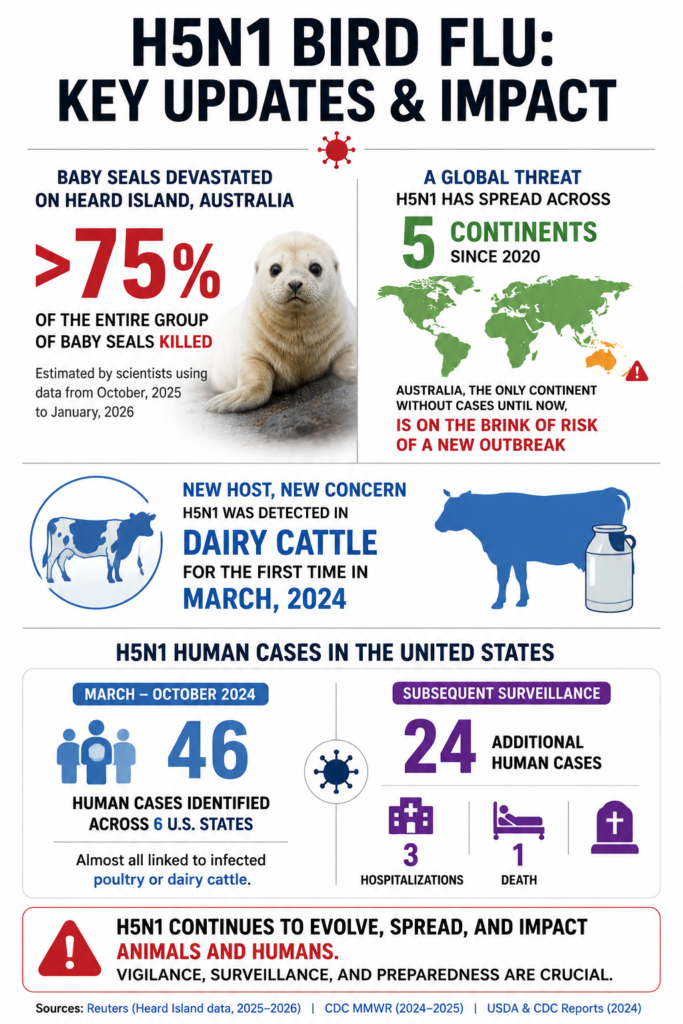
H5N1 strain of bird flu has killed more than 75% of the entire group of baby seals on Heard Island in Australia, as estimated by scienties using data from October, 2025 to January, 2026. The virus has spread across multiple continents since 2020, and now Australia, which remained the only continent to have no cases of H5N1, is in the brink of risk of new outbreak.
Although human-to-human transmission has not been reported yet, the increasing viral population leads to a greater chance of mutations that may improve adaptation to mammalian hosts. While Ebola and Hantavirus are getting a lot of attention, H5N1 strain of bird flu cannot be undermined.
Mammalian Infections Represent a Critical Warning Sign
Historically, H5N1 was primarily considered as a bird pathogen. However, the increasing number of mammalian infections in seals, sea lions, foxes, mink, cats, and dairy cattle is creating concern in recent years.
In the United States, a study showed that the virus can establish itself in a mammalian population, dairy cattle, while maintaining opportunities for human contact. The Food and Agriculture Organization (FAO), World Health Organization (WHO), and World Organization for Animal Health (WOAH) jointly assessed the situation and noted that continued circulation in birds and mammals increases the likelihood of additional human infections.
Rare Cases of Human Infection but Can Be Severe
According to the CDC, more than 1,000 human H5N1 infections have been reported since 1997, with mortality rate of approximately 48%. H5N1 possesses the ability to cause severe respiratory disease, pneumonia, multi-organ dysfunction and even death, proving it to be a potential pandemic cause.
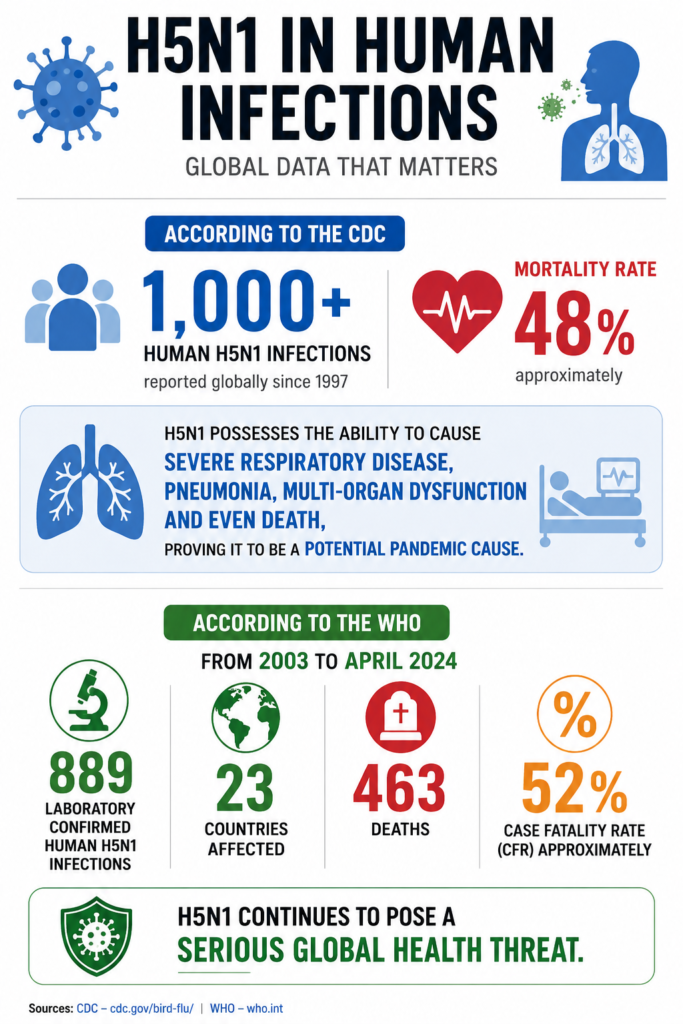
From 2003 to April 2024, 889 laboratory confirmed human H5N1 infections were recorded by WHO. The infections spreaded across 23 countries with 463 deaths, corresponding to a case fatality rate (CFR) of approximately 52%.
The Dairy Cattle Outbreak Changed Risk Assessments
H5N1 was detected in dairy cattle for the first time in March, 2024. A report identified 46 human cases across six U.S. states between March and October 2024, almost all liked to infected poultry or dairy cattle. Subsequent surveillance resulted in an additional 24 human cases, with 3 hospitalizations and 1 death.
Overcoming cross species barriers is a remarkable aspect of the current outbreak, which increases chances for mutations to improve mammalian adaptation.
Still Not a High Risk Pandemic Potential
While concerns are justified, there is still not sufficient evidence to suggest that a pandemic is inevitable. According to a review in Frontiers in Microbiology, H5N1 remains poorly adapted for efficient airborne transmission among humans and lacks several characteristics.
However, monitoring the indicators is crucial to prevent further development of H5N1 cases creating global risk. To summarize, these are the warning signs that scientis are currently watching:
- Increasing numbers of human infections without animal exposure.
- Evidence of sustained human-to-human transmission.
- New mutations improving binding to human respiratory tract receptors.
- Continued expansion in mammalian hosts.
- Global circulation among multiple continents
Like H5N1, hantaviruses originate in animal hosts and occasionally infect humans. Both diseases highlight the importance of monitoring pathogens circulating in wildlife populations. Read more in our article on Hantavirus: History, Types, and Global Distribution.
References
- Centers for Disease Control and Prevention. (2026). Global human cases with influenza A(H5N1), 1997–2026. https://www.cdc.gov/bird-flu/php/surveillance/chart-epi-curve-ah5n1.html
- Food and Agriculture Organization, World Health Organization, & World Organisation for Animal Health. (2025). Updated joint FAO/WHO/WOAH public health assessment of recent influenza A(H5N1) viruses. https://www.woah.org/app/uploads/2025/04/2025-04-17-fao-woah-who-h5n1-assessment.pdf
- Rolfes, M. A., et al. (2025). Human infections with highly pathogenic avian influenza A(H5N1) in the United States. Clinical Infectious Diseases. https://pmc.ncbi.nlm.nih.gov/articles/PMC12477757/
- Swayne, D. E., & Suarez, D. L. (2019). Highly pathogenic avian influenza. Revue Scientifique et Technique. https://pmc.ncbi.nlm.nih.gov/articles/PMC6553608/
- Tobolowsky, F. A., et al. (2025). Highly pathogenic avian influenza A(H5N1) virus infection among dairy workers and poultry workers. MMWR Morbidity and Mortality Weekly Report. https://www.cdc.gov/mmwr/volumes/74/wr/mm7433a2.htm
- Wang, X., et al. (2024). H5N1 influenza: Assessing pandemic potential and current evidence. Frontiers in Microbiology, 15. https://www.frontiersin.org/articles/10.3389/fmicb.2024.1477738/full
- World Health Organization. (2025). Influenza at the human-animal interface: Summary and risk assessment. https://cdn.who.int/media/docs/default-source/influenza/human-animal-interface-risk-assessments/influenza-at-the-human-animal-interface-summary-and-assessment–from-28-may-to-1-july-2025.pdf
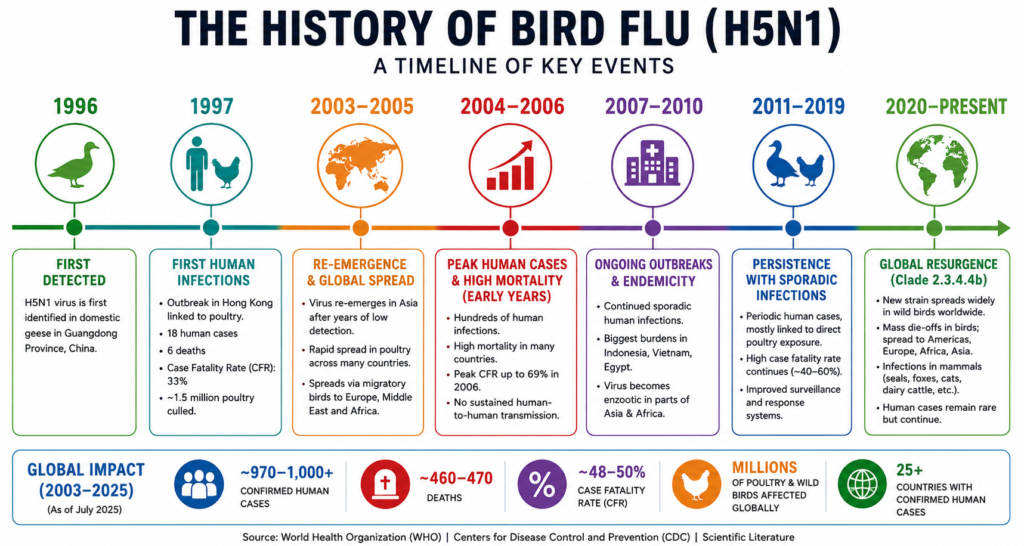
Pingback: History of H5N1 Bird Flu: Timeline – Disease Buddy