
Introduction
Hantaviruses represent a significant global public health threat, characterized by their unique transmission from rodent vectors to humans and their potential to cause severe, often fatal, respiratory and renal diseases.
Hantaviruses are enveloped, negative-strand RNA viruses belonging to the genus Orthohantavirus, within the family Hantaviridae (order Bunyavirales). These viral particles typically measure between 80–120 nm in diameter.
The first hantavirus, Hantaan virus (HTNV), was isolated in 1976. Since then, at least 22 pathogenic hantaviruses have been identified. These are broadly categorized by the clinical syndromes they cause:
- Hemorrhagic Fever with Renal Syndrome (HFRS): Primarily associated with hantaviruses in Europe and Asia (e.g., HTNV, Dobrava, Puumala, and Seoul viruses).
- Hantavirus Pulmonary Syndrome (HPS/HCPS): First recognized in 1993 in the Southwestern United States following the discovery of the Sin Nombre virus (SNV). This syndrome is predominantly found in the Americas.
Epidemiology and Transmission
Hantaviruses are zoonotic, transmitted to humans through contact with the urine, droppings, or saliva of infected rodents. While less common, transmission can also occur via rodent bites.
The impact of hantavirus varies significantly by region and viral strain:
| Region | Primary Syndrome | Annual Estimated Cases | Case Fatality Rate (CFR) |
| Global | Mixed | 10,000 – 100,000+ | Varies by strain |
| China | HFRS | ~12,800 | 1.3% |
| Americas | HPS/HCPS | 200 – 300 | 38% – 50% |
| Europe | HFRS | ~3,100 | <1% (PUUV) to 15% (DOBV) |
Demographic Trends
While hantavirus affects all ages, the clinical course in children is generally similar to that in adults. The proportion of pediatric cases varies significantly by region:
- HFRS: Children account for only 1.3% of cases in Europe and up to 9.7% in Russia.
- HPS: Pediatric cases are more prevalent in South America, reaching 18.6% in Chile, compared to 8% in the United States.
Symptoms
The clinical progression of hantavirus infection is typically divided into early and late phases, depending on the specific syndrome.

Hantavirus Pulmonary Syndrome (HPS)
- Incubation: 1 to 8 weeks.
- Early Phase: Fever, fatigue, and significant muscle aches in large groups (thighs, hips, back). About 50% of patients experience headaches, dizziness, and gastrointestinal distress.
- Late Phase (4–10 days later): Rapid progression to coughing and shortness of breath. As the lungs fill with fluid, patients experience chest tightness and respiratory failure.
Hemorrhagic Fever with Renal Syndrome (HFRS)
- Incubation: Usually 1 to 2 weeks (rarely up to 8 weeks).
- Initial Phase: Sudden onset of intense headaches, back and abdominal pain, fever, and blurred vision. Physical signs may include flushing of the face, eye inflammation, or a rash.
- Late Phase: Progression to hypotension, acute shock, internal bleeding (vascular leakage), and acute kidney failure. Recovery can take several weeks or months.
Diagnostics and Treatment
Because hantavirus can progress rapidly—particularly in cases of HPS—early laboratory confirmation and immediate hospital intervention are vital for patient survival.
Laboratory Diagnostics
Confirmation of a hantavirus infection relies on two primary methods:
- Serological Testing: Detection of hantavirus-specific IgM antibodies or a significant rise in IgG titers.
- Molecular Methods: The use of Reverse Transcription Polymerase Chain Reaction (RT-PCR) during the acute phase of illness to detect viral RNA directly in the blood.
Clinical Management and Supportive Care
There is currently no specific antiviral or immunomodulatory treatment approved for hantavirus. Medical intervention is primarily supportive, focusing on stabilizing the patient during the acute phase of the illness.
Key Management Strategies:
- Hemodynamic Stabilization: Use of intravenous (IV) fluids to treat hypotension and prevent acute shock.
- Respiratory Support: Oxygenation therapy to address hypoxia, which is critical for patients experiencing the respiratory distress associated with HPS.
- Renal Monitoring (HFRS): Careful management of fluid and electrolyte balance, blood pressure, and urine production to mitigate the effects of acute kidney failure.
- Symptomatic Relief: Administration of analgesics to manage intense pain and fever.
Pharmacological Considerations
The use of Intravenous Ribavirin has been studied, notably in HFRS trials in China where it showed a reduction in mortality. However, global clinical data are currently considered insufficient to categorize it as a standard effective treatment, and its efficacy for HPS remains unproven.
Prognosis and Recovery
While the case fatality rate for HPS remains high (approximately 38–40%), HFRS recovery, though often slow, is achievable with intensive supportive care. Complete recovery from severe hantavirus infections can take several weeks to months.
Outbreak

A cluster of severe respiratory illness linked to hantavirus infection has been reported on a cruise ship operating in the South Atlantic under a Dutch flag. The European Centre for Disease Prevention and Control (ECDC) was notified on 2 May 2026 through the European Union’s Early Warning and Response System (EWRS). The ship carried 149 passengers and crew members representing 23 nationalities, including individuals from nine EU/EEA countries.
Initial reports indicated that two individuals had died, while another critically ill passenger was medically evacuated to South Africa. On 3 May 2026, laboratory testing confirmed hantavirus infection in the evacuated patient. By 6 May, seven individuals had developed symptoms including fever, respiratory distress, and gastrointestinal illness, with several cases rapidly progressing to severe pneumonia, acute respiratory distress syndrome (ARDS), and shock.
According to the latest update from the World Health Organization (WHO), a total of eight hantavirus cases, three confirmed and five suspected, have been identified among people aboard the vessel. South African health authorities confirmed that two patients tested positive for the Andes strain of hantavirus, a variant primarily found in Latin America, where the cruise had originated.
The outbreak has raised international public health concern because Andes virus is one of the few hantavirus strains known to have limited person-to-person transmission. Health authorities and international agencies are continuing epidemiological investigations, contact tracing, and surveillance efforts to better understand the source and extent of the outbreak while monitoring passengers and crew for further illness.
Reference
Bi, Z., Formenty, P. B. H., & Roth, C. E. (2008). Hantavirus infection: A review and global update. The Journal of Infection in Developing Countries, 2(1), 3–23. https://doi.org/10.3855/jidc.317
Vial, P. A., Ferrés, M., Vial, C., Klingström, J., Ahlm, C., López, R., Le Corre, N., & Mertz, G. J. (2023). Hantavirus in humans: A review of clinical aspects and management. The Lancet Infectious Diseases, 23(9), e371–e382. https://doi.org/10.1016/S1473-3099(23)00128-7
Centers for Disease Control and Prevention. (2024, May 13). About hantavirus. U.S. Department of Health & Human Services. https://www.cdc.gov/hantavirus/about/index.html
World Health Organization. (2026, May 6). Hantavirus. https://www.who.int/news-room/fact-sheets/detail/hantavirus
BBC News. (2026). Hantavirus outbreak news article. BBC News. https://www.bbc.co.uk/news/articles/c5y093d5n9ko
European Centre for Disease Prevention and Control. (2026). Hantavirus-associated cluster of illness on a cruise ship: ECDC assessment and recommendations. https://www.ecdc.europa.eu/en/publications-data/hantavirus-associated-cluster-illness-cruise-ship-ecdc-assessment-and
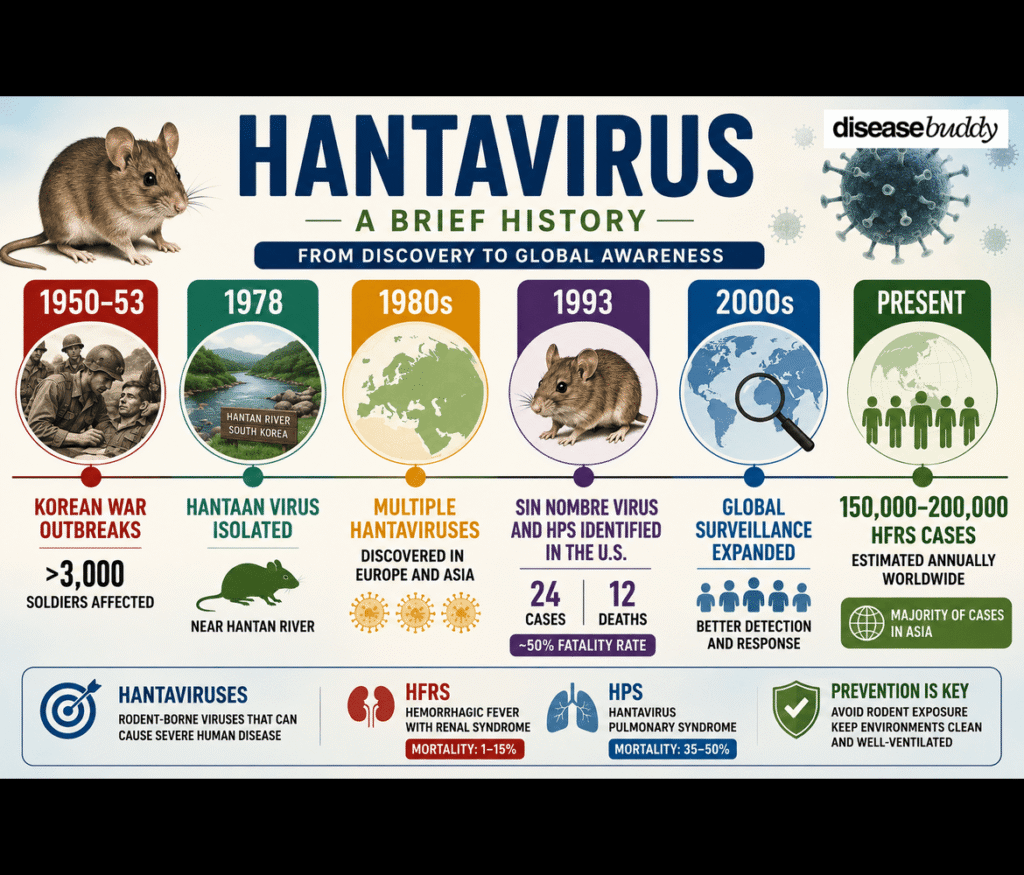
Pingback: History of Hantavirus : Timeline – Disease Buddy
Pingback: History of Hantavirus : Timeline - Disease Buddy