
Salmonellosis is one of the world’s most important foodborne bacterial infections. It is caused by Salmonella bacteria, and closely associated with contaminated food, poultry, eggs and contact with infected animals.
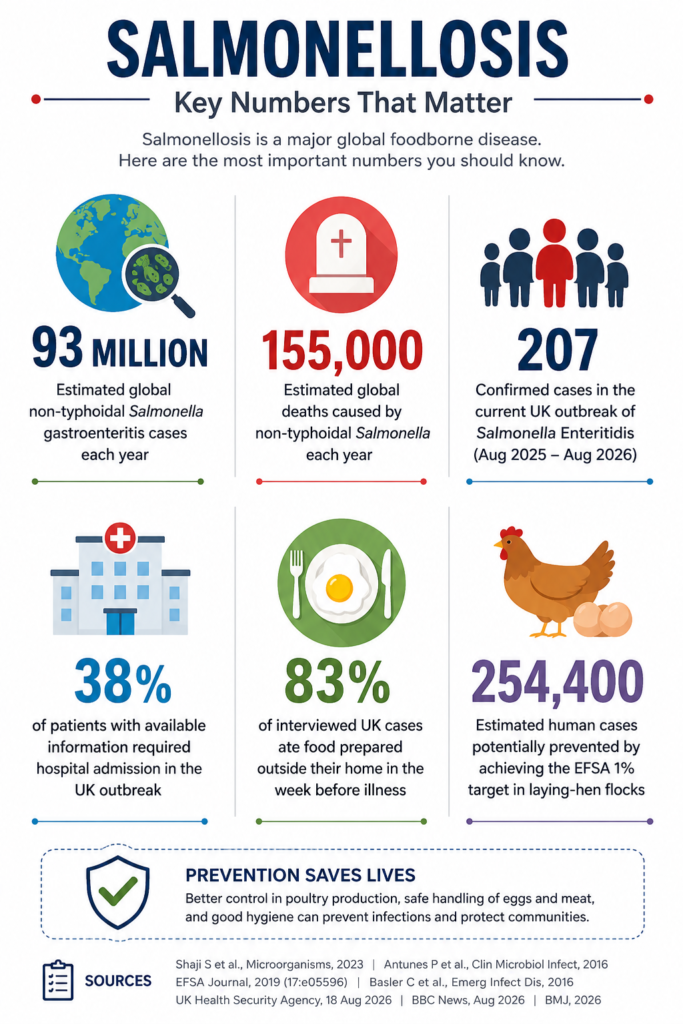
A 2023 review in Microorganisms estimates that non-typhoidal Salmonella causes approximately 93 million cases of gastroenteritis and 155,000 deaths worldwide every year. In the United States alone, the CDC estimate cited by the review is approximately 1.35 million infections and 420 deaths annually.
What is salmonellosis?
Salmonellosis is an infection caused by Salmonella. The disease is most commonly associated with non-typhoidal Salmonella (NTS), particularly S. Enteritidis and S. Typhimurium.
In poultry, the bacteria can spread through both vertical transmission, from breeding birds to offspring, and horizontal transmission, between birds or through contaminated feed, water, litter, equipment, insects, rodents and people.
This makes poultry production an important point of intervention for public-health protection.
Why poultry and eggs matter?
Poultry is an important reservoir for several non-typhoidal Salmonella serotypes.
The EFSA (European Food Safety Authority) assessment of European poultry production found that S. Enteritidis was particularly important in laying hens. Based on EU data from 2014–2016, S. Enteritidis accounted for 43.7% of reported Salmonella serovars in laying-hen flocks, compared with 24.8% in breeding flocks and 8.8% in broiler flocks.
Interestingly, S. Infantis was the most frequently reported serovar in broilers, accounting for 42.5% of reported serovars in that sector. S. Typhimurium accounted for 9.0% in laying hens, 9.4% in breeding flocks and 4.7% in broilers.
These differences are important because Salmonella is not a single uniform organism. Different serotypes can dominate different parts of the poultry production system.
What happened to Salmonella prevalence in European breeding flocks?
There is also evidence that control programmes can make a measurable difference.
EFSA estimated that the prevalence of the targeted Salmonella serovars in EU Gallus gallus breeding flocks fell from approximately 1.12% in 2007 to 0.32% in 2016.
EFSA modelled what could happen if a 1% target for the relevant Salmonella serovars were achieved in laying-hen flocks. The model estimated a reduction of approximately 254,400 true human salmonellosis cases associated with the laying-hen reservoir, corresponding to about a 53.4% reduction in layer-associated cases.
When compared with the estimated total burden of human salmonellosis, this represented approximately a 6.2% reduction in overall true salmonellosis cases in the 23 EU Member States included in the attribution model.
Why is Salmonella not only a food problem?
A CDC study examining US outbreaks between 1990 and 2014 identified 53 outbreaks associated with live poultry. Together, these outbreaks resulted in:
- 2,630 illnesses
- 387 hospitalisations
- 5 deaths
The median age of patients was only 9 years, with cases ranging from younger than one year to 92 years. About 77% of the outbreaks were multistate outbreaks. Among patients for whom exposure information was available, 85% reported contact with chicks and 38% reported contact with ducklings.
The findings demonstrate that even apparently healthy backyard poultry can represent a source of human infection.
How does Salmonella cause illness?
After ingestion, Salmonella interacts with the intestinal lining and uses several mechanisms to invade and survive within host cells.
The 2023 review highlights two important regions of the bacterial genome known as Salmonella pathogenicity islands 1 and 2 (SPI-1 and SPI-2). These contain genes involved in mechanisms that allow Salmonella to invade host cells and survive within the host.
Most infections produce gastrointestinal symptoms such as:
- Diarrhoea
- Abdominal cramps
- Fever
- Nausea
- Vomiting
However, invasive infections can occur. Bacteria may enter the bloodstream and cause serious systemic disease.
The current UK outbreak provides a striking example: two patients developed bloodstream infections, while 38% of patients with available information required hospital admission.
The UK’s 2026 Salmonella outbreak
The issue has become particularly relevant in the UK following the declaration of a national outbreak of Salmonella Enteritidis.
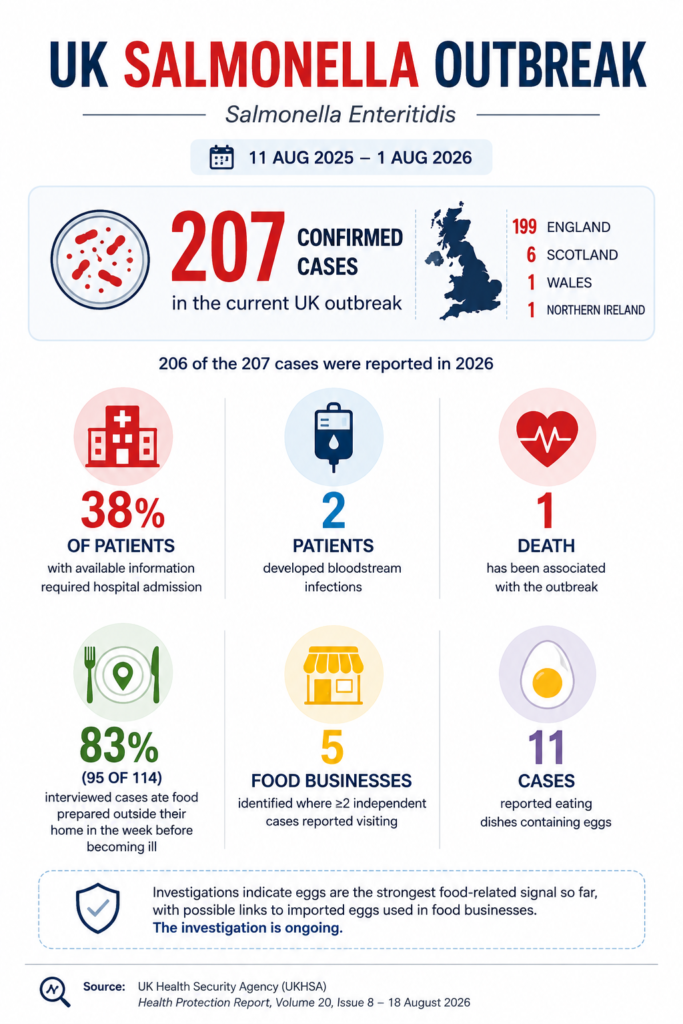
UKHSA identified 207 confirmed cases between 11 August 2025 and 1 August 2026. Remarkably, 206 of the 207 cases were reported during 2026, indicating that the overwhelming majority occurred in the current year.
The cases were distributed across all four UK nations:
- England: 199
- Scotland: 6
- Wales: 1
- Northern Ireland: 1
Within England, London recorded 47 cases, while Yorkshire and the Humber recorded 38. Cases ranged from 0 to 90 years of age, with a median age of 30 years. Females accounted for 51% (105 cases).
How severe has the outbreak been?
Of patients for whom severity information was available:
38% required hospital admission.
Two people developed bloodstream infections and one death has been associated with the outbreak.
What is causing the Salmonella outbreak?
Investigators have not yet established the complete contamination chain, but epidemiological evidence is pointing strongly towards eggs.
UKHSA (UK Health Security Agency) interviewed 114 cases. Of these, 95 people—or 83%—reported eating food prepared outside their home during the week before becoming ill.
Investigators identified five food businesses where at least two independent cases reported visiting. These businesses were associated with 24 cases in total.
Among those cases, 11 people reported eating dishes containing eggs.
This makes egg consumption the strongest food-related signal identified so far. Food-chain investigations found that the businesses received eggs from multiple sources, including importers, and possible cross-contamination events were identified in two settings.
Importantly, UKHSA has not identified a link to UK-produced eggs or poultry at this stage. The investigation is continuing.
What can people do to reduce their risk?
For most people, sensible food hygiene remains the key protection.
Important measures include:
- Wash hands thoroughly before preparing food and after using the toilet.
- Cook poultry and eggs thoroughly.
- Prevent contact between raw poultry or eggs and ready-to-eat food.
- Clean food preparation surfaces and utensils.
- Refrigerate foods appropriately.
- Avoid preparing food for others while experiencing gastrointestinal symptoms.
The current UK outbreak does not mean people should stop eating eggs.
The concern is specifically around the suspected food chain under investigation, particularly imported eggs used in catering and hospitality settings.
References
Shaji S, Selvaraj RK, Shanmugasundaram R. Salmonella Infection in Poultry: A Review on the Pathogen and Control Strategies. Microorganisms. 2023;11:2814.
Antunes P, Mourão J, Campos J, Peixe L. Salmonellosis: the role of poultry meat. Clinical Microbiology and Infection. 2016;22:110–121.
EFSA BIOHAZ Panel. Salmonella control in poultry flocks and its public health impact. EFSA Journal. 2019;17.
Basler C et al. Outbreaks of Human Salmonella Infections Associated with Live Poultry, United States, 1990–2014. Emerging Infectious Diseases. 2016;22:1705–1711.
UK Health Security Agency. National outbreak of Salmonella Enteritidis (t5.9411) in the UK. 18 August 2026.