The U.S. Food and Drug Administration (FDA) has approved Moderna’s first mRNA flu vaccine, mFlusiva, marking the first approval of an mRNA technology vaccine specifically designed against influenza. The approval represents a major advancement in flu vaccine development, using the same messenger RNA platform that transformed COVID-19 vaccine production.
Unlike traditional influenza vaccines, which often rely on egg-based or cell-based production methods, mRNA technology allows manufacturers to design vaccines more rapidly when influenza strains change.
Key Facts and Numbers About Moderna’s mRNA Flu Vaccine
| Category | Data |
| Vaccine name | mFlusiva |
| Manufacturer | Moderna |
| Technology | Messenger RNA (mRNA) |
| Target disease | Seasonal influenza |
| First FDA-approved mRNA flu vaccine | Yes |
| Approved age group | Adults >50 years |
| Clinical trial participants | >40,000 people |
| Improved effectiveness compared with standard vaccine | 26.6% |
| Study population | Adults aged 50 years and older |
| Approval pathway for >65 years | Accelerated approval |
| Vaccine season availability | 2026-27 influenza season |
Why is This Vaccine Important?
Seasonal influenza remains a major global health problem. Older adults are particularly vulnerable because immune responses weaken with age, making influenza infection more likely to result in complications, hospitalisation, and death.
Traditional flu vaccines have provided important protection for decades, but their effectiveness varies depending on how closely vaccine strains match circulating influenza viruses.
mRNA technology offers several potential advantages:
- Faster vaccine design
- Flexible manufacturing
- Ability to rapidly update vaccine composition
- Strong immune responses
Clinical Trial Results: More than 40,000 Participants
The approval moderna’s first mRNA flu vaccine was supported by a large international phase 3 clinical trial involving more than 40,000 adults aged 50 years and older.
Participants were randomly assigned to receive either:
- Moderna’s mRNA-1010 influenza vaccine, or
- A standard seasonal influenza vaccine
Researchers monitored influenza cases during the 2024–2025 flu season.
The results showed 26.6% higher protection against influenza compared with standard influenza vaccines.
Furthermore, in comparative studies, mFlusiva produced stronger antibody responses than a high-dose influenza vaccine used specifically for older adults. This is important because immune ageing can reduce vaccine effectiveness among elderly populations.
Safety Profile of Moderna’s Flu Vaccine
Safety findings were consistent with previous mRNA vaccine studies.
Common reactions included:
- Temporary injection-site reactions
- Fatigue
- Muscle discomfort
- Headache
- Fever-like symptoms
The BMJ report noted that serious adverse events were uncommon and occurred at similar rates between groups.
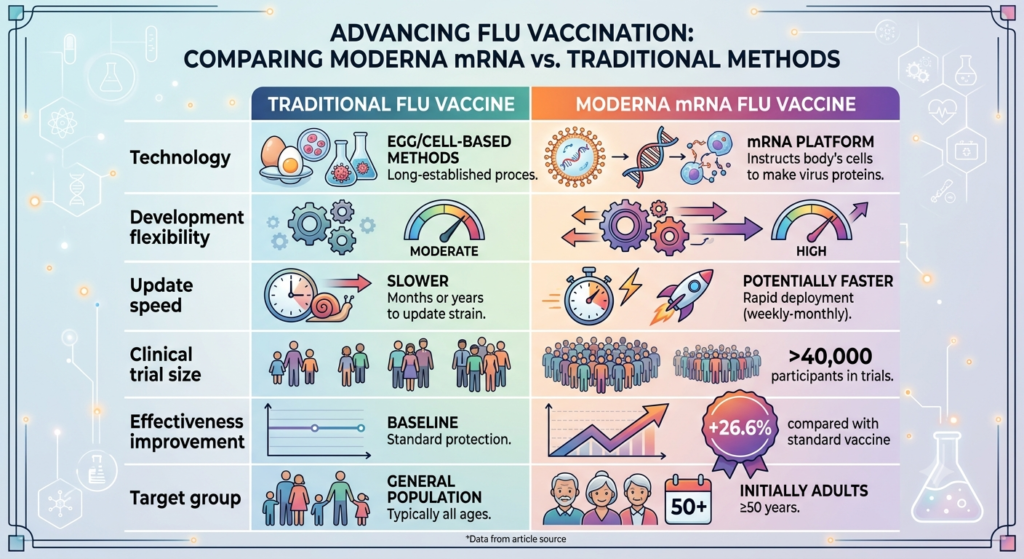
Comparison Table: Traditional Flu Vaccine vs Moderna mRNA Flu Vaccine
| Feature | Traditional Flu Vaccine | Moderna mRNA Flu Vaccine |
| Technology | Egg/cell-based methods | mRNA platform |
| Development flexibility | Moderate | High |
| Update Speed | Slower | Potentially faster |
| Clinical trial size | Variable | >40,000 participants |
| Effectiveness improvement | Baseline | +26.6% compared with standard vaccine |
| Target group | General population | Initially adults >50 years |
References
Iacobucci G. Moderna’s mRNA flu vaccine outperforms standard shot, study finds. BMJ. 2026;393:s895. doi:10.1136/bmj.s895.
Reuters. US FDA approves first mRNA flu shot from Moderna. Reuters. Published August 6, 2026.
Associated Press. A new type of flu shot is coming after FDA approves mRNA-based vaccine. Published August 2026.
Wall Street Journal. FDA approves Moderna’s mRNA flu vaccine after review. Published August 2026.