Cyclosporiasis is a parasitic disease caused by Cyclospora cayetanensis, a coccidian protozoan that infects the human small intestine.
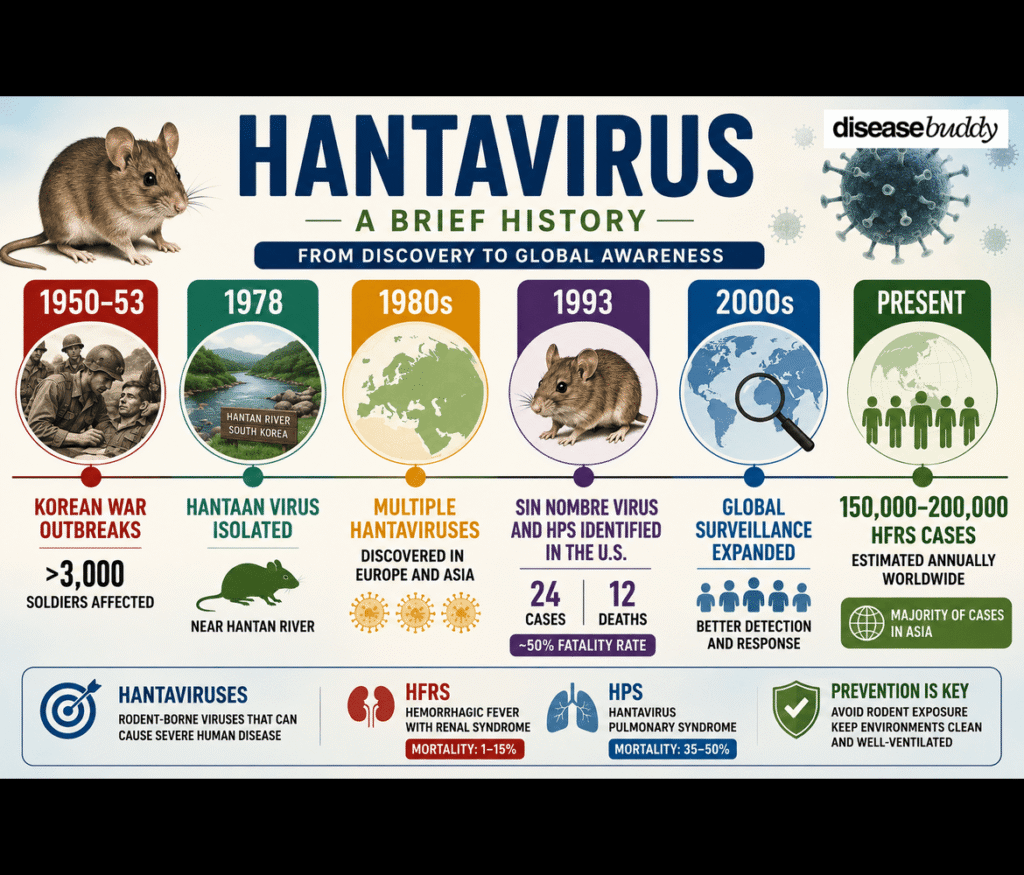
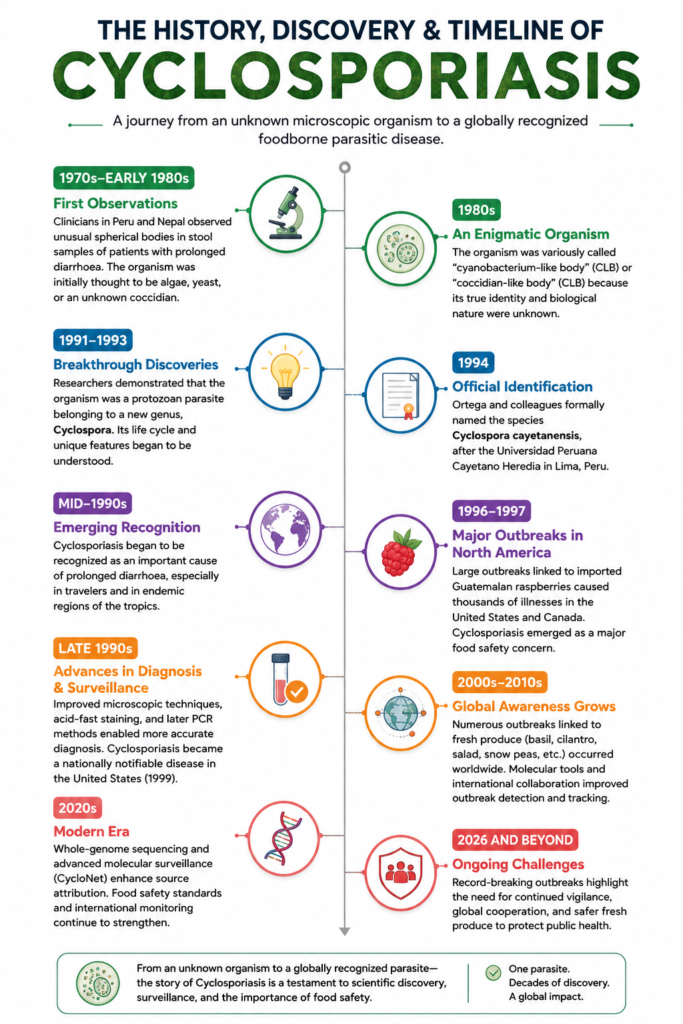
The disease was first reported in the late 1970s and early 1980s as an unusual intestinal organism when clinicians observed spherical bodies in stool samples from patients with prolonged diarrhoea. Initially, their biological characteristics were poorly understood as researchers believed these organisms to be blue-green algae, yeast or unidentified coccidian parasites.
In the early 1990s, scientists demonstrated that the organism was a previously undescribed protozoan parasite belonging to the genus Cyclospora. Later in 1994, Ortega and collegues formally named the species Cyclospora cayetanensis, after the Universidad Peruana Cayetano Heredia in Lima, Peru, where the pioneer research was conducted.
Several large foodborne outbreaks occured in North America during the mid-1990s, recognised as cyclosporiasis. In 1996 and 1997, thousands of infections across the United States and Canada were linked to imported Guatemalan raspberries. These outbreaks highlighted the parasite’s ability to spread internationally through fresh produce and led to significant improvements in food safety surveillance, molecular diagnostics, and epidemiological investigations.
Global Epidemiology
Cyclosporiasis occurs worldwide but is most prevalent in tropical and subtropical regions where warm climates, inadequate sanitation, and contaminated water facilitate parasite transmission. Endemic countries include many parts of Central and South America, South and Southeast Asia, the Middle East, and Africa. In these regions, repeated exposure often results in partial immunity among local residents, whereas travellers from non-endemic countries are more susceptible to symptomatic infection.
Imported cases are increasingly reported in North America, Europe, Australia, and Japan, primarily among international travellers and through contaminated imported fresh produce.
Disease Burden in Endemic Countries
Studies conducted in endemic regions report considerable variation in prevalence depending on the population studied and diagnostic methods used.
| Population | Estimated prevalence |
| General population | 0.1-15% |
| Children with diarrhoea | 2-20% |
| HIV/AIDS patients | 3-22% |
| Immunocompromised individuals | up to 25% |
A recent European surveillance study found:
- 61 confirmed cases among 25,061 stool samples
- 80% were acquired in Mexico
- Median patient age: 41 years
- 59% were male
- Most infections occurred in tourists staying at resorts or hotels.
Major Cyclosporiasis Outbreaks
1996-1997: Guatemalan Raspberry Outbreak
The first internationally recognized cyclosporiasis outbreak occurred in 1996, when more than 1,400 confirmed cases were reported across the United States and Canada. Epidemiological investigations identified imported fresh raspberries from Guatemala as the primary source of infection. Similar outbreaks recurred in 1997, resulting in hundreds of additional cases.
2000-2010: Fresh Produce-Associated Outbreaks
During the following decade, numerous outbreaks were linked to imported basil, snow peas, mesclun lettuce, cilantro, and other uncooked vegetables.
2013: Multistate U.S. Outbreak
In 2013, more than 630 laboratory-confirmed cases of Cyclosporiasis were reported in 25 states of the United States, making it one of the largest outbreaks in history. Investigators linked infections to contaminated salad mixes and fresh cilantro imported from Mexico.
2018-2019: Recurrent Summer Outbreaks
Between 2018 and 2019, the United States experienced record seasonal increases in cyclosporiasis cases. According to CDC, approximately 4,700 laboratory-confirmed infections were reported, with many associated with fresh basil, cilantro, and bagged salad products. Complexity was observed in tracing Cyclospora contamination as multiple contaminated foods were involved simultaneously.
2020-2025
Seasonal outbreaks continued to occur annually, primarily during the summer months. 1,180 domestically acquired cases were reported, including 105 hospitalizations, and 1,346 travel-associated cases, including 51 hospitalizations.The CDC increasingly used molecular typing through CycloNet to identify genetically related parasite clusters, enabling investigators to distinguish multiple concurrent outbreaks and improve source attribution.
Recent Outbreaks
In 2026, the United States recorded one of the largest cyclosporiasis outbreak to date. Cases have been reported across more than 30 states. Investigations have linked part of the outbreak to shredded iceberg lettuce imported from Mexico and distributed through multiple restaurant chains and food suppliers.
More than 25,000 confirmed and suspected cases have been reported nationwide. Michigan has reported over 12,000 cases, accounting for nearly half of all reported infections. More than 500 hospitalizations have been reported nationally. Two deaths, the first documented U.S. deaths associated with cyclosporiasis, were reported in Michigan among individuals with significant underlying medical conditions.
The World Heath Organization (WHO) currently does not maintain global incidence estimates specifically for cyclosporiasis, but recognizes Cyclospora as an emerging foodborne protozoan parasite of public health importance.
References
Centers for Disease Control and Prevention. (2019). Surveillance for cyclosporiasis—United States, 2011–2015. Morbidity and Mortality Weekly Report, 68(SS-3), 1–11. https://doi.org/10.15585/mmwr.ss6803a1
Centers for Disease Control and Prevention. (2026). Cyclosporiasis. https://www.cdc.gov/cyclosporiasis/index.html
Herwaldt, B. L. (2000). Cyclospora cayetanensis: A review, focusing on the outbreaks of cyclosporiasis in the 1990s. Clinical Infectious Diseases, 31(4), 1040–1057. https://doi.org/10.1086/314051
Herwaldt, B. L., & Ackers, M. L. (1997). An outbreak in 1996 of cyclosporiasis associated with imported raspberries. New England Journal of Medicine, 336(22), 1548–1556. https://doi.org/10.1056/NEJM199705293362202
Jalovec, A., et al. (2026). Cyclosporiasis. BMJ, 394, 100462. https://www.bmj.com/content/394/bmj-2026-100462
Li, J., et al. (2021). Cyclospora cayetanensis: A review of epidemiology, biology, clinical features, and control. Microorganisms, 9(9), 1863. https://doi.org/10.3390/microorganisms9091863
Ortega, Y. R., Sterling, C. R., Gilman, R. H., Cama, V. A., & Díaz, F. (1993). Cyclospora species—A new protozoan pathogen of humans. New England Journal of Medicine, 328(18), 1308–1312. https://doi.org/10.1056/NEJM199305063281804
Ryan, U., Hijjawi, N., & Xiao, L. (2018). Cyclospora. In J. B. Rose & B. Jiménez-Cisneros (Eds.), Global Water Pathogens Project. Elsevier.
Shields, J. M., & Olson, B. H. (2003). Cyclospora cayetanensis: A review of an emerging parasitic coccidian. International Journal for Parasitology, 33(4), 371–391.
Shlim, D. R., et al. (1993). Epidemiology of diarrhoeal illness associated with Cyclospora infection among travellers and foreign residents in Nepal. The Lancet, 341(8851), 1175–1179.
Reuters. (2026, August 3). Michigan reports first U.S. deaths in cyclosporiasis outbreak.
Associated Press. (2026, August 3). Michigan reports the first two U.S. deaths related to a Cyclospora outbreak.
Chen, Y., Qin, Z., Li, J., Xiao, L., & Zhang, L. (2024). The global prevalence of Cyclospora cayetanensis infection: A systematic review, meta-analysis, and meta-regression. Acta Tropica, 253, 107175. https://doi.org/10.1016/j.actatropica.2024.107175