An Ebola outbreak creates a bill long before the final patient is discharged.
There is the cost of vaccines, laboratory tests, treatment centres and protective equipment. The less visible costs include contact tracing, healthcare-worker deployment, lost working days, disrupted trade, reduced travel, pressure on government budgets and deaths from other diseases when health services are overwhelmed.
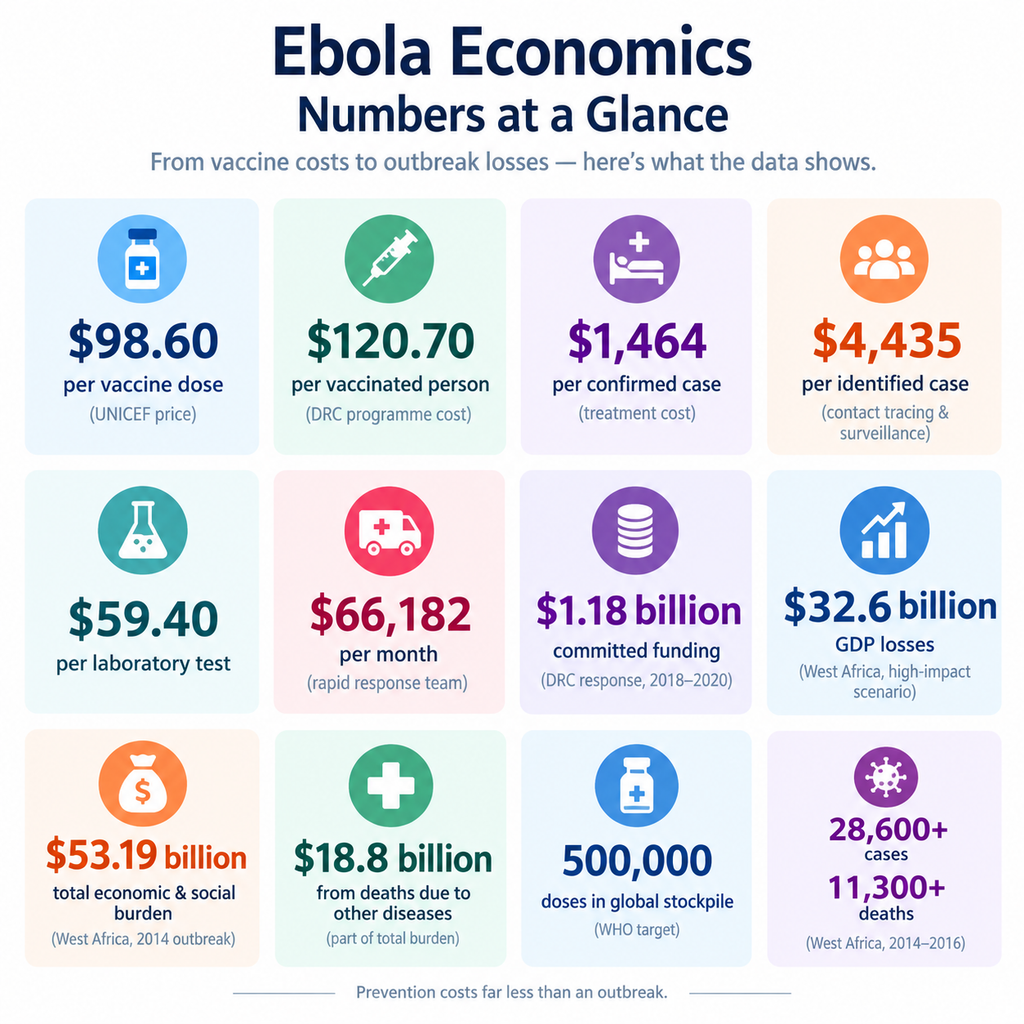
More than 28,600 cases and 11,300 deaths were reported in the 2014-2016 West African Ebola epidemic, making it the largest Ebola outbreak recorded at the time.
The 2014–2016 West African epidemic provides the clearest example of Ebola’s potential economic scale.
| Measure | Approximate figure |
| Reported cases | 28,600+ |
| Reported deaths | 11,300+ |
| Main affected countries | Guinea, Liberia, Sierra Leone |
| Outbreak period | 2014-2016 |
| Estimated lost GDP | $32.6 billion |
| Broader estimated economic and social burden | $53.19 billion |
The World Bank’s high-impact scenario estimated $32.6 billion in lost GDP across West Africa over 2014–2015 if the epidemic continued to spread. However, Huber and colleagues estimated the overall economic and social burden at $53.19 billion.
These numbers prove that the economic cost of Ebola is not the same thing as the money spent fighting Ebola.
What does it cost to vaccinate against Ebola?
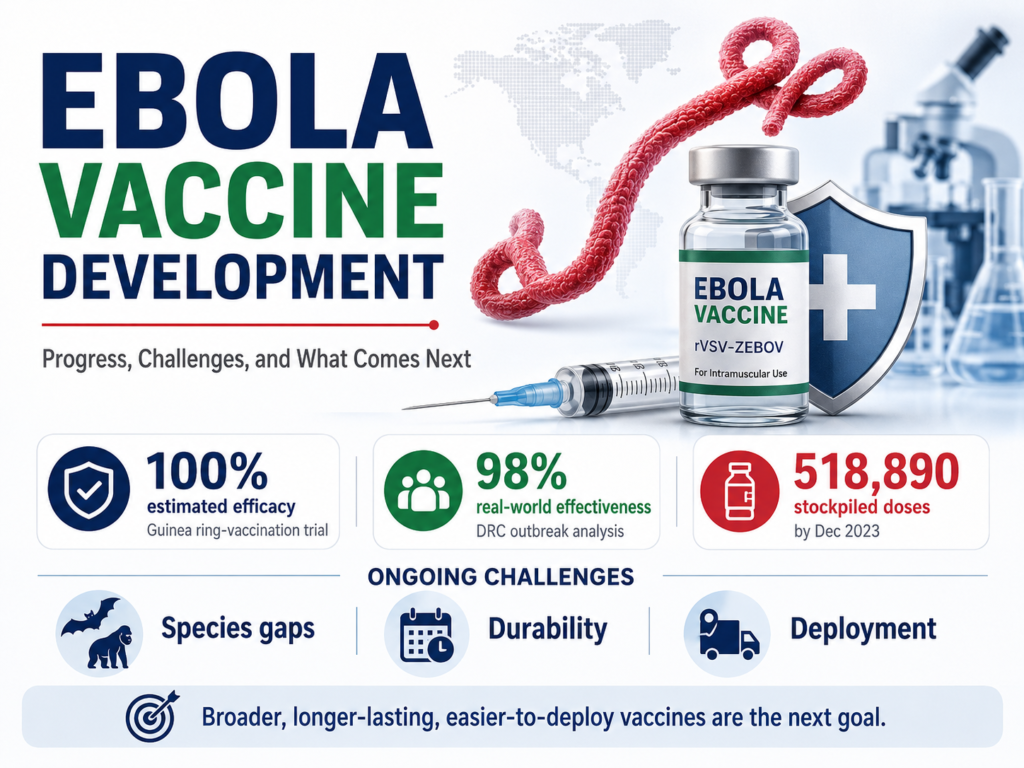
There is now a licensed vaccine for Ebola virus disease caused by Zaire ebolavirus: Ervebo.
WHO recommends Ervebo for outbreak response and for preventive vaccination of healthcare and frontline workers in areas at risk of future Ebola virus disease outbreaks. It is administered as a single dose.
But the price of the vaccine dose is only one part of the vaccination bill.
UNICEF’s January 2026 pricing data list an awarded price of approximately: US$98.60 per dose
for the Merck Ervebo one-dose presentation under the multi-year supply agreement. The price includes a service component associated with managing, storing and replenishing the Ebola vaccine stockpile.
Because Ebola outbreaks are relatively rare and unpredictable, WHO’s global mechanism maintains an emergency stockpile. The current target is 500,000 doses available for outbreak response, which equals to $49.3 million in estimate.
The real cost of vaccination is higher than the vial price
A vaccination campaign requires much more than purchasing doses.
There can be costs associated with:
- transportation
- cold-chain management
- vaccination teams
- healthcare workers
- training
- registration and documentation
- personal protective equipment
- community engagement
- surveillance
- adverse-event monitoring
- security
- wastage and logistics
A detailed analysis of the 2018–2020 Ebola response in the Democratic Republic of the Congo estimated the cost per vaccinated individual at $120.70, reflecting a programme-level cost.
What does one Ebola case cost?
This is where the numbers become surprising.
A mathematical economic model developed during the 2014 West African epidemic estimated the total societal cost of an Ebola case, including healthcare costs and productivity losses.
For a patient who recovered, the estimated cost ranged from: $480–$912 per case
For a patient who died: $5,929–$18,929 per case depending on age and country.
Mortality creates a much larger economic burden than treatment alone.
Treatment is only one part of the response
A later study of the 10th Ebola outbreak in the DRC (2018–2020) provides some of the best real-world unit-cost data.
The study estimated:
| Intervention | Estimated cost |
| Ebola treatment per confirmed case | $1,464 |
| Laboratory test | $59.40 |
| Contact tracing & surveillance per identified case | $4,435 |
| Vaccination per individual | $120.70 |
| Rapid-response team | $66,182/month |
| Mental-health/psychosocial support | $175/beneficiary |
Contact tracing and surveillance cost substantially more per identified case than treatment itself.
Moreover, the same DRC study estimated that approximately 70.2 laboratory tests were required to identify one Ebola case.
At approximately $59.40 per laboratory test, that corresponds to roughly $4,166 in laboratory testing per identified Ebola case in that particular response.
How much can a large outbreak response cost?
The 2018–2020 DRC Ebola outbreak demonstrates how quickly response expenditure can grow.
The response had a planned budget of approximately $1.28 billion, with about $1.18 billion in committed funding over 26 months.
The spending was not simply healthcare spending.
Approximately 68% went toward the public-health response. The remaining 32% supported security and community-support interventions associated with the response.
More interesting aspect of post-epidemic Ebola clusters in Guinea, Liberia and Sierra Leone comes from CDC’s analysis, in which the cost of responding to individual clusters ranged from approximately $113,000 to $1.76 million.
This showed that two outbreaks with the same number of cases can have very different response costs.
Is prevention cheaper than an Ebola outbreak?
There is no single unviersal answer.
A vaccine dose costing approximately $98.60 cannot simply be compared with a $32.6 billion GDP-loss estimate.
They represent completely different levels of measurement.
But the evidence provides a compelling numerical picture:
- A single Ervebo dose has a current UNICEF awarded price of about $98.60.
- A real-world DRC Ebola response estimated $120.70 per vaccinated person when programme costs were considered.
- Treatment of a confirmed Ebola case in the DRC response was estimated at $1,464.
- Contact tracing and surveillance cost approximately $4,435 per identified case.
- The 2018–2020 DRC response had approximately $1.18 billion in committed funding.
- The 2014–2016 West African epidemic was associated with estimated GDP losses of up to $32.6 billion under a high-impact scenario.
- A broader assessment estimated the total economic and social burden at $53.19 billion, including an estimated $18.8 billion from deaths due to causes other than Ebola.
These numbers show why the economics of Ebola cannot be reduced to the price of a vaccine.
References
World Health Organization. Ebola outbreak 2014–2016 — West Africa. WHO.
Centers for Disease Control and Prevention. History of Ebola outbreaks. CDC.
World Bank. The Economic Impact of the 2014 Ebola Epidemic: Short and Medium Term Estimates for West Africa. 2014.
Huber C, Finelli L, Stevens W. The Economic and Social Burden of the 2014 Ebola Outbreak in West Africa. Journal of Infectious Diseases. 2018;218(Suppl 5):S698–S704. doi:10.1093/infdis/jiy213.
Bartsch SM, Gorham K, Lee BY. The cost of an Ebola case. Pathogens and Global Health. 2015;109(1):4–9. doi:10.1179/2047773214Y.0000000169.
Zeng W, Samaha H, Yao M, et al. The cost of public health interventions to respond to the 10th Ebola outbreak in the Democratic Republic of the Congo. BMJ Global Health. 2023;8:e012660. doi:10.1136/bmjgh-2023-012660.
Henao-Restrepo AM, Camacho A, Longini IM, et al. Efficacy and effectiveness of an rVSV-vectored vaccine in preventing Ebola virus disease: final results from the Guinea ring vaccination, open-label, cluster-randomised trial. The Lancet. 2017;389(10068):505–518. doi:10.1016/S0140-6736(16)32621-6.
Obeng-Kusi M, Habila MA, Roe DJ, Erstad B, Abraham I. Economic evaluation using dynamic transition modeling of Ebola virus vaccination in lower-and-middle-income countries. Journal of Medical Economics. 2021;24(Suppl 1):1–13. doi:10.1080/13696998.2021.2002092.
UNICEF Supply Division. Ebola vaccine price data. Updated January 2026.
World Health Organization. Ebola vaccine stockpiles / International Coordinating Group on Vaccine Provision.
Centers for Disease Control and Prevention. Ebola Vaccine Product Information. Updated January 2025.
Centers for Disease Control and Prevention. Overview, Control Strategies, and Lessons Learned in the CDC Response to the 2014–2016 Ebola Epidemic. MMWR.