
Plague is one of the most feared diseases in human history. It is caused by the bacterium Yersinia pestis. The history of plague dates back to 1,500 years and was responsible for some of the deadliest disease outbreaks ever recorded.
Despite the modern development in antibiotics, Y. pestis continues to circulate naturally among rodents and their fleas in parts of Africa, Asia and the Americas. That reality has attracted renewed attention in October 2026 after the death of a laboratory worker at an anti-plague research institute in Irkutsk, Siberia. Reports initially raised concerns about pneumonic plague, although plague has not been confirmed as the cause of death.
What is plague?
Plague is a bacterial infection caused by Yersinia pestis.
The bacterium is maintained in nature primarily through cycles involving wild rodents and fleas. Humans can become infected through:
- bites from infected fleas
- contact with infected animal tissues or bodily fluids
- inhalation of respiratory droplets from someone with pneumonic plague
The disease has three major clinical forms:
- Bubonic plague
- Pneumonic plague
- Septicaemic plague
The three forms are caused by the same bacterium, but they behave very differently.
| Type | Main site affected | Typical transmission | Key feature |
| Bubonic | Lymph nodes | Usually infected flea bite | Painful swollen lymph nodes (buboes) |
| Pneumonic | Lungs | Respiratory droplets; can also develop from another form | Severe pneumonia, can spread person-to-person |
| Septicaemic | Bloodstream | Often develops from infection entering the blood | Sepsis, tissue damage and organ failure |
The First Plague Pandemic: The Plague of Justinian
One of the earliest major plague pandemics occurred during the sixth century CE, during the reign of Byzantine Emperor Justinian I.
The pandemic began around 541 CE, probably reaching Constantinople through trade networks connecting the Mediterranean and eastern regions.
Historical descriptions indicate enormous mortality, although the precise number of deaths remains debated because reliable population statistics did not exist.
Modern historical and molecular research has provided strong evidence that Yersinia pestis was responsible for at least some of these ancient plague epidemics. Ancient DNA studies have detected Y. pestis in human remains associated with historical plague outbreaks.
The Justinianic pandemic represents the beginning of what historians commonly describe as the First Plague Pandemic.
The Black Death: History’s Most Famous Plague Pandemic
The second and most devastating historical plague pandemic began in the 14th century.
The outbreak that became known as the Black Death reached Europe in the late 1340s. Between approximately 1347 and 1353, plague spread across Europe, North Africa and parts of Asia.
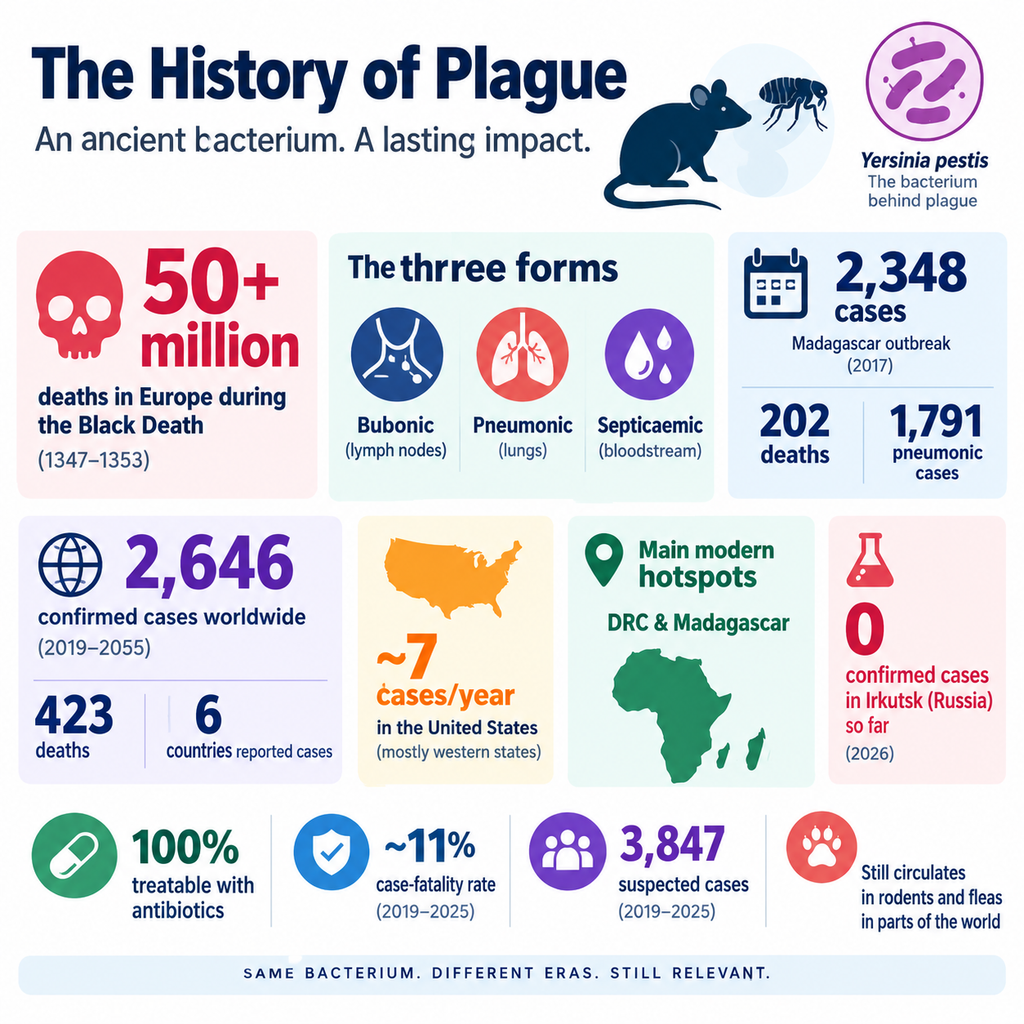
The WHO estimates that the Black Death caused more than 50 million deaths in Europe during the 14th century. However, historians continue to debate the precise mortality because medieval population estimates and death records are incomplete.
Some historical studies have estimated that plague killed approximately 30–50% of Europe’s population in affected areas, although mortality varied substantially between regions.
Quarantine Was Born From Plague
One of plague’s most important legacies is not medical, it is public health.
Medieval cities began introducing measures designed to prevent infected people and ships from entering populated areas. Venice became particularly important in the development of quarantine. Ships arriving from plague-affected areas could be required to remain isolated for a defined period before passengers and goods were allowed to enter the city.
These measures eventually contributed to the development of modern concepts of:
- isolation
- quarantine
- travel restrictions
- contact tracing
- port health controls
The history of plague therefore helped shape some of the fundamental tools still used during infectious-disease outbreaks today.
Black Death Was Not The End
Plague continued to return to Europe in waves for centuries.
Major outbreaks occurred in different European cities, including:
- London – 1665–1666
- Marseille – 1720–1722
The Great Plague of London in 1665–1666 became one of the most famous later European outbreaks. Approximately 100,000 people died in London during the epidemic, around one-quarter of the city’s population according to commonly cited historical estimates.
The Marseille epidemic of 1720 was one of the last major plague epidemics in western Europe.
The Third Plague Pandemic
A third major plague pandemic began in the 19th century.
It originated in China and spread internationally during the late 1800s and early 1900s through expanding maritime trade networks. This pandemic was especially important scientifically.
In 1894, during an outbreak in Hong Kong, French-Swiss physician Alexandre Yersin identified the bacterium responsible for bubonic plague. The organism was subsequently named Yersinia pestis.
This discovery transformed understanding of plague from a mysterious epidemic disease into an infection with an identifiable bacterial cause. The third pandemic also helped establish the modern understanding of plague transmission involving rodents and fleas.
Plague in the Modern Era
The discovery of the bacterium did not eliminate plague.
Instead, it allowed scientists to develop better diagnostic methods, understand transmission and eventually introduce effective antibiotic treatment.
According to the WHO, untreated plague can have a case-fatality ratio of approximately 30–100%, depending on the form and circumstances. The pneumonic and septicaemic forms are particularly dangerous without early treatment.
Early diagnosis and appropriate antibiotic treatment can turn a historically devastating disease into a treatable infection. But Y. pestis cannot simply be eradicated because it remains established in natural animal reservoirs.
Where Does Plague Still Occur?
The disease was historically associated strongly with Europe and Asia, but since the 1990s, most reported human cases have occurred in Africa, particularly in:
- Democratic Republic of the Congo
- Madagascar
Between 2019 and 2025, six countries reported confirmed human plague cases:
- Democratic Republic of the Congo
- Madagascar
- Kenya
- Uganda
- China
- Mongolia
Together, these countries accounted for 2,646 confirmed cases during the period, although surveillance methods and case definitions differ between countries.
The Democratic Republic of the Congo reported 1,893 cases during 2019–2025, while Madagascar reported 693 confirmed cases.
Across countries reporting confirmed cases during this period, 423 deaths were recorded among 3,847 suspected cases, giving an overall case-fatality rate of approximately 11%.
Madagascar: A Modern Example of Plague
Plague is endemic in Madagascar, with cases occurring almost every year, particularly during the epidemic season between approximately September and April.
The country experienced an unusually large outbreak in 2017. Between 1 August and 22 November 2017, Madagascar reported 2,348 suspected, probable and confirmed cases and 202 deaths for a reported case-fatality rate of 8.6%.
Of the 2,348 reported cases:
- 1,791 were classified as pneumonic plague
- 341 were bubonic
- 1 was septicaemic
- 215 had an unspecified form
The pneumonic cases represented approximately 76% of the total reported cases during that period.
The outbreak also affected healthcare workers: 81 healthcare workers developed illness compatible with plague, although none died.
This outbreak demonstrated why pneumonic plague continues to receive particular attention from public-health authorities.
Plague in the United States
Plague is not confined to Africa. It also persists in parts of the western United States, where Y. pestis circulates naturally among wild rodents.
According to the CDC, the United States records approximately seven human plague cases per year on average.
Most occur in the western states, particularly around:
- northern New Mexico
- northern Arizona
- southern Colorado
The disease was introduced into the United States around 1900, probably through rat-infested ships arriving from affected regions. The last major urban plague epidemic in the United States occurred in Los Angeles during 1924–1925.
Since then, plague has become primarily a sporadic rural disease in the United States rather than an urban epidemic.
The Current Russian Situation
On 2 October 2026, a 28-year-old laboratory worker at the Irkutsk Anti-Plague Research Institute in Siberia died after developing severe pneumonia.
Because she worked at an institute specializing in plague and other dangerous pathogens, reports raised concerns about possible pneumonic plague.
Approximately 200 people were initially placed under observation or quarantine as a precaution. However, the crucial point is:
There is currently no confirmed plague outbreak in Irkutsk.
Russia told WHO that no case of plague had been recorded in Irkutsk, and reported that people who had been in contact with the deceased had tested negative for dangerous infectious pathogens. WHO has nevertheless continued to seek clarification about the original death and reports of another employee with pneumonia of unknown cause.
The ECDC has also stated that there were no reported secondary cases and no evidence of sustained human-to-human transmission.
References
World Health Organization. Plague. WHO Fact Sheet. 2026.
Bennasar-Figueras A. The Natural and Clinical History of Plague: From the Ancient Pandemics to Modern Insights.Microorganisms. 2024;12(1):146.
Wiechmann I, Benedictow OJ, Bianucci R, Kacki S. History of the Plague.RCC Perspectives. 2012;3:63–74.
Peset JL. Plagues and Diseases in History.International Encyclopedia of the Social & Behavioral Sciences. 2015:174–179.
Centers for Disease Control and Prevention. Plague: Maps and Statistics. Updated March 25, 2025.
World Health Organization. Plague – Madagascar. Disease Outbreak News, November 2017.
World Health Organization. Plague surveillance, 2019–2025.Weekly Epidemiological Record. 2026.
European Centre for Disease Prevention and Control. ECDC closely monitoring situation following case of pneumonia of unknown origin in Russia. 6 October 2026.
Wise J. Russia plague outbreak after reported death of lab worker: what you need to know.BMJ. 2026;395:e101046.