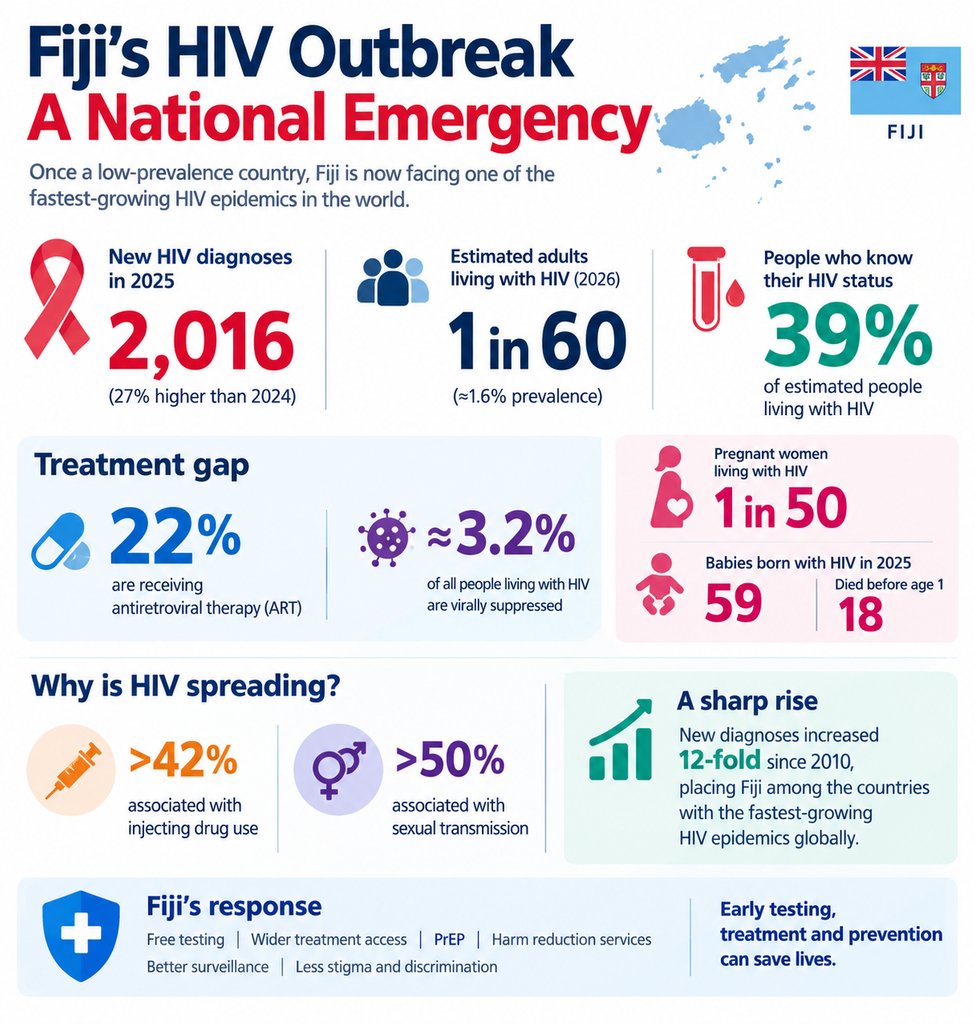
Fiji has declared a national HIV emergency, after a rapid increase in HIV diagnoses transformed what was historically a relatively small epidemic into one of the fastest-growing HIV epidemics in the world.
The declaration was made by Fiji’s Minister for Health and Medical Services on 15 September 2026, following the government’s decision earlier in September that the HIV outbreak constituted a national crisis. Fiji had already declared an HIV outbreak in January 2025, but officials now say an outbreak-level response is no longer sufficient.
The Numbers Behind the Emergency HIV Outbreak
| Indicator | Figure |
| Estimated adults living with HIV, 2026 | ~1 in 60 |
| Estimated prevalence 5 years earlier | ~1 in 167 |
| New HIV diagnoses, 2025 | 2,016 |
| New diagnoses, 2024 | 1,583 |
| Estimated people living with HIV, 2025 | ~9,100 |
| People receiving antiretroviral treatment | 22% |
| Estimated HIV prevalence among pregnant women | ~1 in 50 |
| Babies born with HIV in 2025 | 59 |
| Babies with HIV who died before age 1 | 18 |
The 2,016 diagnoses in 2025 were Fiji’s highest annual total on record, and represented a 27% increase from 2024. However, the Ministry of Health stresses that increased testing and improved surveillance contributed to the rise in reported diagnoses, meaning diagnoses should not automatically be interpreted as equivalent to newly acquired infections.
UNAIDS estimates that Fiji had approximately 9,100 people living with HIV in 2025, but only 39% knew their status and just 22% were receiving antiretroviral therapy (ART). That means a large proportion of people estimated to be living with HIV were either undiagnosed or not receiving treatment.
A Brief Timeline of Fiji’s HIV Epidemic
Fiji’s first HIV-1 diagnosis was reported in 1989. For many years, HIV remained relatively uncommon.
A 2009 scientific review reported 294 confirmed HIV cases at that time. During the first decade after HIV appeared in Fiji, there were generally fewer than 10 diagnoses per year; after 2000, the number increased to approximately 30 diagnoses per year.
By 2011, Fiji had recorded 54 new HIV diagnoses, while historical surveillance data show that 35,518 HIV tests were conducted in 2010 and 37,788 in 2011.
A 2015 review described Fiji as a low-prevalence country, with 508 cumulative HIV cases and an estimated prevalence of only 0.05% of the total population at that time.
The contrast with today is enormous.
The Ministry of Health’s latest surveillance report records 5,676 cumulative diagnosed cases between 1989 and 2025, including 2,016 diagnoses in 2025 alone. In other words, roughly 36% of all recorded diagnoses over 37 years occurred during 2025 alone.
Acceleration Before the 2025 Outbreak Declaration
According to Fiji’s 2025 surveillance data, reported cases were relatively stable between 2018 and 2021, but began rising sharply from 2022. In the Central/Eastern Division, for example, diagnoses increased from 135 in 2022 to more than 1,100 in 2024, before reaching 1,376 in 2025.
WHO reported that Fiji recorded:
- 1,583 new cases in 2024
- 1,226 cases during only the first six months of 2025
- 48% of people starting HIV treatment in 2024 were people who inject drugs.
UNAIDS estimates that the number of new HIV infections increased 12-fold between 2010 and 2025, putting Fiji among the countries experiencing the sharpest recent increases globally.
Why is HIV Spreading So Rapidly?
One of the most important features of Fiji’s current epidemic is the role of injecting drug use, particularly methamphetamine.
A WHO/UNDP assessment found major gaps in access to sterile injecting equipment. Interviews with 56 people who inject drugs found that all participants reported having reused a needle or syringe after someone else at some point because sterile equipment was unavailable.
Among cases where the route of transmission was known, UNAIDS reports that:
- >50% were associated with sexual transmission
- >42% were associated with injecting drug use.
AIDSmap reported an estimated HIV prevalence of approximately 64% among people who inject drugs in Fiji. It also described the epidemic as increasingly spreading beyond traditionally recognised key populations into the wider population.
A worrying mother-to-child transmission signal
Another particularly concerning statistic is the number of infants acquiring HIV.
Fiji reported 59 babies born with HIV in 2025, with 18 dying before reaching their first birthday. That is approximately 1 HIV-positive birth every 6 days and 1 infant death every 20 days, if spread evenly across the year.
The government also estimates that approximately 1 in 50 pregnant women in Fiji is living with HIV.
This is particularly significant because effective HIV testing and antiretroviral treatment during pregnancy can dramatically reduce mother-to-child transmission.
The Treatment Gap is Another Major Problem
The number of people estimated to be living with HIV is much higher than the number diagnosed.
UNAIDS estimates:
~9,100 people living with HIV → only 39% know their status → only 22% are receiving ART.
Among people who knew they had HIV, only around 56% were on treatment, and only approximately 15% of those receiving treatment were virally suppressed. This translated to only about 3.2% of all people living with HIV having an undetectable viral load.
What is Fiji Doing Now?
The emergency response is focusing on expanding several interventions:
- Free HIV testing
- Wider access to antiretroviral treatment
- Expanded PrEP
- Sterile needle and syringe services
- Better access to HIV prevention for people who inject drugs
- Improved surveillance and testing
- Measures to reduce stigma and discrimination
- Greater coordination between government ministries and health organisations.
References
Fiji Ministry of Health and Medical Services. 2025 National HIV Statistics: Summary Report. Suva: Ministry of Health and Medical Services; 2026.
UNAIDS. UNAIDS to support Fiji as it declares HIV a national crisis and puts in new measures to strengthen the response. Geneva: Joint United Nations Programme on HIV/AIDS; 2026 Sep 16.
Lamb K. Fiji declares national HIV emergency as Pacific nation grapples with surge in cases. The Guardian. 2026 Sep 17.
Samuel K. Fiji’s perfect HIV storm. aidsmap. 2026 Aug 1.
Ryan CB, Kama M, Darcy A, Aleksic E, Mirza T, Chaudhary A, et al. HIV type 1 in Fiji is caused by subtypes C and B. AIDS Res Hum Retroviruses. 2009;25(12):1355-1358. doi:10.1089/aid.2009.0175.
Mitchell E. The Fiji national response to HIV and sexually transmitted infections: mapping key successes and challenges. J Pac Stud. 2015;35(1):5-25.