
Floods can create conditions that favour infectious-disease transmission by contaminating drinking-water supplies, damaging sanitation systems, displacing populations, increasing crowding, and creating mosquito and rodent habitats. However, floods do not automatically cause epidemics; the magnitude of a disease outbreak depends on baseline disease transmission, sanitation, environmental conditions, population displacement and the capacity of health systems.
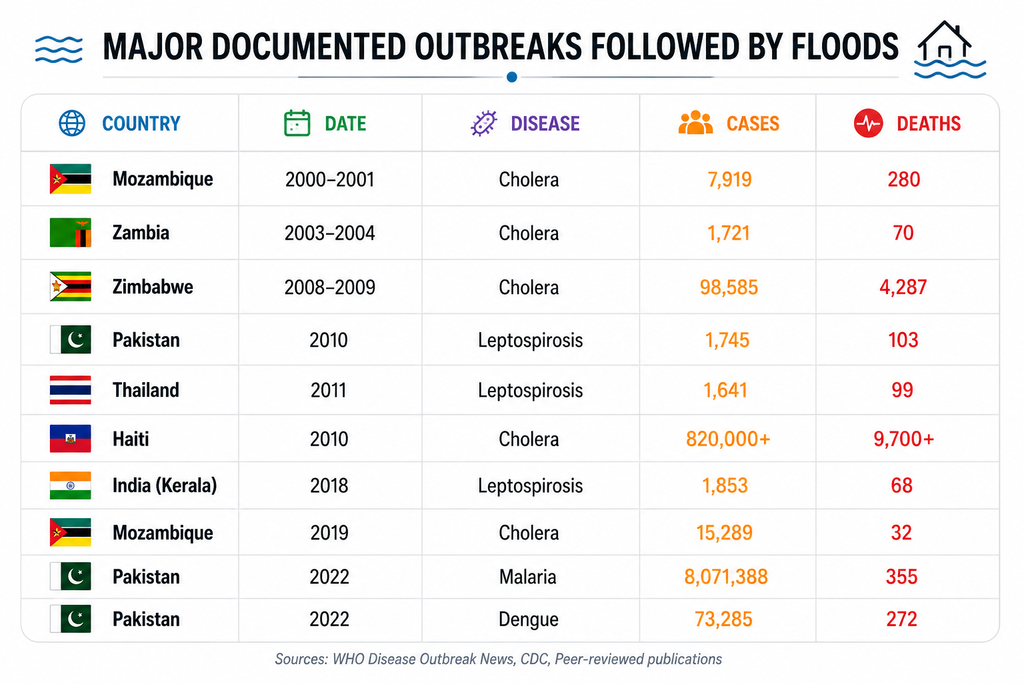
Several well-documented disease outbreaks illustrate the range of diseases that can follow major floods.
Pakistan: 2022 floods and disease outbreaks
Pakistan’s 2022 floods affected more than 33 million people and severely disrupted health infrastructure. The subsequent increase in infectious diseases included diarrhoeal illnesses, malaria, dengue and skin infections.
Data from Sindh showed particularly large increases between the first and second halves of 2022:
| Disease | Cases Before Floods | Cases During/After Floods | Increase in Cases |
| Diarrhoea/dysentery, <5 years | 992,454 | 1,499,022 | 51% |
| Diarrhoea/dysentery, >5 years | 807,573 | 1,329,943 | 65% |
| Acute respiratory infections | 4,041,112 | 5,352,703 | 33% |
| Malaria | 691,197 | 2,615,745 | 278% |
| Dengue | 2,857 | 27,377 | 858% |
| Skin infections | 1,660,346 | 2,878,433 | 73% |
From January–August 2022, Pakistan recorded more than 3.4 million suspected malaria cases, compared with 2.6 million during 2021; more than 170,000 were laboratory-confirmed. In Sindh, confirmed cases in August increased from 19,826 in 2021 to 69,123 in 2022. In Balochistan, they increased from 22,032 to 41,368.
Dengue also surged: 25,932 confirmed cases and 62 deaths were reported nationally between 1 January and 27 September 2022, with 74% of cases occurring in September alone.
Malawi, 2022 floods/cyclones
WHO explicitly linked the 2022 cholera outbreak in Malawi to flooding, displacement and loss of access to safe water, sanitation and hygiene. The disease outbreak initially remained concentrated in flood-affected southern districts before spreading to other parts of the country.
There were 36,943 cases reported with 1,210 deaths by 3 Feb 2023 and CFR (Case Fatality Rate) of 3.3%.
Zimbabwe: 2008-09 Cholera Outbreak
Zimbabwe experienced its largest recorded cholera epidemic from August 2008 to July 2009, with 98,592 cases and 4,288 deaths, giving a case-fatality rate of 4.3%; 60 of 63 districts were affected.
WHO linked the epidemic to severe deterioration of safe water and sanitation infrastructure, a weakened health system and population movement, while the onset of the rainy season increased the risk of further transmission.
Zambia: 2003-04 floods and Cholera
In Zambia, a cholera outbreak occurred during the 2003–04 rainy and flood season, with WHO reporting 1,721 cases and 70 deaths by 22 January 2004, a case-fatality rate of approximately 4.1%.
The disease outbreak affected areas including Lusaka, where peri-urban communities had recently experienced flooding. The connection with flooding was primarily through contaminated water and deteriorating sanitation: flooding and heavy rainfall can overwhelm drainage and sanitation systems, while unsafe water supplies facilitate Vibrio cholerae transmission.
Philippines: Leptospirosis after the 2009 typhoon
One of the clearest examples of a post-flood leptospirosis outbreak occurred in Metro Manila after severe flooding caused by a typhoon on 26 September 2009.
By mid-November, 2,299 suspected cases and 178 deaths had been reported across 15 hospitals, giving a case-fatality ratio of approximately 8%.
A detailed hospital investigation identified 471 hospitalized patients, of whom 51 died (10.8%). Pulmonary haemorrhage was the leading recorded cause of death (35%), followed by acute respiratory distress/severe respiratory failure (24%) and acute renal failure (20%).
The outbreak demonstrates why floodwater exposure is particularly important for leptospirosis: floodwater can become contaminated with urine from infected rodents and other animals.
Malaysia: Leptospirosis after the 2014 Kelantan floods
Across the three-month pre-flood, flood and three-month post-flood periods, 1,229 leptospirosis cases were notified. Incidence doubled during the post-flood period compared with the pre-flood period. The number of subdistricts with incidence above 100 cases per 100,000 population increased from 4 before the flood to 12 after it.
Living close to water bodies and activities such as post-flood garbage clean-up were among the factors associated with increased risk.
India: Cholera after Cyclone Aila, 2009
Following Cyclone Aila in West Bengal in May 2009, a cholera outbreak occurred in the Sundarban region.
Investigators identified 1,076 probable cases and 14 deaths, corresponding to an attack rate of 44 per 10,000 population. Vibrio cholerae O1 El Tor Ogawa was isolated from patient specimens. The outbreak began during the fourth week of May, reached peaks in the second and fourth weeks of June, and continued until August.
Use of contaminated or inadequately treated water was strongly associated with illness.
Mozambique: Floods of 2000 and 2003-04
The January–March 2000 floods in Mozambique provide an important example of a major post-flood increase in endemic disease without a cholera epidemic.
In the most severely affected Hokwe area of Gaza Province, a Japanese Disaster Relief medical team treated 2,611 patients during nine days. Infectious diseases were identified in 85% of patients, mainly malaria, respiratory infections and diarrhoea. Despite concerns about waterborne disease, no outbreak of cholera or dysentery was detected.
Malaria incidence increased approximately four- to five-fold compared with non-disaster periods, while drinking-water quality deteriorated substantially.
According to WHO, 15,237 cases of Cholera and 85 deaths were reported by 18 March 2004 across seven provinces of Mozambique in 2003-04 after heavy rainfall and flooding contributed to difficult control conditions.
Mozambique: Cyclone Idai, 2019
Nearly two decades later, Mozambique experienced another major flood-related infectious-disease emergency following Cyclone Idai in March 2019.
The cyclone and associated flooding affected millions of people. By August 2019, Mozambique had reported 6,768 confirmed cholera cases and 8 cholera deaths following the disaster. The wider humanitarian impact included approximately 2.5 million people requiring humanitarian assistance.
Malaria transmission also became a major concern. WHO reported 104,850 cumulative malaria cases in Idai-affected districts between 27 March and 28 July 2019.
China: Bacillary dysentery and flooding
An analysis of Dalian, China, from 2004–2010 examined the relationship between flooding and bacillary dysentery.
During the study period, 18,976 cases of bacillary dysentery were reported. Flooding was associated with a statistically significant increase in disease risk, with a relative risk of 1.17 (95% CI 1.03–1.33) and an approximately two-week lag between flooding and increased cases.
The finding supports the importance of delayed surveillance after floods rather than limiting disease monitoring to the immediate disaster period.
Greece: Leptospirosis after Storm Daniel, 2023
Flood-associated leptospirosis has also been documented in Europe. After Storm Daniel caused catastrophic flooding in Thessaly, Greece, in September 2023, a marked increase in leptospirosis occurred.
During the approximately three-month post-flood period, 285 probable and 45 laboratory-confirmed cases were identified. The post-flood notification rate reached 6.5 cases per 100,000 population.
A separate case series from the University Hospital of Larissa identified 13 confirmed cases among 35 patients investigated between late September and early November 2023. 84.6% of confirmed cases were associated with direct floodwater contact.
Kerala, India: Leptospirosis after the 2018 floods
The severe 2018 Kerala floods were also associated with increased leptospirosis transmission. In Alappuzha district, 254 leptospirosis cases and 6 deaths were reported during 2018, compared with 204 cases and 2 deaths in 2017.
What the global evidence shows
The disease outbreaks reported across Asia, Africa, Europe and other regions show several recurring patterns:
- Leptospirosis is one of the most consistently documented post-flood infections, particularly where people wade through contaminated water or participate in clean-up activities.
- Diarrhoeal diseases, cholera and dysentery can increase when floods contaminate drinking-water and sanitation systems.
- Malaria and dengue may increase when flooding creates favourable mosquito-breeding conditions and disrupts vector-control activities. Pakistan provides an especially large-scale example.
- Respiratory infections can increase among displaced populations living in crowded conditions.
- Skin and soft-tissue infections may increase because of prolonged exposure to contaminated water and disrupted hygiene.
- The timing is variable: some infections rise within days to weeks, while others may increase over subsequent weeks as mosquito populations, environmental contamination and population displacement evolve.
Nepal’s August 2026 flood: What could happen next?
Nepal’s current disaster is particularly concerning because it is not simply a conventional monsoon flood.
On 26 August 2026, severe flash flooding affected communities along the Bhote Koshi and Trishuli river corridors, with Rasuwa, Nuwakot, Dhading, Chitwan, Gorkha and Tanahun among the affected districts.
Nepal should be especially alert to cholera because the country has demonstrated that it can experience outbreaks under favourable environmental conditions.
In August 2025, an acute watery diarrhoea outbreak in Birgunj rapidly exceeded 600 cases, with 187 active cases by 28 August and laboratory confirmation of Vibrio cholerae in samples.
That history matters for the 2026 flood response. If floodwater contaminates drinking-water systems in affected communities, an existing vulnerability to acute watery diarrhoea/cholera could be amplified.
The biggest immediate infectious-disease concern is not necessarily a single dramatic epidemic, but a combination of acute diarrhoeal disease, respiratory infections and skin/wound infections, followed by possible increases in leptospirosis and mosquito-borne diseases.
However, it would be premature to predict a cholera, leptospirosis, malaria or dengue disease outbreak solely from the flood. The outcome will depend heavily on how quickly safe water, sanitation, surveillance, vector control and healthcare services are restored.
References
World Health Organization. Nepal: flash floods and health response [Internet]. Geneva: WHO; 2026 [cited 2026 Sep 3].
World Health Organization. Cholera in Chad, Mozambique and Zambia [Internet]. Geneva: WHO; 2004 Jan 28 [cited 2026 Sep 3].
World Health Organization. Cholera in Zimbabwe [Internet]. Geneva: WHO; 2008 Dec 2 [cited 2026 Sep 3].
Centers for Disease Control and Prevention. Floodwater safety guidelines [Internet]. Atlanta: CDC; 2024 [cited 2026 Sep 3].
Disease outbreaks following floods: a systematic review. 2024. PubMed Central.
Flooding and infectious diseases: global evidence and post-disaster risks. 2018. PubMed Central.
Leptospirosis following flooding in Malaysia. 2018. PubMed Central.
Post-flood infectious diseases in Mozambique. Prehosp Disaster Med. Cambridge University Press.
Outbreaks following natural disasters: a review of the literature. Disaster Med Public Health Prep. Cambridge University Press.
Infectious diarrhoea risks as a public health emergency in floods: a systematic review and meta-analysis. 2024.

Pingback: The History of Cholera: From Ancient India to a Global Pandemic - Disease Buddy