A personalized cancer Melanoma vaccine developed by Moderna and Merck has produced positive results in a large Phase 3 clinical trial, marking an important milestone for mRNA technology in cancer treatment.
On 19 August 2026, the companies announced that their investigational therapy, intismeran autogene—also known as V940 or mRNA-4157—met both its primary and a key secondary endpoint in patients with high-risk melanoma.
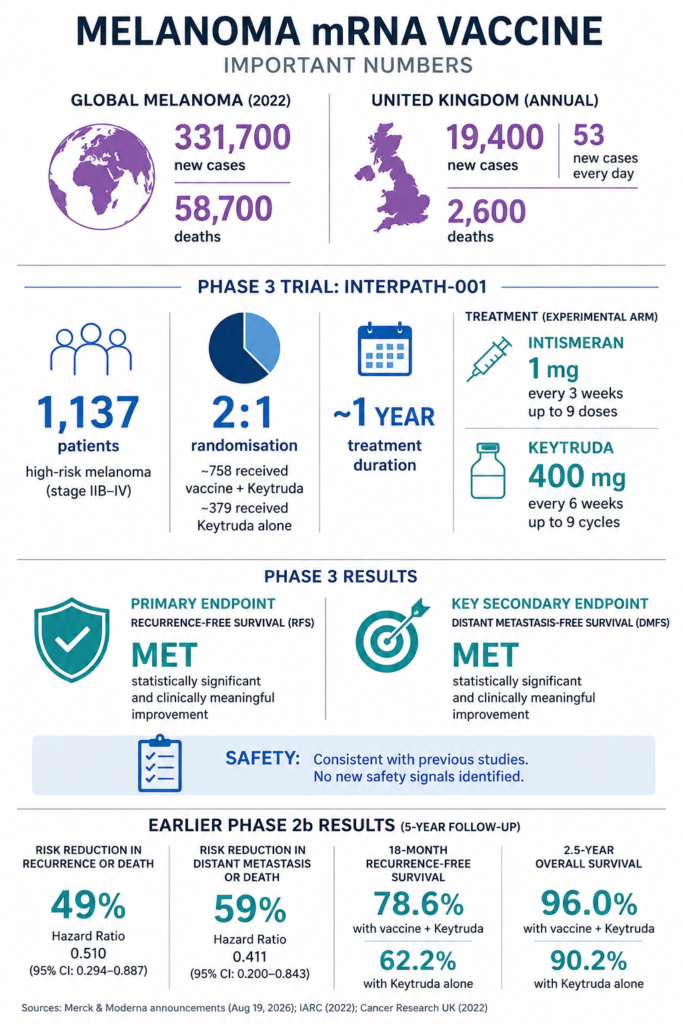
The Phase 3 INTerpath-001 trial involved 1,137 patients with completely resected stage IIB, IIC, III or IV melanoma. The melanoma vaccine was tested in combination with Merck’s immunotherapy pembrolizumab (Keytruda) and compared with pembrolizumab alone.
The results are significant, but the precise Phase 3 hazard ratios, event numbers and absolute recurrence percentages have not yet been disclosed.
Why This Matters: The Global Melanoma Burden
According to the International Agency for Research on Cancer (IARC), approximately 331,700 people were diagnosed with melanoma worldwide in 2022, while about 58,700 died from the disease.
According to National Cancer Institute, more than 1.5 million people were living with melanoma in the US, in 2023.
Cancer Research UK estimates that around 19,400 people develop melanoma every year in the UK, equivalent to approximately 53 new cases every day. Around 2,600 people die from melanoma each year.
The number of cases is increasing. Cancer Research UK reported in 2026 that more than 20,000 people were diagnosed with melanoma in the UK in 2022, and projected that annual cases could reach approximately 26,500 by 2040 if current trends continue.
What was tested?
The treatment being studied is called intismeran autogene.
Unlike conventional vaccines designed to prevent an infection, this is a therapeutic cancer vaccine. It is intended to help the immune system recognise and attack a patient’s own cancer cells.
The process begins with a sample of the patient’s tumour. Researchers analyse the tumour’s mutations and identify cancer-specific targets called neoantigens. The resulting treatment is individually designed for that patient.
According to Moderna and Merck, each vaccine can encode up to 34 neoantigens selected from the patient’s tumour. The mRNA then provides instructions that enable cells to produce these tumour-associated targets, helping stimulate a targeted immune response involving T cells.
In simple terms:
Tumour sample → genetic analysis → identification of mutations → personalised mRNA melanoma vaccine → immune system trained to recognise tumour-specific targets.
The Phase 3 Trial: 1,137 Patients
The most important new evidence comes from INTerpath-001, a global Phase 3 clinical trial.
The study enrolled:
- 1,137 patients
- Melanoma stages IIB through IV
- Patients had undergone complete surgical removal of their melanoma
- Patients had not previously received systemic treatment for their melanoma
- Participants were randomised in a 2:1 ratio
- The study was randomised and double-blind
- It compared intismeran + pembrolizumab against pembrolizumab alone.
Based on the 2:1 randomisation, approximately 758 patients would have received the intismeran combination and approximately 379 the control treatment, although the exact final allocation should be taken from the full trial dataset when published.
Treatment schedule
Patients receiving the experimental combination received:
Intismeran
- 1 mg
- Every 3 weeks
- Up to 9 doses
Pembrolizumab
- 400 mg
- Every 6 weeks
- Up to 9 cycles
- Approximately one year of treatment
The control group received pembrolizumab alone, with placebo replacing the personalised vaccine. Treatment could end earlier because of recurrence, unacceptable toxicity or other protocol-defined reasons.
What did the Phase 3 Trial find?
The trial successfully met its primary endpoint: recurrence-free survival (RFS).
It also met a key secondary endpoint: distant metastasis-free survival (DMFS).
Both improvements were described by the companies as statistically significant and clinically meaningful compared with pembrolizumab alone.
What is recurrence-free survival?
Recurrence-free survival measures the length of time after treatment before a patient experiences a recurrence of cancer or dies.
For this trial, recurrence included local, locoregional, regional or distant recurrence.
What is distant metastasis-free survival?
DMFS measures the time before melanoma spreads to distant parts of the body or the patient dies.
This endpoint is particularly important in melanoma because distant spread is associated with substantially more difficult-to-treat disease.
The Phase 3 results therefore suggest that adding the personalised mRNA treatment to pembrolizumab can keep high-risk melanoma patients free from recurrence and distant metastatic disease for longer than pembrolizumab alone.
The earlier Phase 2 results were already promising
Before the Phase 3 result, Moderna and Merck had reported five-year follow-up data from the KEYNOTE-942/mRNA-4157-P201 Phase 2b trial.
That study involved patients with high-risk stage III/IV melanoma following complete surgical removal.
At a median follow-up of 60.3 months, the combination of intismeran and pembrolizumab produced:
- 49% reduction in the risk of recurrence or death
- 59% reduction in the risk of distant metastasis or death
compared with pembrolizumab alone.
What did the earlier trial actually look like?
The earlier randomised Phase 2 study included 157 patients.
Of these:
- 107 received intismeran + pembrolizumab
- 50 received pembrolizumab alone
At the earlier analysis, recurrence or death occurred in:
- 24 of 107 patients (22.4%) in the combination group
- 20 of 50 patients (40%) in the pembrolizumab-only group.
At 18 months, recurrence-free survival was:
78.6% with the combination
versus
62.2% with pembrolizumab alone.
That represented a 44% reduction in the risk of recurrence or death in the initial analysis.
The longer five-year follow-up subsequently showed that the benefit remained substantial, with the risk reduction reaching 49%.
What about side effects?
The safety profile is another important part of the story.
The companies reported that the Phase 3 safety profile was consistent with previous studies and that no new safety signals were identified.
In the earlier Phase 2 experience, the most commonly reported treatment-related adverse effects associated with the combination included:
- Fatigue: 60.6%
- Injection-site pain: 56.7%
- Chills: 49.0%
Most adverse events attributed to intismeran were grade 1 or 2.
The earlier study reported grade 3 or higher treatment-related adverse events in approximately 25% of patients in the combination group compared with 18% in the pembrolizumab-only group.
These figures should again be distinguished from the Phase 3 safety dataset, for which the detailed numerical results have not yet been released.
Why combine the vaccine with Keytruda?
The two treatments are designed to work in different but potentially complementary ways.
Intismeran is intended to teach the immune system to recognise tumour-specific neoantigens.
Pembrolizumab, meanwhile, is an immune checkpoint inhibitor. It blocks the PD-1 pathway, which cancer cells can exploit to suppress immune responses.
The idea is therefore:
Personalised vaccine → identifies the cancer
Pembrolizumab → helps prevent the immune response from being switched off
Together, the two approaches may generate a stronger anti-cancer immune response than either strategy alone.
This is not yet a standard cancer vaccine
Despite the headlines, intismeran is not yet an approved routine cancer vaccine. It remains an investigational therapy.
The positive Phase 3 topline result is an important step, but regulators will need to assess the complete clinical dataset, including efficacy, safety and other relevant information.
The companies have said they intend to discuss the results with regulatory authorities and prepare potential regulatory submissions.
Could the technology work against other cancers?
Melanoma is currently the leading indication, but Moderna and Merck are testing the same personalised neoantigen approach in other cancers.
The companies currently have nine Phase 2 and Phase 3 clinical trials within their broader intismeran development programme, covering cancers including:
- Melanoma
- Non-small-cell lung cancer
- Bladder cancer
- Renal cell carcinoma
References
Merck and Moderna — Phase 3 INTerpath-001 results — primary source for the 1,137-patient Phase 3 trial, treatment schedule, endpoints and study design.
Moderna — INTerpath-001 announcement — primary company announcement of the Phase 3 topline results and broader development programme.
Merck — Five-year Phase 2b results — detailed five-year data, including the 49% and 59% risk reductions.
American Association for Cancer Research — KEYNOTE-942 Phase 2 results — earlier patient-level recurrence and 18-month RFS figures.
Cancer Research UK — Melanoma statistics — UK incidence, mortality and survival statistics.
International Agency for Research on Cancer — Skin cancer statistics — global melanoma incidence and mortality estimates.