
Introduction: Measles was Controlled, Not Eradicated
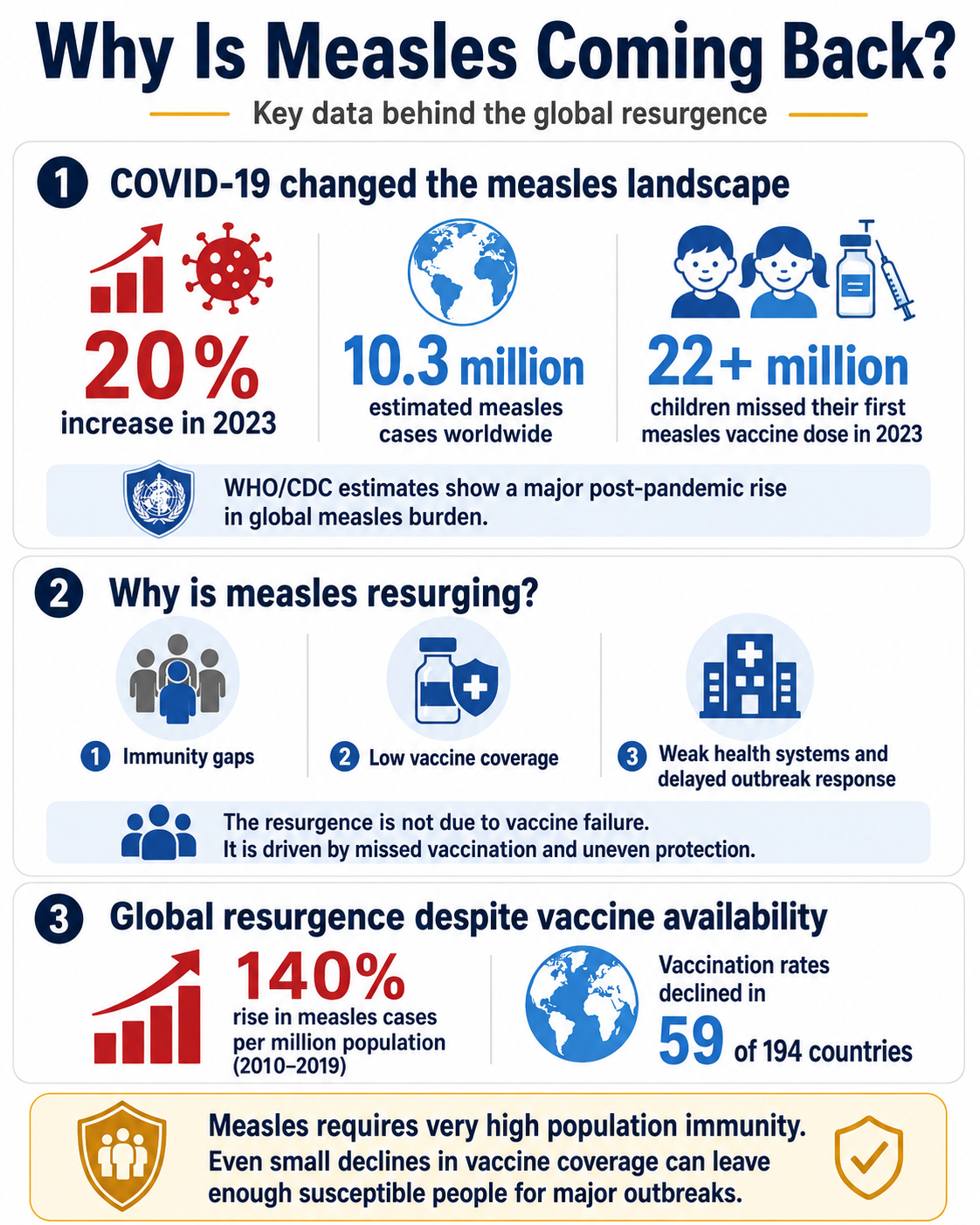
COVID-19 pandemic completely changed the scenario of measles globally. A 20% increase was reported in 2023, with an estimated 10.3 million measles cases worldwide. WHO/CDC estimates that more than 22 million children missed their first measles vaccine dose in 2023.
The reason for measles resurgence across multiple regions is not due to vaccination failure. It is because of the immunity gaps, led by vaccine coverage, weak health systems in lower-income settings, and delayed outbreak response.
Global Resurgence Despite Vaccine Availability
A 2024 analysis of WHO member countries clearly showed a increase of 140% in measles cases per million population from 2010 to 2019. The same study reported that vaccination rates declined in 59 out of 194 countries. Measles require very high population immunity, and even small decline in coverage can create enough space for major outbreaks.
The global pattern showing measles incidence was significantly associated with literacy, income, political stability, and vaccine accessibility in low- and middle-income countries. However, it was completely different in high-income countries. The study suggested that the major cause of incidence in these regions was vaccine hesitancy.
Measles resurgence shows how quickly vaccine-preventable diseases can return when immunity gaps grow. A similar lesson is seen in Ebola outbreaks and public-health response, where delayed detection, weak surveillance, and poor outbreak response can allow localised infections to become major public-health emergencies.
The United States: Increasing Cases Despite Measles Elimination in 2000
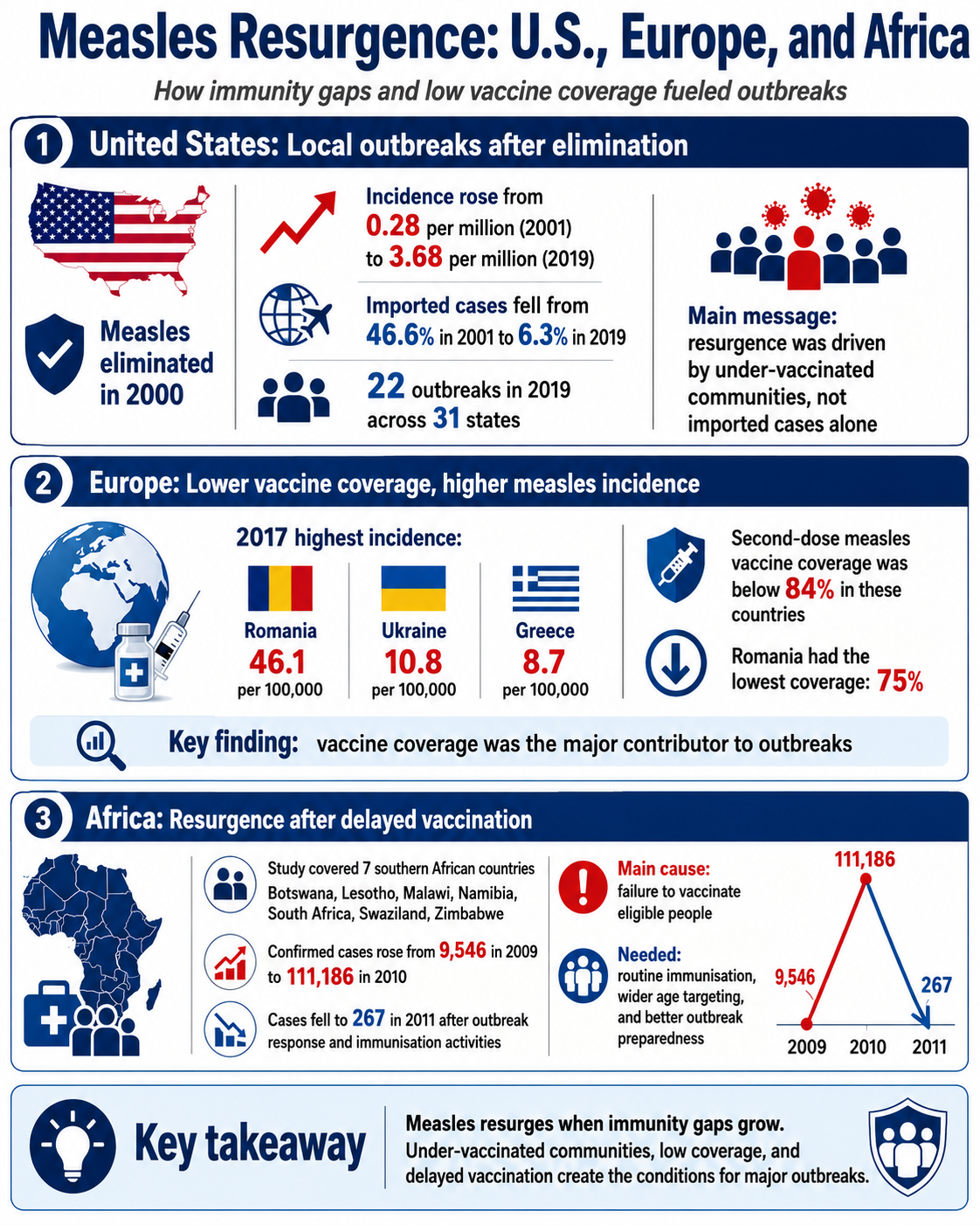
Measles was declared eliminated in 2000 from the United States, but the chances of future incidence remained. A study reported the rise of measles incidence from 0.28 per million population in 2001 to 3.68 per million population in 2019 among US residents. As the imported cases declined from 46.6% in 2001 to 6.3% in 2019, susceptibility to local outbreaks increased significantly.
There were 22 measles outbreaks in 2019 in 31 states of the United States, which almost came close to the US losing its measles elimination status. This suggests that measles resurgence in the US was driven by outbreaks in under-vaccinated communities, and not by imported cases alone.
Europe: Lower Vaccine Coverage Resulting Measles Incidence
A study analysed the resurgence of measles in the Europe, and found that vaccine coverage was the significant contributor to the outbreaks. It found that measles incidence in 2017 was highest in Romania at 46.1 cases per 100,000 population, followed by Ukraine at 10.8 per 100,000 and Greece at 8.7 per 100,000. In these countries, the second-dose measles vaccine coverage was below 84%, with Romania reporting the lowest coverage at 75%.
Africa: Measles Resurgence after Delayed Vaccination
The accumulation of susceptible people overtime led to increased measles incidence in Africa. A study performed from 1996 to 2011 in 7 southern African countries, namely Botswana, Lesotho, Malawi, Namibia, South Africa, Swaziland, and Zimbabwe, reported that confirmed cases rose sharply from 9,546 in 2009 to 111,186 in 2010, before falling to 267 in 2011 after outbreak response and immunisation activities.
The study concluded failure to vaccinate eligible people as the major reason for the outbreak. It further suggested the need for routine immunisation, wider age targeting and better outbreak preparedness, to prevent resurgence of measles.
The Post-Covid Effect: Missed Children and Larger Gaps
It is reported that WHO warned in February 2024 that more than half of the world’s countries could expect significant measles outbreaks. The estimation came as a result of disruption in routine immunisation services in many countries during the COVID-19 pandemic. Children remained susceptible and measles was introduced into the communities with immunity gaps.
The measles comeback also connects with the wider problem of missed infections and weak health systems. In missing millions in tuberculosis tracking showing how gaps in detection and healthcare access can silently sustain disease transmission.
In overall, falling vaccine coverage is one of the main drivers of measles resurgence. It is found that global first-doses coverage was 83% in 2023, and second-dose coverage was 74%, below the 95% target needed to prevent outbreaks. Restoring and maintaining this number along with identification of under-vaccinated communites and better preparedness for outbreaks can be a clear solution to prevent resurgence of measles outbreaks as shown by the data.
References
Bidari, S., & Yang, W. (2024). Global resurgence of measles in the vaccination era and influencing factors. International Journal of Infectious Diseases, 147, 107189. https://doi.org/10.1016/j.ijid.2024.107189
Dimala, C. A., Kadia, B. M., Nji, M. A. M., & Bechem, N. N. (2021). Factors associated with measles resurgence in the United States in the post-elimination era. Scientific Reports, 11, Article 51. https://doi.org/10.1038/s41598-020-80214-3
Feemster, K. A., & Szipszky, C. (2020). Resurgence of measles in the United States: How did we get here? Current Opinion in Pediatrics, 32(1), 139–144. https://doi.org/10.1097/MOP.0000000000000845
Leong, W.-Y., & Wilder-Smith, A. B. (2019). Measles resurgence in Europe: Migrants and travellers are not the main drivers. Journal of Epidemiology and Global Health, 9, 294–299. https://doi.org/10.2991/jegh.k.191007.001
Parums, D. V. (2024). A review of the resurgence of measles, a vaccine-preventable disease, as current concerns contrast with past hopes for measles elimination. Medical Science Monitor, 30, e944436. https://doi.org/10.12659/MSM.944436
Shibeshi, M. E., Masresha, B. G., Smit, S. B., Biellik, R. J., Nicholson, J. L., Muitherero, C., Shivute, N., Walker, O., Reggis, K., & Goodson, J. L. (2014). Measles resurgence in southern Africa: Challenges to measles elimination. Vaccine, 32(16), 1798–1807. https://doi.org/10.1016/j.vaccine.2014.01.089
World Health Organization. (2024, November 14). Measles cases surge worldwide, infecting 10.3 million people in 2023. https://www.who.int/news/item/14-11-2024-measles-cases-surge-worldwide–infecting-10.3-million-people-in-2023
Pingback: Measles: Complete Guide to Symptoms, Causes, Transmission, Prevention and Global Impact - Disease Buddy
Pingback: The Shocking Economics of MMR Vaccine: What Measles Outbreaks Really Cost the United States - Disease Buddy