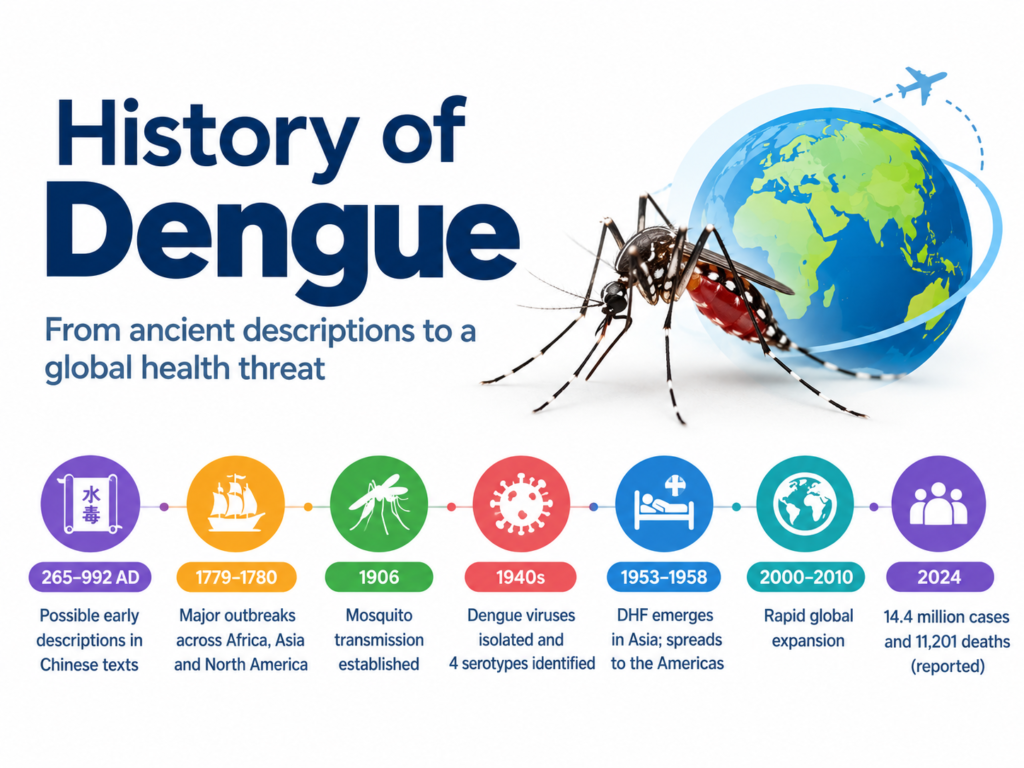
Dengue has entered a period of unusually high global transmission. The Americas experienced an extraordinary peak in 2024 followed by a substantial decline in 2025–2026, while some parts of Asia and Europe continue to show persistent or emerging transmission.
Dengue by the numbers
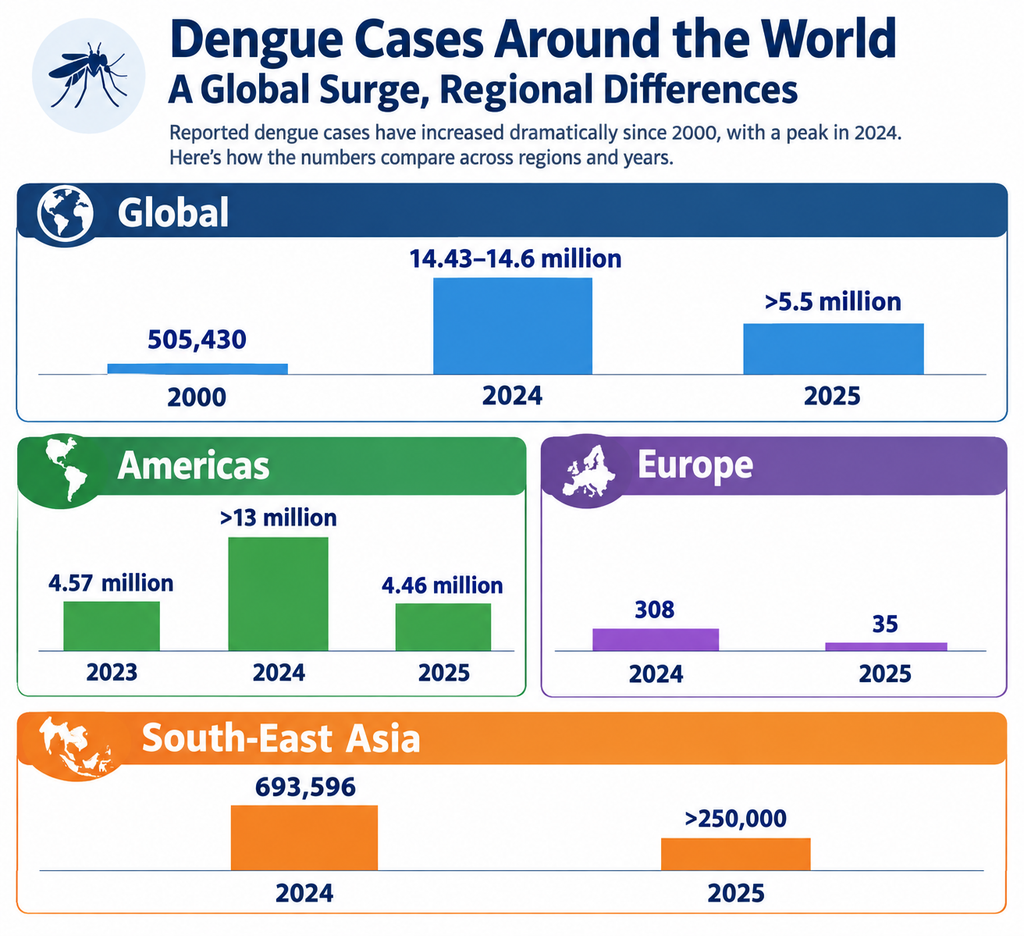
According to the World Health Organization, reported dengue cases increased from 505,430 in 2000 to 14.6 million in 2024, which is almost a 29-fold increase in reported cases. WHO recorded more than 12,000 dengue-related deaths in 2024, making it the largest reported annual dengue-related deaths till date.
| Year | Region or country | Dengue reported cases |
| 2000 | Global | 505,430 |
| 2024 | Global | 14.43-14.6 million |
| 2025 | Global | >5.5 million |
| 2023 | Americas | 4.57 million |
| 2024 | Americas | >13 million |
| 2025 | Americas | 4.46 million |
| 2024 | Europe | 308 |
| 2025 | Europe | 35 |
| 2024 | South-East Asia | 693,596 |
| 2025 | South-East Asia | >250,000 |
The Americas: an extraordinary rise followed by a sharp decline
In 2023, the region reported approximately 4.57 million cases, already its highest annual total at the time. By the end of April 2024, however, the region had already recorded 7.52 million suspected cases, including 3.53 million laboratory-confirmed cases and 3,504 deaths. That was about three times the number recorded during the same period in 2023.
The eventual 2024 burden exceeded 13 million reported cases, with Brazil accounting for more than 10 million.
However, in 2025, the Americas recorded:
- 4,459,521 suspected cases
- 1,682,588 confirmed cases
- 8,966 severe cases
- 2,207 deaths
- 0.05% case-fatality rate
Compared with 2024, cases declined by 66% and deaths by 74%.
The decline continued in 2026. By the end of August 2026, the Americas had recorded 1,569,789 cases, a 60% reduction in cases compared with the same period in 2025.
Brazil: the centre of the 2024 surge
WHO reported more than 10 million dengue cases in Brazil during 2024, alongside 6,321 deaths.
During the first four months alone, Brazil had already reported 6.30 million suspected cases, including approximately 3.04 million laboratory-confirmed cases.
All four dengue serotypes were simultaneously circulating in several countries in the Americas, including Brazil, Costa Rica, Guatemala, Honduras, Mexico and Panama.
South and Southeast Asia: the pattern is more mixed
Asia did not experience exactly the same trajectory as the Americas.
WHO reported significant outbreaks in Indonesia, India, Bangladesh, Nepal and Thailand during 2024. Indonesia had recorded 88,593 confirmed cases and 621 deaths by 30 April 2024, approximately three times the number during the same period of 2023. Bangladesh, Nepal and Thailand also reported more cases than during the corresponding period of 2023.
For the whole of 2024, WHO reported:
- Indonesia: 257,271 cases
- India: 232,425 cases
The broader South-East Asia and Western Pacific regions together recorded more than 1 million cases, with major contributions from Bangladesh, India, Indonesia, Malaysia and Viet Nam.
The trend therefore cannot be described simply as “dengue is rising everywhere.” Some countries experience epidemic peaks while others decline or shift geographically.
Europe: still relatively small numbers, but a different trend
Europe’s absolute dengue burden remains tiny compared with Latin America and Asia, but locally acquired transmission has become increasingly important.
Historically, mainland European dengue was overwhelmingly travel-associated. However, the invasive Aedes albopictus mosquito is now established across much of southern Europe. ECDC notes that locally acquired dengue outbreaks and cases increased considerably between 2021 and 2024.
| Year | France | Italy | Spain |
| 2022 | 65 | 0 | 6 |
| 2023 | 45 | 82 | 3 |
| 2024 | 83 | 213 | 8 |
| 2025 | 29 | 4 | – |
These are locally acquired cases, rather than imported infections.
The pattern also shows why individual years should not be interpreted as a straight upward trend. France and Italy had fewer locally acquired cases in 2025 than in 2024.
However, transmission has not disappeared.
As of 23 September 2026, ECDC reported 47 locally acquired cases in Italy across seven clusters and five cases in France across four clusters. All seven Italian clusters were still active at that reporting date.
So Europe currently shows a pattern of sporadic but increasingly established seasonal transmission, rather than the enormous epidemic burden seen in Brazil or other tropical regions.
Why is dengue increasing?
Several factors are occurring simultaneously.
1. Warmer temperatures
Temperature affects mosquito survival, biting activity and the rate at which dengue virus develops inside mosquitoes. WHO identifies increasing temperature, rainfall and humidity among factors associated with dengue’s expanding risk.
2. Expansion of Aedes mosquitoes
Aedes aegypti and Aedes albopictus have expanded into areas that previously had limited or no dengue transmission.
Europe provides a particularly important example: Aedes albopictus is now established in 13 EU countries, according to ECDC.
3. Urbanisation
Dengue thrives particularly well in environments where mosquitoes have access to numerous small water containers and large human populations.
The scientific literature identifies urbanisation, population density and human mobility as important contributors to dengue’s expansion.
4. International travel and movement
An infected traveller can introduce dengue into a region containing competent Aedes mosquitoes. This is particularly important in Europe and other areas where dengue is not yet continuously endemic.
5. Population immunity and serotypes
Dengue is unusual because infection with one serotype does not provide lifelong immunity against all four serotypes. Consequently, changes in serotype circulation can alter the size of the susceptible population and the severity profile of subsequent outbreaks.
6. Surveillance differences
Reported cases are not equivalent to total infections. WHO notes that many infections are asymptomatic or mild and that surveillance and reporting capacity varies considerably between countries. Therefore, apparent increases can reflect both genuine transmission and improved detection.
Future of Dengue: What happens next?
The most important finding from long-term modelling is that dengue does not necessarily increase forever.
A Nature Communications study modelled dengue across eight Southeast Asian countries through 2099, incorporating climate, population and socioeconomic scenarios. It projected that dengue incidence would generally increase in the short-to-medium term, reach a peak, and subsequently decline, but with major differences between countries.
The model projected increasing incidence in areas including:
- Malaysia
- Singapore
- Indonesia
- southern Philippines
- parts of Vietnam and Laos
while decreases were projected across substantial parts of:
- Cambodia
- Thailand
- southern Vietnam
- northern Philippines.
By 2080, the model projected that Indonesia, the Philippines, Malaysia and Vietnam could account for approximately 93% of Southeast Asia’s dengue cases, compared with a much more distributed burden historically.
One of the most interesting findings from the modelling is that population growth could have a larger effect on total dengue burden than climate change alone. Thus, dengue cannot be explained simply by global warming, population growth, urbanisation, economic development and climate.
References
World Health Organization. Dengue: global situation, surveillance and progress – 2024 update.Weekly Epidemiological Record. 2025;100:665–678.
World Health Organization. Dengue and severe dengue – Fact sheet. WHO. Updated 2025.
Anand A, et al. An urgent call for action: addressing the unprecedented rise in dengue cases in the Americas.Ann Med Surg (Lond). 2024;86:3814–3815.
Mohapatra RK, et al. Global health concern on the rising dengue and chikungunya cases in the American regions: Countermeasures and preparedness.Health Sci Rep. 2024.
Colón-González FJ, et al. Projecting the future incidence and burden of dengue in Southeast Asia.Nature Communications. 2023;14:5439.
Wheaton NW, et al. Uncovering the surge: dengue fever on the rise.Frontiers in Epidemiology. 2025;5.
European Centre for Disease Prevention and Control. Historical data on local transmission of dengue in the EU/EEA.
Pan American Health Organization. PAHO updates dengue situation in the Americas. 20 February 2026.