
Key Takeaways
- Cyclosporiasis is an intestinal infection caused by Cyclospora cayetanensis.
- The parasite is primarily transmitted through fecally contaminated food or water.
- Fresh produce is an important vehicle of infection.
- Direct person-to-person transmission is unlikely because oocysts require approximately 1–2 weeks to become infectious.
- Watery diarrhea is the most common symptom.
- Symptoms usually begin approximately one week after infection.
- Illness can persist for weeks or longer than a month and may relapse.
- Diagnosis requires specific stool testing, and Cyclospora may not be included in routine testing.
- Trimethoprim-sulfamethoxazole (TMP-SMX) is the treatment of choice.
- A 2024 meta-analysis estimated global prevalence at 3.4%, based on 166,611 people from 42 countries.
- The highest pooled prevalence in that analysis was 5.9% in Africa.
- In the United States, most domestically acquired cases historically occur during May–August.
- As of August 5, 2026, CDC reported 6,358 cases, 278 hospitalizations and 2 deaths in the ongoing iceberg-lettuce-associated multistate outbreak.
- The 2026 outbreak demonstrates the continuing importance of food safety, surveillance, laboratory diagnosis and international supply-chain monitoring.
Introduction
Cyclosporiasis is an intestinal infection caused by Cyclospora cayetanensis, a microscopic coccidian parasite that primarily affects the small intestine. The infection is transmitted through the fecal–oral route, most often when people consume food or water contaminated with infectious Cyclospora oocysts.
The disease is particularly important from a food-safety perspective because outbreaks have repeatedly been associated with fresh fruits and vegetables, including berries, cilantro, basil, salad mixes and lettuce. Cyclosporiasis is most common in tropical and subtropical regions, but cases also occur in countries such as the United States through international travel and contaminated imported produce.
History
The first documented human infections now recognized as cyclosporiasis date back to 1977–1978. At that time, the organism was poorly understood and was described using terms such as a “cyanobacterium-like body” or “coccidian-like body.” Researchers gradually established that it was a protozoan parasite rather than an alga or bacterium.
In the early 1990s, researchers led by Ortega characterized the organism as a new human coccidian. The species was subsequently named Cyclospora cayetanensis.
The parasite gained major public-health attention during the 1996 North American outbreak, when 1,465 cases were reported across 20 U.S. states, the District of Columbia and two Canadian provinces. Epidemiological investigations ultimately implicated imported Guatemalan raspberries.
Global Epidemiology: Cyclosporiasis in Numbers
Cyclosporiasis is geographically widespread, but its true global burden is difficult to determine because testing and surveillance are inconsistent between countries.
A 2024 systematic review and meta-analysis derived from datasets from 42 countries provides analysis and estimated prevalence of the disease around the world. The researchers also found that children were more susceptible to infection than adults.
| Population/Region | Estimated Prevalence |
| Global | 3.4% |
| Africa | 5.9% |
| Low-income countries | 7.6% |
| Lower-middle-income countries | 4.8% |
| Upper-middle-income countries | 2.9% |
| High-income countries | 0.4% |
Where is cyclosporiasis most common?
Cyclospora cayetanensis is particularly associated with tropical and subtropical regions. Cases have been documented throughout Central and South America, the Caribbean, South and Southeast Asia, and parts of Africa.
The United States has conducted national surveillance for cyclosporiasis since it became a nationally notifiable disease in 1999.
CDC surveillance for 2011–2015 identified:
- 2,207 reported cases
- 1,988 confirmed cases (90.1%)
- 219 probable cases (9.9%)
- Annual reported cases ranged from 130 in 2012 to 798 in 2013
- Population-adjusted incidence ranged from 0.05 to 0.29 cases per 100,000
- 1,384 cases (62.7%) were classified as domestically acquired
- 415 cases (18.8%) were travel-associated
- 408 cases (18.5%) had unknown travel status
- 6.7% of patients with available information were hospitalized
According to CDC, 92.9% of domestically acquired cases with known onset information occurred during May–August.
What Causes Cyclosporiasis?
Cyclosporiasis is caused by the protozoan parasite Cyclospora cayetanensis.
The parasite belongs to the coccidia, a group of microscopic parasites. Humans are the only known hosts of C. cayetanensis.
Infected people pass immature oocysts in their stool. These freshly excreted oocysts are not immediately infectious. They need time outside the human body to undergo maturation, or sporulation.
This unusual feature is important because it helps explain why direct person-to-person transmission is unlikely.
The parasite’s life cycle therefore creates an environmental stage between one infected person and the next susceptible person.
How is Cyclosporiasis Transmitted?
The main route of transmission is fecal–oral transmission.
A simplified transmission pathway is:
Infected person → feces → environment → food/water → another person
1. Oocysts are shed in feces
An infected person releases Cyclospora oocysts through bowel movements.
2. Oocysts mature in the environment
The freshly passed oocysts require approximately 1–2 weeks under suitable environmental conditions to become infectious.
3. Food or water becomes contaminated
Mature infectious oocysts can contaminate water or fresh produce through fecal contamination.
4. People consume contaminated food or water
Eating contaminated raw or minimally processed produce can result in infection.
Why person-to-person transmission is unlikely?
Because freshly excreted oocysts need time to become infectious, an infected person is unlikely to transmit the infection directly to another person immediately after passing stool.
This characteristic distinguishes Cyclospora from pathogens that can be transmitted directly through recently shed organisms.
Symptoms of Cyclosporiasis
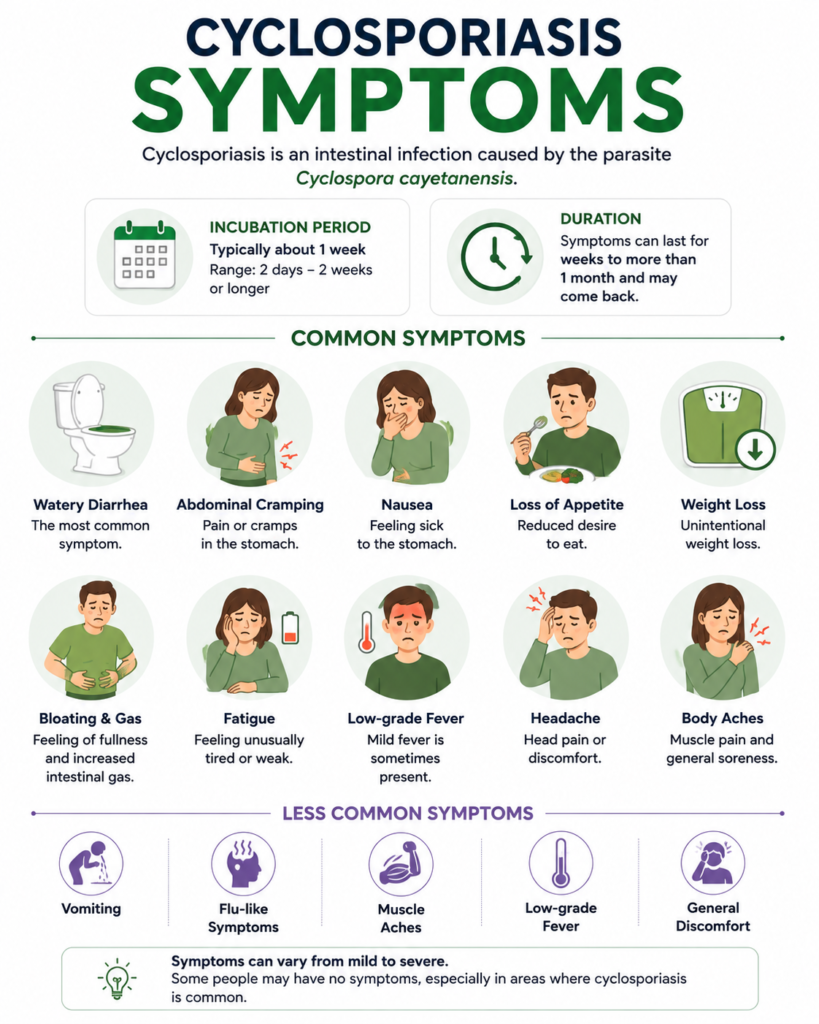
The most characteristic symptom is watery diarrhea.
Symptoms generally begin about one week after infection, although the incubation period can range from approximately 2 days to 2 weeks or longer.
Common symptoms include:
- Watery diarrhea
- Loss of appetite
- Weight loss
- Abdominal cramping
- Bloating
- Increased intestinal gas
- Nausea
- Fatigue
Less common symptoms can include:
- Vomiting
- Headache
- Body aches
- Low-grade fever
- Other flu-like symptoms
Some infected people have no symptoms, particularly people living in areas where cyclosporiasis is endemic.
How long does cyclosporiasis last?
Without treatment, illness can persist for weeks or longer than one month. A characteristic feature is a relapsing-remitting pattern: diarrhea and other symptoms may improve and subsequently return.
Fatigue can persist even after the gastrointestinal symptoms have improved.
Who is at Greater Risk?
Anyone can become infected, but risk is particularly relevant for:
- People living in or travelling to endemic tropical or subtropical regions
- International travellers
- People consuming contaminated fresh produce
- People exposed to contaminated water
- Individuals with weakened immune systems
In immunocompromised people, infection can become more prolonged and clinically significant. A systematic review of immunocompromised populations highlights the importance of Cyclospora as a gastrointestinal pathogen in these groups.
How is Cyclosporiasis Diagnosed?
Diagnosis generally requires stool testing.
One of the major challenges is that Cyclospora testing is not automatically included in every routine stool examination.
CDC specifically recommends that healthcare professionals consider Cyclospora in people with compatible prolonged diarrhea, particularly when there is a history of travel to endemic areas or exposure during an outbreak.
Microscopic diagnosis
Laboratories can use specialized techniques to identify Cyclospora oocysts, including:
- Modified acid-fast staining
- Modified safranin staining
- Concentration techniques
- Ultraviolet fluorescence microscopy
Cyclospora oocysts are approximately 8–10 μm in diameter and demonstrate characteristic autofluorescence under appropriate microscopy.
Molecular Testing
PCR-based molecular methods can detect Cyclospora DNA in stool and have become increasingly important for diagnosis and surveillance.
However, not every gastrointestinal PCR panel includes Cyclospora. Therefore, clinicians may need to specifically request testing.
Why multiple stool samples may be required
Oocyst shedding can be intermittent and occur at low levels. Consequently, a single negative stool specimen does not necessarily exclude infection.
Several specimens collected on different days may be required when clinical suspicion remains high.
Treatment of Cyclosporiasis
The recommended treatment for symptomatic cyclosporiasis is trimethoprim-sulfamethoxazole (TMP-SMX).
For immunocompetent adults, CDC lists the typical regimen as:
TMP 160 mg + SMX 800 mg, orally twice daily for 7–10 days.
People living with HIV may require longer treatment courses depending on their clinical circumstances.
Most otherwise healthy people eventually recover, even without treatment, but untreated illness can be prolonged and may relapse.
There is currently no vaccine for cyclosporiasis.
For people who cannot take TMP-SMX because of allergy or intolerance, there is no alternative treatment with comparable evidence of effectiveness. Management should therefore be individualized by a healthcare professional.
Adequate fluid intake is also important during diarrheal illness because prolonged diarrhea can result in dehydration.
Prevention of Cyclosporiasis
Preventing cyclosporiasis is challenging because contamination can occur before food reaches the consumer.
- Wash your hands
- Wash fresh produce
- Be careful when travelling
- Refrigerate prepared produce
- Follow outbreak alerts and recalls
Current Scenario: The 2026 U.S. Cyclosporiasis Outbreak
Cyclosporiasis has become a major food-safety story in the United States during 2026.
As of August 5, 2026, CDC reported an ongoing multistate outbreak associated with iceberg lettuce.
The CDC’s latest outbreak figures at that date were:
| Cases in the iceberg-lettuce outbreak | 6,358 |
| Hospitalizations | 278 |
| Deaths | 2 |
| States involved | 15 |
The outbreak was linked epidemiologically and through traceback investigations to shredded iceberg lettuce sourced from central Mexico. Taylor Farms de Mexico initiated a recall of affected iceberg lettuce on July 17, 2026.
The recalled products had been distributed to consumers, restaurants and retailers in at least 27 states, including products associated with Taco Bell and Marketside-branded products sold through selected Walmart stores.
Importantly, the CDC also states that other cyclosporiasis illnesses occurring nationally may come from different sources and are unrelated to this particular outbreak. Therefore, the 6,358 figure should not be interpreted as the total number of all U.S. cyclosporiasis cases in 2026.
References
CDC. Cyclosporiasis: About, symptoms, clinical overview, clinical care, prevention and surveillance.
Casillas SM, Hall RL, Herwaldt BL. Cyclosporiasis Surveillance — United States, 2011–2015. MMWR. 2019.
Chen Y, Qin Z, Li J, Xiao L, Zhang L. The global prevalence of Cyclospora cayetanensis infection: A systematic review, meta-analysis, and meta-regression.Acta Tropica. 2024;253:107175.
Giangaspero A, Gasser RB. Human cyclosporiasis.The Lancet Infectious Diseases. 2019.
Herwaldt BL, Ackers ML. An Outbreak in 1996 of Cyclosporiasis Associated with Imported Raspberries.New England Journal of Medicine. 1997;336:1548–1556.
Ortega YR, Sterling CR, Gilman RH, Cama VA, Díaz F. Cyclospora species—A new protozoan pathogen of humans.New England Journal of Medicine. 1993.
CDC. Cyclospora Outbreak Linked to Iceberg Lettuce, updated August 5, 2026.
FDA. Investigation of 9-State/15-State Outbreak of Cyclospora Illnesses: Iceberg Lettuce.
Pingback: Salmonellosis: The Critical Numbers Behind a Global Foodborne Disease and the UK's 2026 Outbreak - Disease Buddy