Introduction
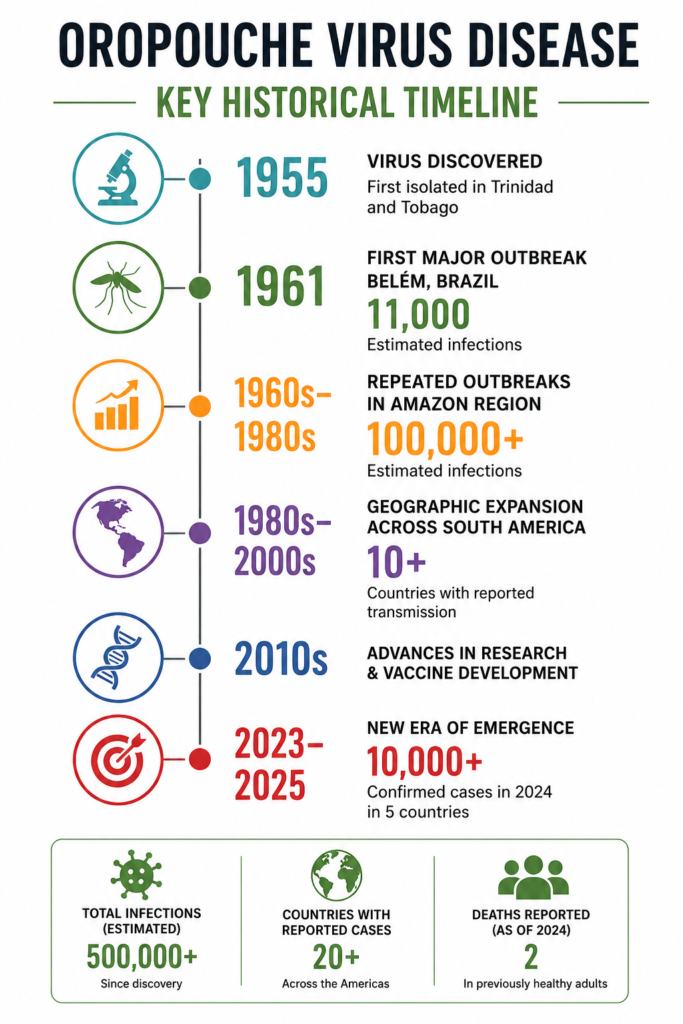
Oropouche virus disease (OROV) is an emerging arboviral infection caused by Oropouche orthobunyavirus. Although Oropouche virus has remained a tropical disease of South America for most of the period, it has been responsible for numerous outbreaks across Central America and Europe in recent days. Historical records estimate that more than 500,000 human infections have occurred since the virus was first identified.
1955: Discovery of Oropouche Virus
In 1955, Oropouche virus was first isolated for the first time in Trinidad and Tobago from a febrile patient living near the village of Vega de Oropouche.
The initial discovery suggested that Oropouche virus was circulating naturally in tropical ecosystems but had limited recognition as a human disease threat.
1960-1961: Identification of Transmission and First Major Outbreak
First major outbreak of Oropouche virus outside Trinidad was observed in 1960 in Brazil.
In 1961, Brazil experienced the first recognised large urban outbreak of Oropouche fever in Belém, Pará State. This outbreak demonstrated that the virus could adapt from forest-associated transmission to urban environments.
The Belém outbreak infected approximately 11,000 people, making it one of the earliest large-scale Oropouche outbreaks documented. This event changed scientific understanding of Oropouche virus by demonstrating that:
- Oropouche virus was not limited to isolated forest environments.
- Human-to-vector-to-human transmission could sustain urban outbreaks.
- Population-dense tropical cities could become areas of sustained transmission.
1960s-2000s: Establishment as a Major Cause of Febrile Illness in the Amazon Region
Repeated outbreaks occurred mainly in northern Brazil, particularly in Amazonian states during 1960s. Studies documented widespread transmission of Oropouche virus infection involving large communities, with outbreaks affecting tens of thousands of individuals.
However, the disease remained relatively neglected because symptoms were usually mild and self-limiting, and many cases remained undiagnosed as the symproms resembled dengue and other arboviral infections.
2000s-2010s: Geographic Expansion and Increasing Scientific Interest
During the late 20th and early 21st centuries, human infections were reported in several countries across South and Central America, which included Brazil, Peru, Panama, Ecuador, Venezuela, and Colombia.
Advances in molecular biology and genomic surveillance increased understanding of Oropouche virus evolution during the 2010s. Although no licensed vaccine became available, experimental vaccine studies demonstrated that Oropouche virus could be targeted through modern vaccine platforms.
2023-2025: Emergence of Oropouche Virus
Recent studies describe this period as an unprecedented phase of Oropouche virus activity, characterised by:
- Increased geographic spread
- Detection in regions with limited previous transmission
- Larger numbers of reported infections
- Greater international scientific attention
According to WHO, more than 10,000 confirmed cases were reported in 2024, including infections detected in areas where Oropouche virus had not previously been documented.
CDC also reported that by August 2024, more than 8,000 laboratory-confirmed cases had been identified in Bolivia, Brazil, Colombia, Cuba, and Peru, alongside travel-associated infections in the United States and Europe.
Although historically considered a mild febrile illness, recent outbreaks have highlighted the need for improved surveillance, advanced diagnostics, genomic monitoring, and continued vaccine research. The future impact of Oropouche virus will depend on understanding how viral evolution, environmental change, and human movement influence its transmission patterns.
References
Centers for Disease Control and Prevention. (2024). Oropouche virus disease among U.S. travelers — United States, 2024. Morbidity and Mortality Weekly Report, 73(35), 767–771.
World Health Organization. (2024). Oropouche virus disease: Fact sheet.
da Rosa, J. F. T., de Souza, W. M., Pinheiro, F. P., Figueiredo, M. L., Cardoso, J. F., Acrani, G. O., & Nunes, M. R. T. (2017). Oropouche virus: Clinical, epidemiological, and molecular aspects of a neglected orthobunyavirus. The American Journal of Tropical Medicine and Hygiene, 96(5), 1019–1030. https://doi.org/10.4269/ajtmh.16-0672
Sakkas, H., Bozidis, P., Franks, A., & Papadopoulou, C. (2018). Oropouche fever: A review. Viruses, 10(4), 175. https://doi.org/10.3390/v10040175
Files, M. A., Hansen, C. A., Herrera, V. C., Schindewolf, C., Barrett, A. D. T., Beasley, D. W. C., Bourne, N., & Milligan, G. N. (2022). Baseline mapping of Oropouche virology, epidemiology, therapeutics, and vaccine research and development. npj Vaccines, 7, Article 38. https://doi.org/10.1038/s41541-022-00456-2