Global malaria funding reached just US$3.9 billion in 2024, against a US$9.3 billion target for 2025. With hundreds of millions of infections each year, the financing gap raises a difficult question: why is a preventable and treatable disease still receiving less than half the investment required to control it?
Introduction: A preventable disease with an enormous price tag
Malaria is one of the world’s most persistent infectious diseases. It is preventable, diagnosable and treatable, yet it continues to cause hundreds of millions of infections and hundreds of thousands of deaths annually.
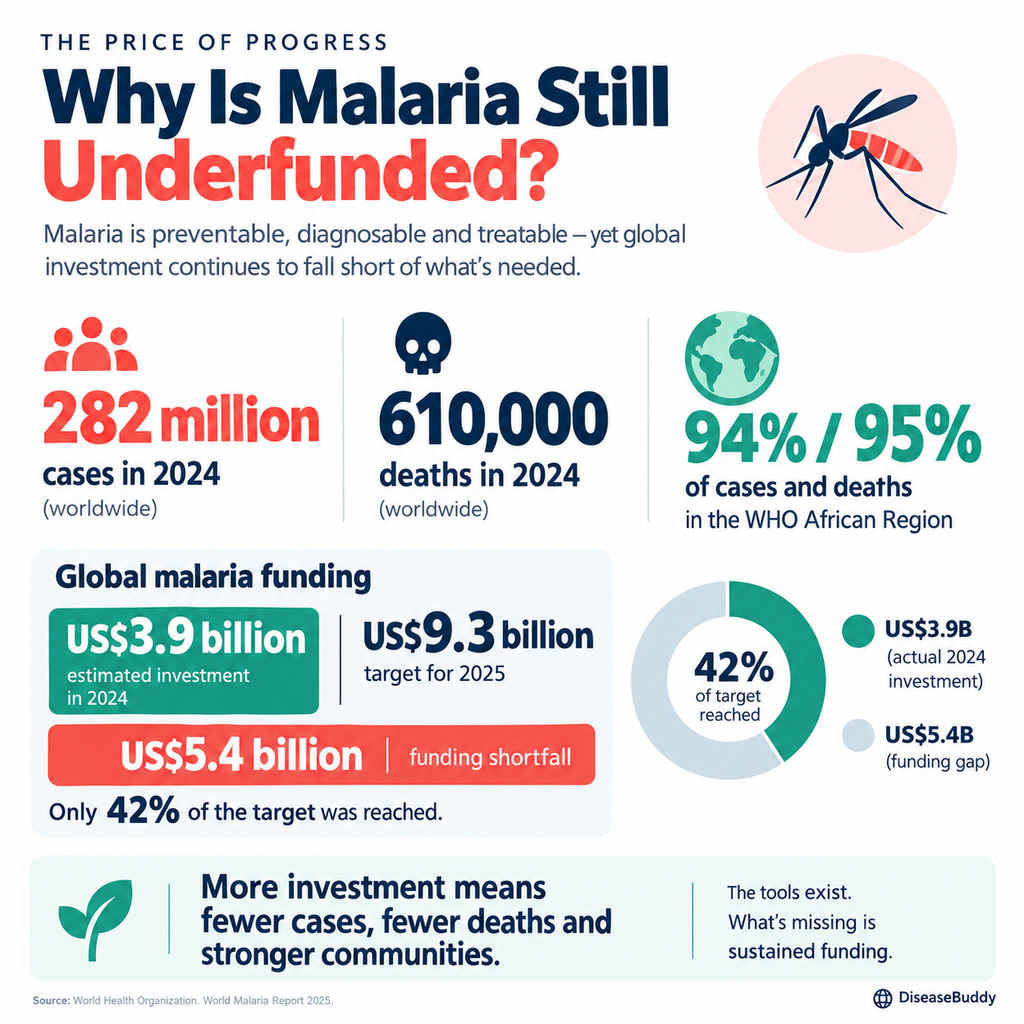
The World Health Organization’s World Malaria Report 2025 estimated that malaria caused 282 million cases and 610,000 deaths worldwide in 2024. The WHO African Region accounted for approximately 94% of cases and 95% of deaths, with young children bearing a particularly heavy burden.
At the same time, global investment in malaria control was estimated at US$3.9 billion in 2024, against a Global Technical Strategy target of US$9.3 billion by 2025.
The world mobilised less than half the targeted resources despite the availability of interventions that can prevent infections, reduce severe disease and save lives.
The Malaria Funding Gap in Numbers
The WHO’s 2025 report provides a clear measure of the shortfall between actual investment and the target established for 2025.
- Funding shortfall: US$9.3 billion − US$3.9 billion = US$5.4 billion.
- Target achieved: US$3.9 billion ÷ US$9.3 billion × 100 = approximately 41.9%.
- Target not achieved: approximately 58.1%.
These calculations describe the gap between 2024 investment and the 2025 target. Global malaria investment was less than half the amount considered necessary to meet the strategy’s funding target.
The shortfall is particularly concerning because malaria programmes require continuing expenditure. Mosquito nets wear out, insecticides lose effectiveness, medicines and diagnostic tests must be replenished, health workers require training, and surveillance systems must continue operating even when case numbers fall.
What Does Malaria Funding Actually Pay For?
Malaria financing supports a range of interventions, rather than a single treatment or prevention programme.
Insecticide-treated mosquito nets
Long-lasting insecticidal nets are a cornerstone of malaria prevention. They reduce contact between people and malaria-carrying mosquitoes and can provide community-wide benefits when coverage is sufficiently high.
However, purchasing nets is only part of the cost. Programmes must also identify target populations, transport supplies, distribute nets, communicate correct use and replace them when necessary.
Diagnostic testing and treatment
Rapid diagnostic tests help identify malaria infections and support appropriate treatment decisions. Effective antimalarial medicines can prevent uncomplicated disease from progressing, while prompt management of severe malaria can be lifesaving.
But a functioning treatment programme requires more than the price of a test or a medicine. It depends on reliable supply chains, trained health workers, accessible facilities and systems that can identify and respond to stock shortages.
Preventive medicines and vaccines
Seasonal malaria chemoprevention provides preventive medicines to eligible children in areas where malaria transmission is seasonal. Other preventive approaches are used for specific populations and transmission settings.
Malaria vaccines add another tool to the prevention package. Their implementation requires financing for vaccine procurement, delivery, cold-chain capacity where applicable, staff and continued monitoring.
Surveillance, research and programme management
Malaria programmes also need reliable information about where infections occur, which interventions are working and whether mosquitoes or parasites are developing resistance.
These activities can be less visible than distributing medicines or vaccines, but without them governments may struggle to allocate resources effectively.
The economic implication is important: the cost of malaria control includes the systems needed to deliver interventions consistently, not just the products themselves.
Who pays for malaria control?
According to the WHO’s World Malaria Report 2025, approximately 67% of malaria funding over 2010–2024 came from international sources, while malaria-endemic countries contributed 33%. In 2024, international sources accounted for about 56% of total funding, with domestic sources contributing 44%.
International financing includes bilateral assistance, multilateral organisations and other external contributors. The Global Fund to Fight AIDS, Tuberculosis and Malaria is a particularly important source. It reported providing approximately 59% of all international financing for malaria programmes and having invested more than US$20.3 billion in malaria programmes by June 2025.
Domestic financing includes government expenditure and other nationally mobilised resources supporting malaria programmes.
In lower-income settings, domestic resources may be insufficient to replace external financing rapidly. A reduction in donor support can therefore translate into fewer prevention campaigns, weaker surveillance or interruptions in supplies.
Why is malaria still underfunded?
There is no single explanation for the funding gap. Several economic and institutional factors help explain why investment has not kept pace with the resources required.
1. Competing demands on public budgets
A government deciding how to allocate a limited budget may face immediate demands for hospital beds, emergency care, staff salaries and essential medicines. Preventive spending can be harder to prioritise when its benefits are distributed across time and are less visible than the services delivered in a hospital.
2. Dependence on international assistance
The financing literature has identified a plateau in international malaria financing since approximately 2010. A peer-reviewed analysis, Financing malaria, argues that both donor countries and malaria-endemic countries face fiscal constraints, making it difficult to close the gap simply by asking existing funders to contribute more.
3. Lack of visible benefits of prevention
The success of malaria prevention is often measured by events that do not happen: infections prevented, hospitalisations avoided and deaths averted.
That creates a communication challenge. The benefit of a mosquito net or preventive medicine may be invisible because the person protected never develops the disease. By contrast, the cost of buying and distributing the intervention is immediate and measurable.
The WHO estimates that malaria control efforts since 2000 have averted approximately 2.3 billion cases and 14 million deaths worldwide. These are substantial achievements, but they do not automatically guarantee future funding.
Preventive programmes must continue to demonstrate their value while competing with other priorities for limited resources.
4. Uneven distribution of malaria burden and economic capacity
The countries experiencing the largest malaria burdens are not necessarily those with the greatest capacity to finance control programmes.
The concentration of cases and deaths in the WHO African Region means that the need for resources is geographically concentrated. Yet the ability to mobilise public revenue varies substantially across countries.
This mismatch creates an international financing problem. Countries with the greatest need may be least able to increase domestic spending sufficiently, while countries with greater fiscal capacity may face less direct domestic pressure to prioritise malaria.
5. Progress requires recurring investment
Malaria control is vulnerable to interruptions. Prevention campaigns must be repeated, diagnostics and medicines must remain available, and surveillance must continue.
Even where transmission has fallen substantially, countries may need ongoing resources to detect imported infections, respond to local transmission and prevent resurgence.
The economic risk is that funding reductions can weaken the very programmes responsible for earlier progress. Saving money in the short term may increase the risk of larger health and economic losses later.
What Happens When Malaria Programmes Lose Funding?
In April 2025, the WHO warned that reductions in international assistance were putting malaria progress at risk. It reported that, by early April, more than 40% of planned insecticide-treated net distribution campaigns intended to reach 425 million people were delayed or at risk of disruption. Nearly 30% of planned seasonal malaria chemoprevention campaigns intended to protect 58 million children were also off track.
The same WHO update highlighted concerns about declining stocks of rapid diagnostic tests and antimalarial medicines in some countries.
Such disruptions can produce consequences at multiple levels:
- For households: delayed diagnosis and treatment can increase the risk of severe illness and impose additional transport, care and income costs.
- For health services: stock shortages and interrupted campaigns can undermine routine service delivery.
- For governments: rising cases may require additional emergency spending and redirect resources from other priorities.
- For international partners: interruptions can reduce the effectiveness of previous investments in prevention, health workers and programme infrastructure.
The precise financial impact depends on the country, the intervention affected, the duration of the interruption and the level of malaria transmission.
Is Malaria Funding an Expense or an Investment?
Effective malaria programmes can avert infections and deaths, reduce the need for treatment, protect household income and help preserve the productivity of workers and caregivers.
The Global Fund’s 2025 results report illustrates the scale of service delivery supported by malaria programmes. In countries where it invests, programmes distributed 162 million insecticide-treated mosquito nets and treated 173 million malaria cases during 2024.
The strongest economic case for malaria investment combines several measures:
- The cost of delivering an intervention.
- The number of infections, severe cases or deaths it prevents.
- The healthcare costs and productivity losses it may avert.
- The distribution of benefits across income groups and communities.
- The affordability and sustainability of the programme over time.
What Would Closing The Funding Gap Require?
Closing the malaria funding gap will likely require a combination of domestic and international measures.
- More predictable international financing
- Greater domestic investment where feasible
- Better coordination between funders
- Continued investment in research and innovation
- Stronger accountability for results
References
World Health Organization. World malaria report 2025. Geneva: WHO; 2025.
The Global Fund to Fight AIDS, Tuberculosis and Malaria. Results Report 2025.
Rannan-Eliya RP. Financing malaria. PLOS Global Public Health. 2022;2(6):e0000609.
World Health Organization. Malaria progress in jeopardy amid foreign aid cuts. 11 April 2025.
World Health Organization. Global technical strategy for malaria 2016–2030.
Dieleman JL and colleagues. Examining malaria treatment and prevention spending efficiency in malaria-endemic countries, 2000–2020.
World Health Organization. Malaria fact sheet.
The Global Fund to Fight AIDS, Tuberculosis and Malaria. Malaria programme and financing data.