Dengue is usually discussed as a mosquito-borne disease that causes fever, severe body aches and, in some patients, life-threatening complications. But is also has another dimension that receives less attention: the economics of dengue.
The bill for dengue is much larger than the cost of treating a patient. It can include hospital care, diagnostic tests, medicines, mosquito-control programmes, surveillance, transportation, lost wages, missed school and work, caregiver time and reduced productivity. During large outbreaks, healthcare systems can also become overloaded.
One of the most widely cited global economic analyses, published in The Lancet Infectious Diseases in 2016, estimated the economic burden of dengue across 141 countries and territories with active dengue transmission.
| Measure | Estimate |
| Symptomatic dengue infections | 58.4 million |
| Dengue deaths | 13,586 |
| Global annual economic cost | US$8.9 billion |
| Hospital-treated cases | 18% |
| Ambulatory cases | 48% |
| Non-medical care | 34% |
This figure should not be directly compared with the other studies estimates because the studies used different disease-burden estimates, costing methods and assumptions. Thus, the true cost of dengue is difficult to measure because the true number of infections is itself uncertain.
The 2015 systematic review by Constenla and colleagues found 42 eligible economic studies from 32 dengue-endemic countries. Annual overall dengue costs reported in those studies ranged from US$13.5 million in Nicaragua to US$56 million in Malaysia, using 2010 values. The authors concluded that hospital care and lost earnings were major contributors to the economic burden.
The cost varies dramatically around the world
There is no single price for a dengue infection. Healthcare costs, wages, hospital systems and the severity of disease differ substantially between countries.
A 2026 systematic review of 56 cost-of-illness studies from 26 countries provides one of the most useful recent comparisons.
| Country | Setting | Average cost per dengue episode |
| Burkina Faso | Public outpatient | US$15 |
| Brazil | Public outpatient | US$84 |
| Colombia | Public outpatient | US$128 |
| Bangladesh | Public inpatient | US$330 |
| India | Public inpatient | US$210 |
| Indonesia | Public inpatient | US$436 |
| Sri Lanka | Public inpatient | US$255 |
| Thailand | Public inpatient | US$263 |
| Vietnam | Public inpatient | US$195 |
| Mexico | Public inpatient | US$1,855 |
| Mexico | Public ICU | US$9,386 |
| Vietnam | Public ICU | US$2,186 |
*Costs are reported averages from the studies included in the systematic review, not universal prices for those countries.
The difference between routine and critical illness can be enormous. In Mexico, the reported ICU cost was about US$9,386 per episode, compared with about US$1,855 for a non-ICU inpatient episode. In Vietnam, ICU treatment was approximately US$2,186, compared with about US$195 for an inpatient episode.
India: billions in economic costs
Between 2006 and 2012, researchers estimated an average of 5.78 million clinically diagnosed dengue cases per year, compared with only about 20,474 officially reported cases annually.
The estimated direct medical cost alone was US$548 million per year. When non-medical and indirect costs were included, the estimated economic burden increased to US$1.11 billion annually, equivalent to approximately US$0.88 per person.
Hospitalisation was particularly expensive: although an estimated 33% of cases were hospitalised, they accounted for 82% of direct medical expenditure.
Southeast Asia: a major regional burden
A study covering 12 Southeast Asian countries, including Indonesia, Malaysia, the Philippines, Singapore, Thailand and Vietnam, estimated an average of 2.9 million dengue episodes and 5,906 deaths annually during 2001–2010.
The estimated annual economic burden was approximately US$950 million, with a 95% certainty range of US$610 million–US$1.384 billion.
Individual costs also vary considerably. A systematic review of Asian studies found productivity costs for hospitalised non-fatal dengue episodes ranging from approximately US$14 in Cambodia to US$277 in Malaysia, after adjustment to 2017 prices. [6]
Thailand provides another example. A nationwide analysis estimated an average cost of approximately US$261 per dengue case, with an estimated annual national burden of US$440 million after adjusting for under-reporting.
Economics of Dengue in Latin America: productivity is a major part of the bill
A systematic review of dengue economics in Latin America and the Caribbean included 17 studies covering 39 countries.
It estimated the region’s average annual economic burden at more than US$3 billion. Productivity losses were the largest component overall. For hospitalised patients, direct costs represented more than 70% of total costs, whereas for outpatient cases, indirect costs could account for up to 80% of the total.
Brazil alone was estimated in this review to have an annual dengue burden of up to approximately US$1.4 billion.
Why the bill is bigger than the hospital bill
The economic burden of dengue comes from several sources:
Medical costs
- Consultation and diagnostic testing
- Medicines and intravenous treatment
- Hospitalisation
- Intensive care
Household costs
- Transport
- Food and other expenses
- Out-of-pocket healthcare payments
- Caregiver time
Productivity costs
- Missed work
- Missed school
- Caregiver absence
- Lost productivity from premature death
Public-health costs
- Mosquito surveillance
- Vector control
- Outbreak investigations
- Public-health campaigns
The global estimate of US$8.9 billion demonstrates that productivity losses alone can represent a very large share of the total burden.
Severe dengue can require hospitalisation and intensive monitoring. CDC guidance states that severe dengue is a medical emergency and may require intensive-care-level management.
A 2026 study from Puerto Rico provides a recent example. Researchers estimated that during a typical incidence year, the median cost per dengue case was approximately:
| Patient setting | Median cost |
| Hospitalised child | US$5,200 |
| Hospitalised adult | US$6,800 |
| Outpatient child | US$2,300 |
| Outpatient adult | US$2,700 |
These are Puerto Rico-specific estimates and should not be interpreted as universal dengue treatment costs.
Some studies have estimated that vector control can account for 40–72% of dengue-related health-system costs in particular settings. These figures should not be treated as a global average because vector-control programmes and accounting methods differ between countries.
Outbreaks can multiply the cost
Similarly, A recent 2026 analysis of Puerto Rico illustrates that outbreaks can multiply the cost.
During a median-incidence year, researchers estimated:
- 597 reported cases
- Approximately 4,500 outpatient cases
- Approximately 3,900 hospitalised cases
- Total economic burden: US$62.7 million
During an epidemic year, reported cases increased to 10,359, while the researchers estimated:
- Approximately 77,300 outpatient cases
- Approximately 67,300 hospitalised cases
- Total economic burden: US$1.1 billion
The estimated economic burden therefore increased from approximately US$62.7 million to US$1.1 billion between the two scenarios — roughly a 17.5-fold difference.
The hidden economic problem
One reason dengue’s economic burden is difficult to measure is that many infections never appear in official statistics.
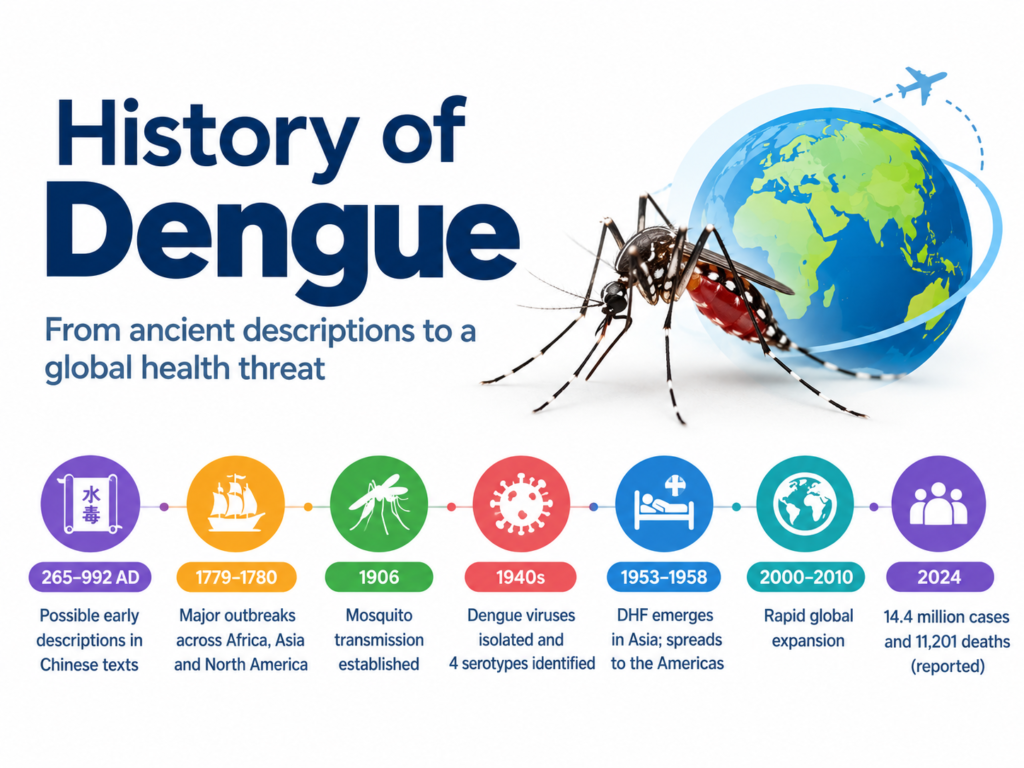
WHO reported 14.6 million dengue cases and more than 12,000 dengue-related deaths in 2024, the highest number of reported cases in a single year. WHO also notes that many infections are asymptomatic or mild and therefore go undiagnosed and unreported.
This means that the economic cost calculated from reported cases alone can underestimate the true burden.
References
Shepard DS, Undurraga EA, Halasa YA, Stanaway JD. The global economic burden of dengue: a systematic analysis. Lancet Infect Dis. 2016;16(8):935-941. doi:10.1016/S1473-3099(16)00146-8.
Hung TM, Shepard DS, Bettis A. Productivity costs from a dengue episode in Asia: a systematic literature review. BMC Infect Dis. 2020;20:393. doi:10.1186/s12879-020-05109-0.
Leelavanich D, Dorigatti I, Turner HC. The economic burden of dengue: a systematic literature review of unit costs for non-fatal episodes treated in the formal healthcare system. BMC Infect Dis. 2026;26:320. doi:10.1186/s12879-025-12451-8.
Harapan H, Michie A, Mudatsir M, Sasmono RT, Imrie A. Epidemiology of dengue hemorrhagic fever in Indonesia: analysis of five decades data from the National Disease Surveillance. [For economic estimates: Shepard DS et al.; India economic burden study]. Am J Trop Med Hyg. 2014;91(5):1020-1029.
Limkittikul K, Brett J, L’Azou M. Epidemiology and costs of dengue in Thailand: a systematic literature review. BMC Public Health. 2022;22:1512.
Pacheco-Castillo A, et al. Economic impact of dengue fever in Latin America and the Caribbean: a systematic review. PLoS One. 2019;14(2):e0211401.
World Health Organization. Dengue and severe dengue [Internet]. Geneva: WHO; 2025 [cited 2026 Sep 22].