
Babies can have the highest incidence. Young children account for a large share of cases. Teenagers and adults can remain susceptible for years. And adults over 30 are among the groups at greater risk of complications.
Measles is often called a childhood disease. However, the numbers tell a different story.
In 2024, for example, the EU/EEA recorded 35,212 measles cases, while the United States recorded 285. In England alone, there were 2,911 laboratory-confirmed cases. The age distribution was different in each setting.
So, who is most vulnerable to measles?
The answer depends on whether we measure infection, incidence, hospitalization or complications.
| Measure | Number |
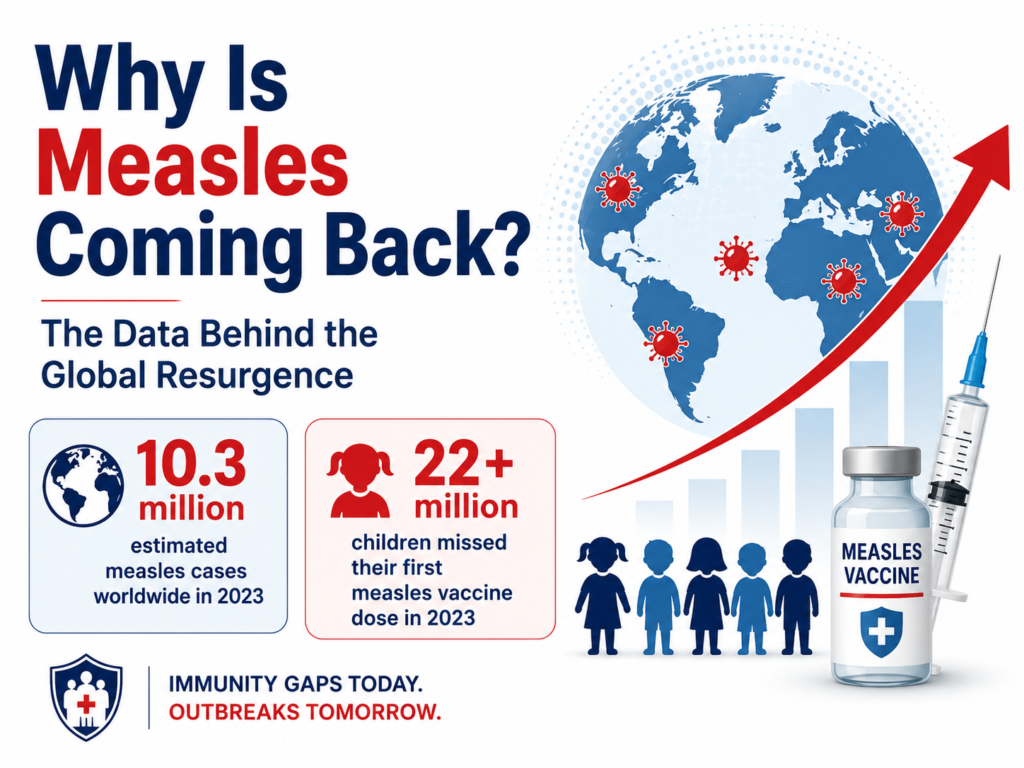
| Estimated global measles infections, 2023 | 10.3 million |
| Estimated measles deaths, 2023 | 107,500 |
| EU/EEA cases, 2024 | 35,212 |
| US cases, 2024 | 285 |
| England cases, 2024 | 2,911 |
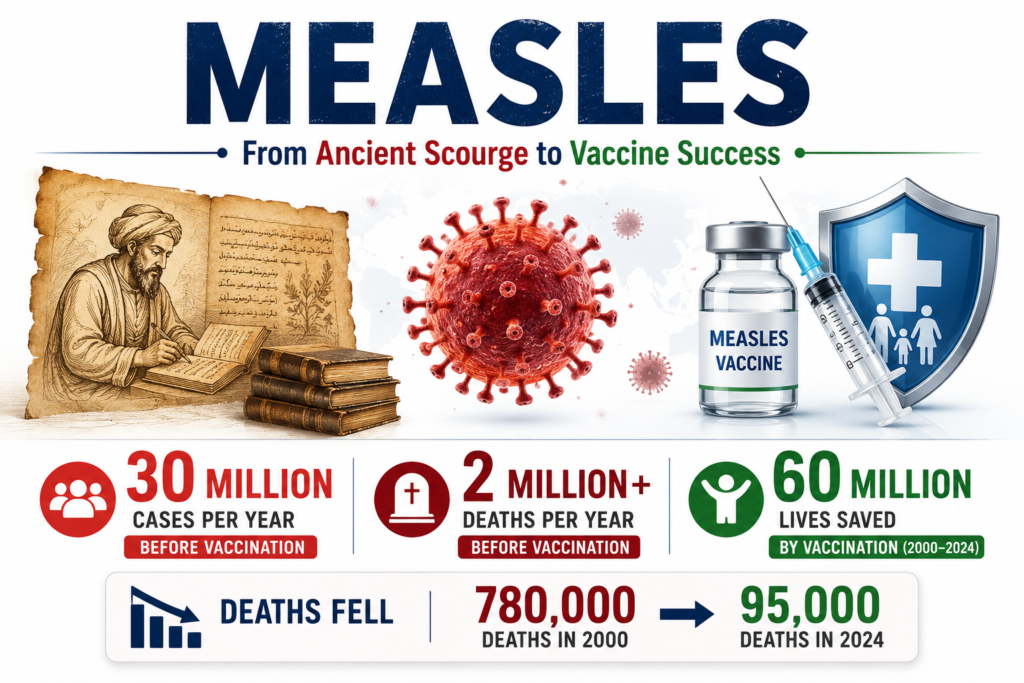
WHO estimates that 107,500 people died from measles in 2023, with most deaths occurring among children younger than 5 years.
<1 Year: The Highest Incidence
Infants are one of the most vulnerable groups because many are too young for routine measles vaccination.
2024 EU/EEA
- 13.0% of all reported cases were infants under 1.
- Notification rate: 1,175.4 cases per million.
- This was the highest age-specific rate recorded.
- 98% of cases with known vaccination status were unvaccinated.
Comparing it to other age groups, the infant notification rate was therefore approximately 96 times higher than the rate among people aged 30 years and older in the EU/EEA in 2024.
Infants: 1,175.4/million
Age 1–4: 688.7/million
Age 30+: 12.2/million
Maternal antibodies can provide early protection, but this protection decreases over time. Routine vaccination generally begins later. That makes exposure to measles particularly concerning during infancy.
1-4 Years: The Largest European Age Group
Children aged 1–4 accounted for the largest proportion of measles cases in the EU/EEA in 2024.
- 33.1% of all cases
- 688.7 cases per million
- 90% of cases with known vaccination status were unvaccinated.
When children miss vaccination, the resulting susceptible population can become large enough for measles to spread rapidly.
5-9 Years: Still a Major Risk Group
The notification rate drops substantially after age 4, but measles remains common among school-age children.
EU/EEA, 2024
- 16.0% of cases
- 247.1 cases per million
- 84% of cases with known vaccination status were unvaccinated.
As age increases, measles incidence generally falls, but susceptibility does not disappear.
10-14 Years: The Declining but Persistent Risk
Among 10–14-year-olds in the EU/EEA in 2024:
- 11.6% of cases occurred in this age group.
- Notification rate: 169.9 per million.
- 80% of cases with known vaccination status were unvaccinated.
This age group is particularly useful for understanding accumulated immunity gaps.
A child who missed vaccination at age 1 or 2 does not necessarily become sick immediately. They can remain susceptible for years. If measles is later introduced into a school or community, that previously invisible immunity gap can suddenly become visible.
15-19 Years: Measles Moves Into Adolescence
EU/EEA, 2024
- 8.8% of cases
- 129.4 cases per million
- 78% of cases with known vaccination status were unvaccinated.
An interesting historical example comes from Pune, India.
During a 2014 college outbreak:
- 31 students developed fever and rash.
- Most were 18–24 years old.
- 7 of 12 tested samples were positive for measles IgM.
- 58% of the tested samples were therefore positive.
- All cases reported childhood measles vaccination, although documentary evidence was unavailable.
When childhood vaccination reduces transmission, susceptible people can increasingly be found at older ages.
20-29 Years: Fewer Cases, But Adults Matter
EU/EEA, 2024
- 6.5% of cases
- 45.8 cases per million
- 83% of cases with known vaccination status were unvaccinated.
Young adults can encounter measles through:
- international travel;
- universities;
- workplaces;
- healthcare settings;
- household exposure;
- communities with vaccination gaps.
30+ Years: Low Incidence, Higher Concern About Complications
In the EU/EEA in 2024:
- 10.9% of cases occurred in people aged 30+.
- Notification rate: 12.2 per million.
- 87% of cases with known vaccination status were unvaccinated.
The incidence was much lower than in young children.
But WHO identifies children under 5 and adults over 30 as groups in which measles complications are more common.
The United States: A Different Age Profile
In 2024, the CDC recorded 285 measles cases.
| Age | Cases | Share |
| <5 years | 120 | 42% |
| 5-19 years | 88 | 31% |
| >20 years | 77 | 27% |
| Total | 285 | 100% |
Almost 1 in 3 US measles cases in 2024 occurred in someone aged 20 or older.
Africa: Much Younger Age Profile
Senegal, 2024
Between January and May 2024:
- 252 confirmed cases
- Cases ranged from 0.4 to 42 years
- Median age: 6 years
- 70% were aged 9 months to 5 years
- 69% of cases in this age group were unvaccinated.
This is very different from an adult-focused outbreak. The burden was concentrated in young children.
Ghana: Another Young-Age Pattern
Ghana reported 350 confirmed measles cases between January and April 2024. 61.4% of cases occurred among children aged 5 years or younger.
That means approximately:
6 in every 10 cases → ≤5 years
Again, the age profile is strongly concentrated among young children.
South Africa: School-Age Children Stand Out
South Africa reported 931 laboratory-confirmed measles cases during 2024.
A surveillance report covering January–August 2024 recorded 178 cases with detailed age information.
| Age | Cases | Share |
| 0-6 months | 9 | 5.1% |
| 7-11 months | 5 | 2.8% |
| 1-4 years | 37 | 20.8% |
| 5-9 years | 63 | 35.4% |
| 10-14 years | 15 | 8.4% |
| 15-49 years | 16 | 9.0% |
| >50 years | 0 | 0% |
| Unknown | 33 | 18.5% |
The biggest identifiable group was therefore:
5–9 years: 35.4%
And children aged 1–14 accounted for 64.6% of the cases with known age in this dataset.
England: Measles in 2026
Between 1 January and 31 August 2026, England recorded:
983 laboratory-confirmed cases
| Age | Cases | Share |
| <1 | 111 | 11.3% |
| 1-4 | 264 | 26.9% |
| 5-10 | 224 | 22.8% |
| 11-14 | 59 | 6.0% |
| 15-24 | 119 | 12.1% |
| 25-34 | 113 | 11.5% |
| 35+ | 93 | 9.5% |
61% of all cases account for children <10 years.
Indonesia: The 2022 measles outbreak
WHO reported that in 2022, Indonesia had 4,845 laboratory-confirmed measles cases with age information available.
- 93% (4,502) were aged 1–14 years
- At least 41 cases occurred among people >40
- 67% had received no measles-containing vaccine dose
- In 2023, 95% (1,978/2,076) of confirmed cases with age information were again aged 1–14 years
- 100% of confirmed cases under 9 months had received no vaccine dose.
Bangladesh: The Most Recent Measles Outbreak
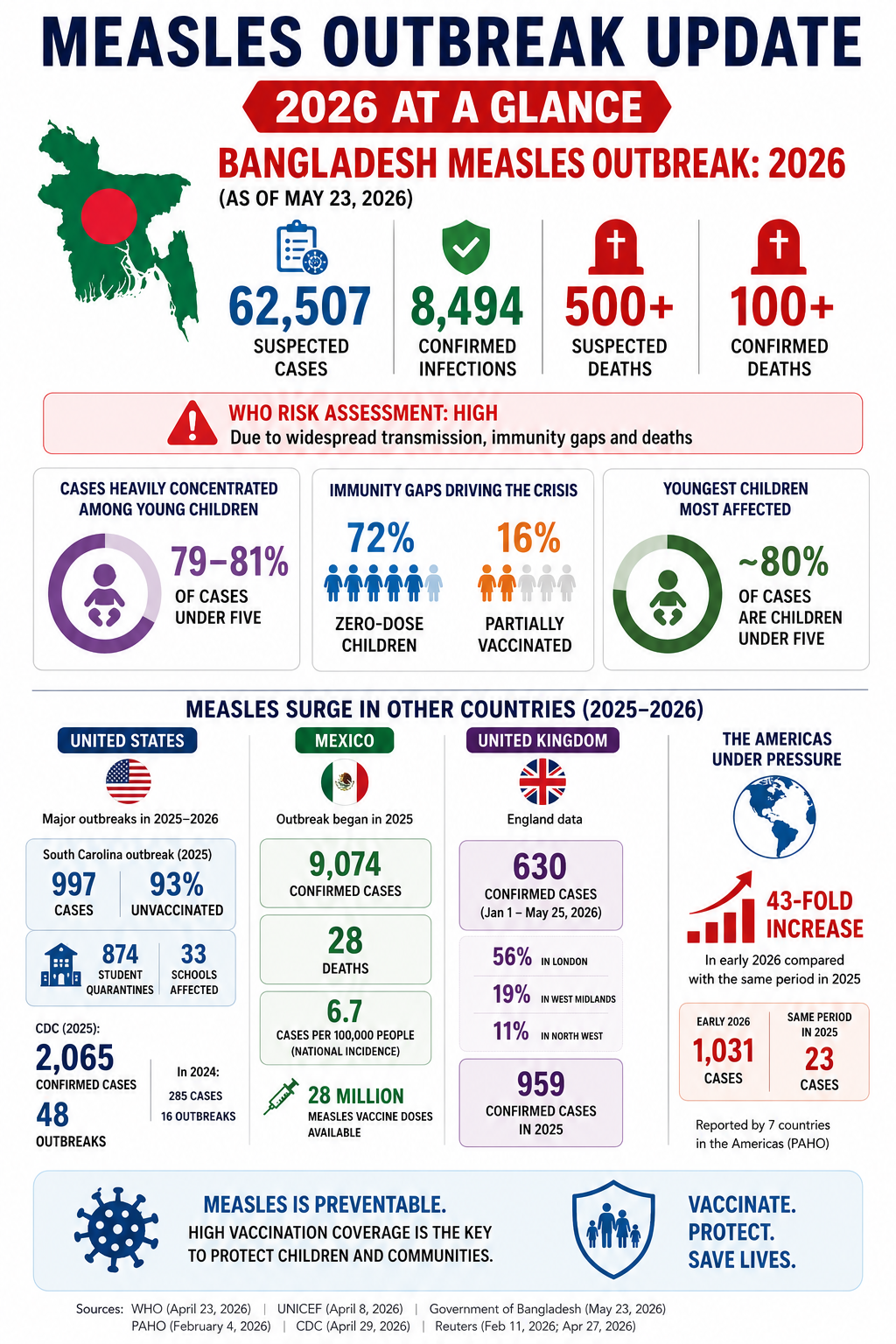
In Bangladesh’s 2026 outbreak, WHO reported that from 15 March to 14 April:
- 19,161 suspected cases
- 2,973 laboratory-confirmed cases
- 30 confirmed deaths
- 12,318 hospital admissions
- 79% of reported cases were under 5
- 66% were under 2
- 33% were infants under 9 months.
In Bangladesh’s 2026 outbreak, roughly 1 in 3 reported cases were infants under 9 months, and nearly 4 in 5 were children under 5.
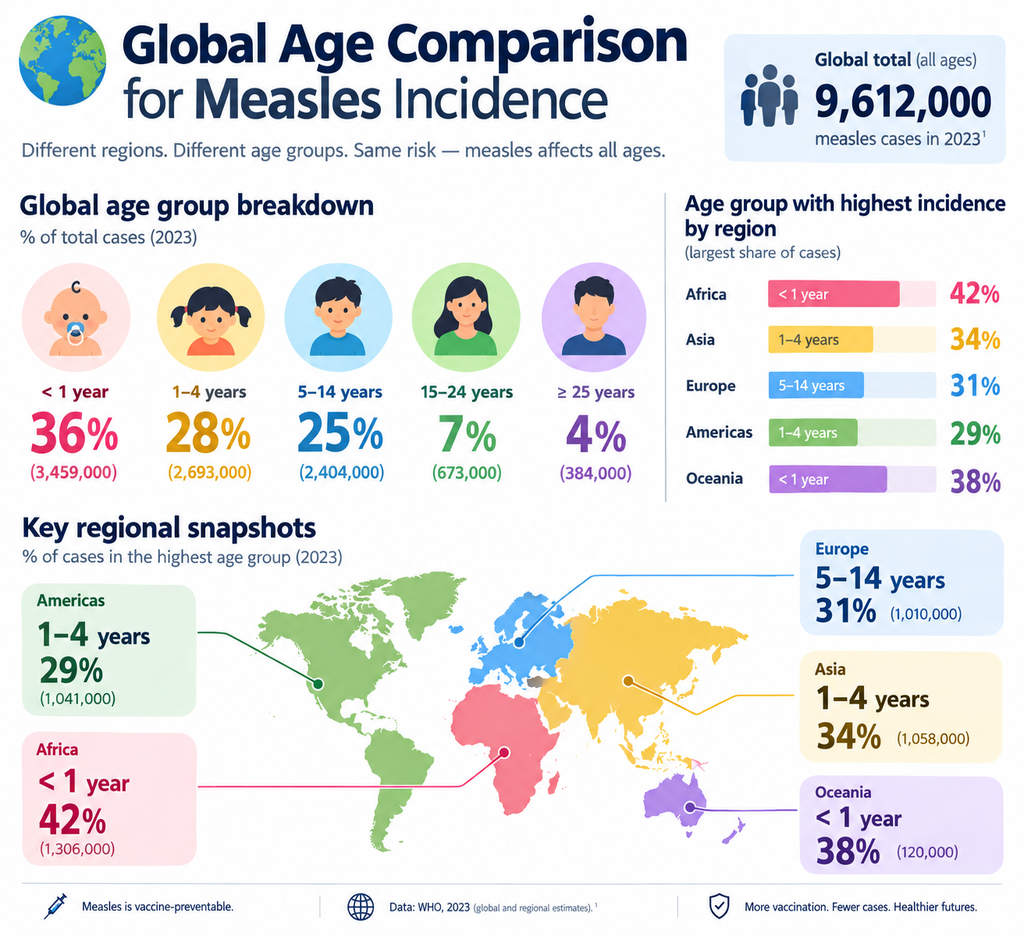
A Global Age Comparision
Different surveillance systems use different age categories. However, the broad pattern is remarkably consistent.
References
World Health Organization. Measles. WHO Fact Sheet. 2026.
European Centre for Disease Prevention and Control.Measles: Annual Epidemiological Report for 2024. Stockholm: ECDC; 2025.
Centers for Disease Control and Prevention. Measles Cases and Outbreaks: 2024 US surveillance data.
UK Health Security Agency. Confirmed cases of measles in England by month, age, region and upper tier local authority: 2026. Updated 4 September 2026.
National Institute for Communicable Diseases, South Africa. Measles and Rubella Monthly Situation Report, 21 August 2024.
Misin A, Antonello RM, Di Bella S, et al. Measles: an overview of a re-emerging disease in children and immunocompromised patients. Microorganisms. 2020;8(2):276. doi:10.3390/microorganisms8020276.
Bajaj S, Bobdey P, Singh N. Measles outbreak in adults: a changing epidemiological pattern. Med J Dr DY Patil Univ. 2017;10(5):447–452. doi:10.4103/MJDRDYPU.MJDRDYPU_43_17.
Zhao L, et al. Clinical characteristics of adult inpatients with measles in Beijing from 2010 to 2021: a retrospective analysis. BMC Infect Dis. 2023. doi:10.1186/s12879-023-08256-2.
Pingback: The Shocking Economics of MMR Vaccine: What Measles Outbreaks Really Cost the United States - Disease Buddy
Pingback: Measles: Complete Guide to Symptoms, Causes, Transmission, Prevention and Global Impact - Disease Buddy
Pingback: Why is Measles Coming Back? The Data Behind the Global Resurgence - Disease Buddy