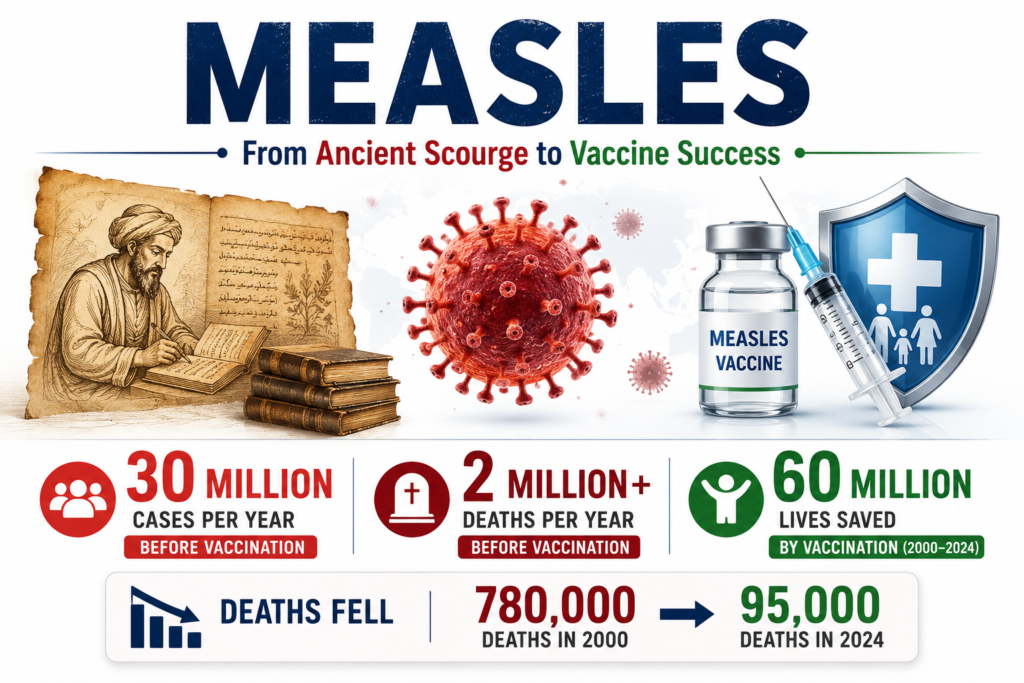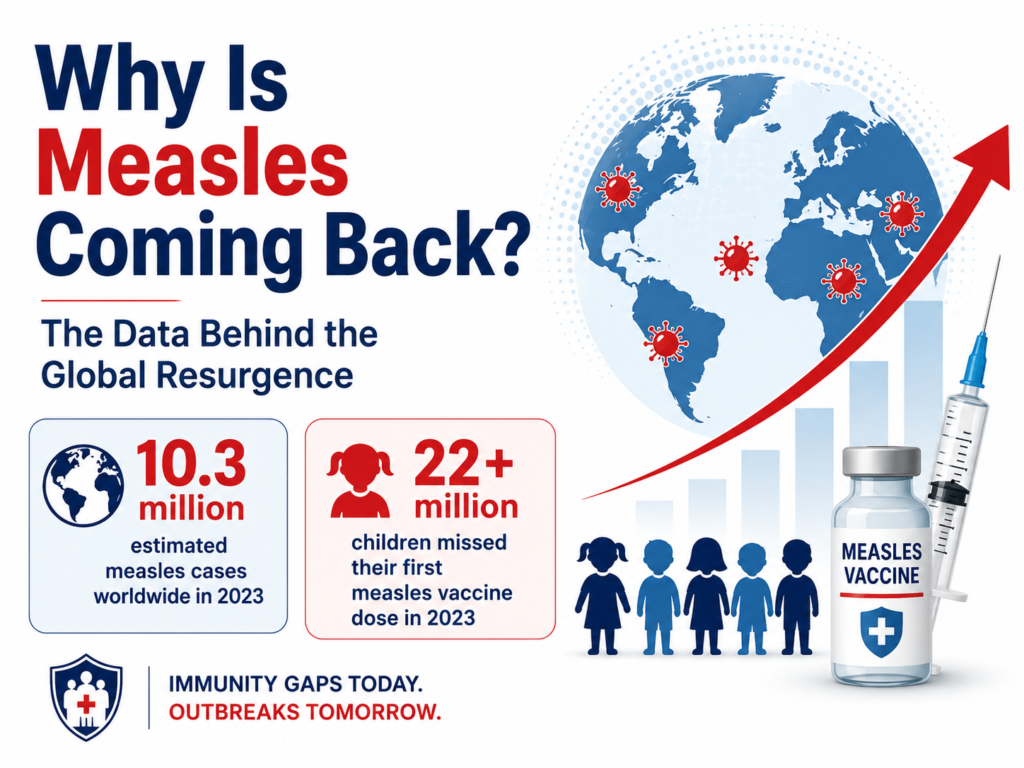
The recent resurgence of measles in the United States illustrates what can happen when vaccination coverage falls. It is not only related to individual protection but the MMR vaccine is also an investment in preventing much larger healthcare and societal costs.
A Highly Effective Vaccine with Large Economic Returns
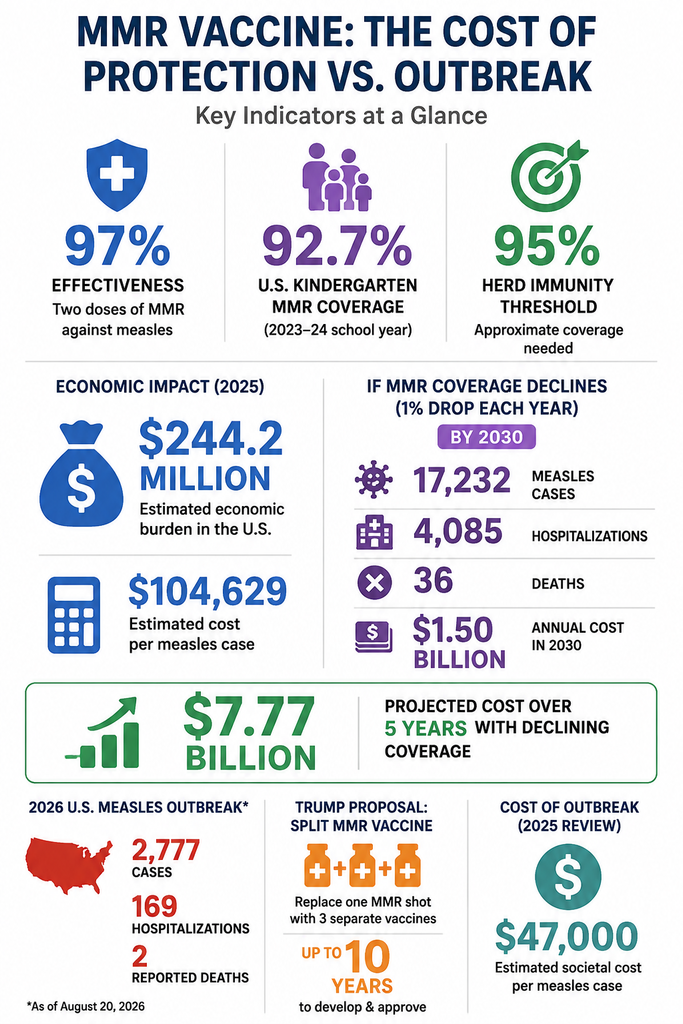
Two doses of the MMR vaccine provide approximately 97% protection against measles. Yet U.S. kindergarten MMR coverage fell to 92.7% in the 2023–24 school year, below the roughly 95% population coverage generally needed to maintain herd immunity.
The economic consequences of even relatively small declines can be substantial.
A 2026 study published in PNAS estimated that measles generated approximately $244.2 million in economic costs in the United States during 2025, equivalent to an estimated $104,629 per measles case. These costs include medical treatment, public-health investigations and outbreak control, and productivity losses.
The researchers modelled what could happen if MMR vaccine coverage among young children declined by just 1 percentage point each year. By 2030, a 5-percentage-point reduction from baseline could result in approximately:
- 17,232 measles cases
- 4,085 hospitalizations
- 36 deaths
- $1.50 billion in annual costs
Over five years, the projected economic burden reached $7.77 billion. Importantly, the relationship was nonlinear: a relatively small decline in vaccination coverage could produce a disproportionately large increase in infections and costs.
Outbreaks Are Expensive Even Before Patients Reach Hospital
Every outbreak requires case investigation, contact tracing, laboratory testing, vaccination campaigns, public communication and, in some circumstances, quarantine and exclusion from schools or workplaces.
A review of the 2025 U.S. outbreak estimated an average societal cost of approximately $47,000 per measles case, including public-health response and productivity losses. With more than 1,000 cases during that outbreak, the resulting societal costs reached tens of millions of dollars.
Thus, vaccination is a preventive expenditure; an outbreak is a recurring liability.
The Cost of Vaccine Hesitancy
A JAMA Pediatrics study estimated that a 5% decline in MMR coverage among U.S. children aged 2–11 could produce approximately a threefold increase in measles cases, from 48 to about 150 cases annually, together with an additional $2.1 million in public-sector costs.
Conversely, increasing coverage from approximately 93% to 95% was estimated to reduce annual measles cases by about 20%, from 48 to 38 cases.
These findings highlight the economic value of herd immunity. The benefit of vaccination extends beyond the vaccinated child because high coverage reduces the probability that an infected person can sustain transmission.
The U.S. Measles Problem
As of August 20, 2026, the United States had reported 2,777 confirmed measles cases across 47 jurisdictions, according to CDC-linked reporting. 169 people had been hospitalized, and 94% of cases were associated with outbreaks.
The country has also recorded its first two reported measles-associated deaths of 2026, both in Lancaster County, Pennsylvania. Both individuals were unvaccinated. The deaths are the first measles-associated fatalities reported in Pennsylvania in approximately 35 years.
Trump’s Proposal to Split the MMR Vaccine
Against this background, President Donald Trump signed an executive order in August 2026 recommending that the combined measles-mumps-rubella (MMR) vaccine be replaced by three separate vaccines once individual products become domestically available.
The order also recommends reducing the number of vaccines routinely recommended for children from 18 to 11, while moving several vaccines into high-risk or shared-decision categories.
The proposal has generated significant controversy because separate measles, mumps and rubella vaccines are currently not licensed and routinely available in the United States. Merck stopped producing its individual measles, mumps and rubella vaccines in 2008.
Merck and GSK, the manufacturers of the combined MMR vaccine used in the U.S., have said that there is no published scientific evidence supporting separation of the vaccines and that decades of evidence support the safety of the combined product.
The economic implications are also significant. Producing three separate vaccines would require additional manufacturing capacity, testing and regulatory work. Instead of producing and administering one combined vaccine, manufacturers would potentially need to produce three products, while families could face more appointments and injections. Experts quoted by Reuters warned that this could involve substantial additional investment.
The Controversy Is Bigger Than the Vaccine Schedule
Trump has continued to raise questions about vaccines and autism, despite extensive evidence finding no causal association between MMR vaccination and autism. A review cited in the 2025 U.S. measles literature examined more than 1.2 million children and found no association between MMR exposure and autism. A Danish cohort involving 657,461 children similarly found no increased autism risk following MMR vaccination.
The current U.S. experience presents a straightforward economic lesson.
A highly effective vaccine prevents a disease whose control becomes dramatically more expensive once transmission begins. The 2026 PNAS modelling suggests that a modest decline in MMR coverage could eventually generate billions of dollars in additional costs.
At the same time, the proposed separation of MMR would require new manufacturing, regulatory approval and potentially higher delivery costs without established evidence that splitting the vaccine provides a health advantage.
The central economic question is therefore not simply “How much does an MMR dose cost?”
It is:
“How much does society pay when vaccination coverage falls and measles returns?”
The answer increasingly appears to be measured not in thousands, but in millions and potentially billions of dollars—along with hospitalizations, lost productivity and preventable deaths.
References
Wells CR, Pandey A, Ye Y, Bawden C, Giglio R, Wong C, et al. The health and economic repercussions of declining MMR coverage in the United States. Proc Natl Acad Sci U S A. 2026;123(??):e2605971123. doi:10.1073/pnas.2605971123.
Lo NC, Hotez PJ. Public health and economic consequences of vaccine hesitancy for measles in the United States. JAMA Pediatr. 2017;171(9):887-892. doi:10.1001/jamapediatrics.2017.1695.
Kuppalli K, et al. Measles: the urgent need for global immunisation and elimination. Lancet. 2025;405(10491):??. doi:10.1016/S0140-6736(25)00675-0.
Wells CR, Pandey A, Ye Y, et al. The health and economic repercussions of declining MMR coverage in the United States. medRxiv [Preprint]. 2026 Feb 20. doi:10.64898/2026.02.19.26346619.
Reuters. Trump’s goal to split MMR vaccine could take a decade, experts say [Internet]. Reuters; 2026 Aug 12 [cited 2026 Aug 28].
Reuters. Trump order reduces US vaccine schedule, seeks to split MMR shot [Internet]. Reuters; 2026 Aug 10 [cited 2026 Aug 28].
Reuters. Trump’s frustrations drove order limiting child vaccinations, but MAHA wants more [Internet]. Reuters; 2026 Aug 24 [cited 2026 Aug 28].
Reuters. US health department seeks public feedback on vaccine guidelines after Trump order [Internet]. Reuters; 2026 Aug 21 [cited 2026 Aug 28].
Reuters. Pennsylvania reports first US measles deaths this year as outbreak grows [Internet]. Reuters; 2026 Aug 25 [cited 2026 Aug 28].
Cureus. The 2025 United States measles outbreak and its public health implications [Internet]. Cureus; 2025 [cited 2026 Aug 28]. Available from: https://assets.cureus.com/uploads/review_article/pdf/379966/20250817-331321-h29q8a.pdf
WTTW News. Pediatricians sound alarm over Trump executive order targeting childhood vaccine schedule [Internet]. Chicago: WTTW; 2026 Aug 25 [cited 2026 Aug 28].
The Lancet. Measles: the urgent need for global immunisation and elimination [Internet]. 2025 Apr 8 [cited 2026 Aug 28]. Available from: https://www.thelancet.com/journals/lancet/article/PIIS0140-6736(25)00675-0/fulltext