
SARS, MERS and COVID-19 are three major coronavirus diseases that have caused significant outbreaks in humans over the past two decades. Although they share similarities in their viral characteristics and clinical manifestations, they differ considerably in their transmissibility, disease severity, mortality and patterns of spread. The following table compares SARS, MERS and COVID-19 across key epidemiological, clinical, laboratory and virological characteristics.
Comparision of SARS, MERS and COVID-19
| Feature | SARS | MERS | COVID-19 |
| Causative Agent | SARS-CoV | MERS-CoV | SARS-CoV-2 |
| Coronavirus group | Betacoronavirus | Betacoronavirus | Betacoronavirus |
| First emergence | 2002, Guangdong/Foshan, China | 2012, Middle East; first recognized case in Saudi Arabia | December 2019, Wuhan, China |
| Main animal reservoir / origin | Bats considered natural reservoir; palm civets implicated as an intermediate host | Bats considered probable natural reservoir; dromedary camels important intermediate host | Bat-related origin suggested; possible intermediate hosts were discossed, but the precise origin remained uncertain in the reviewed literature |
| Main cellular receptor | ACE2 | DPP-4/CD26 | ACE2 |
| Genome similarity | SARS-CoV and SARS-CoV-2 share substantial genomic similarity; SARS-CoV-2 was reported to share ~79% of its genome with SARS-CoV | More distantly related to SARS-CoV-2 than SARS-CoV | Closely related to SARS-CoV; approximately 79% genomic similarity reported in the Frontiers review |
| Primary transmission | Mainly person-to-person respiratory transmission; substantial healthcare-associated transmission | Mainly healthcare-associated and close-contact transmission; outbreaks strongly associated with hospitals | Efficient person-to-person respiratory transmission with community and household spread |
| Typical incubation period | Generally around 2–10 days | Generally around 2–14 days | Generally around 2–14 days; several reviews report a median around 4–5 days |
| Common symptoms | Fever, dry cough, myalgia, headache; dyspnea and pneumonia in more severe disease | Fever, cough, dyspnea, myalgia, headache; gastrointestinal symptoms were relatively prominent | Fever, cough, fatigue/myalgia, headache and dyspnea; loss of smell/taste was also reported |
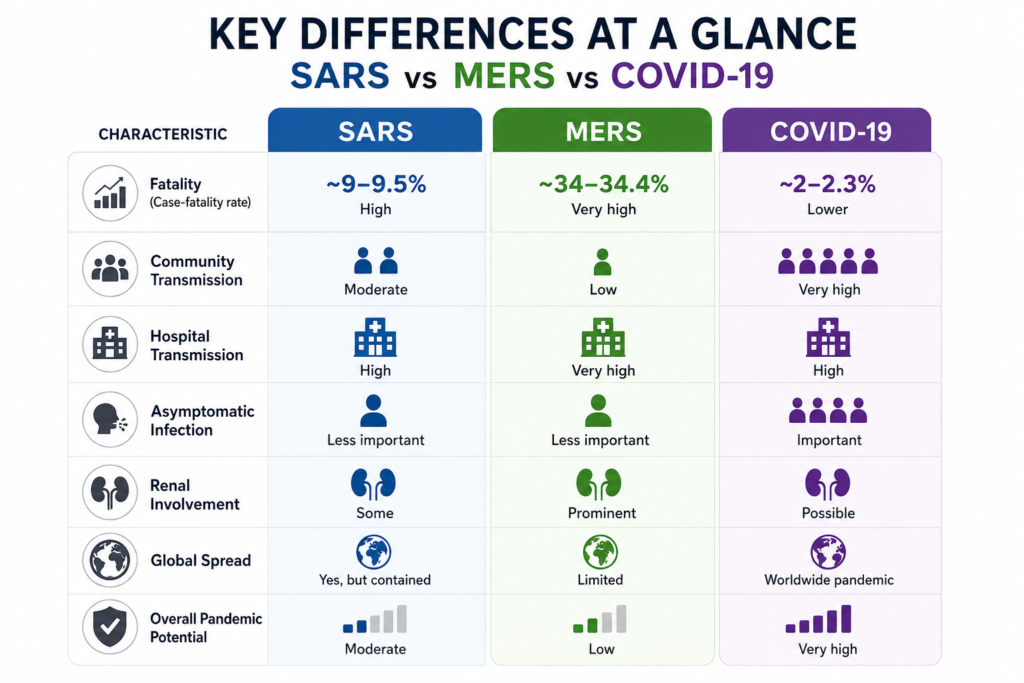
| Case fatality rate | ~ 9-9.5% | ~ 34-34.4% | ~ 2-2.3% |
| Relative severity per infected person | High | Highest | Lower than SARS/MERS on a case-fatality basis |
| Geographical spread | Spread internationally but was eventually contained in 2003 | Mostly Middle East with sporadi international outbreaks | Global pandemic |
| Major distinguishing feature | High severity and efficient transmission after symptom onset allowed containment | Very high fatality and strong healthcare/animal-associated transmission | Lower fatality but much greater community transmission including infections without obvious symptoms |
| Pandemic outcome | Outbreak contained in 2003 | Did not develop into a global pandemic | Developed into a global pandemic |
MERS had the highest reported fatality, SARS had substantial severity and healthcare-associated transmission, while COVID-19 had a considerably lower fatality rate but much greater ability to spread through the community.
Important interpretation
The most important epidemiological distinction is that high pathogenicity does not necessarily mean high pandemic potential.
- MERS had the highest case-fatality rate (~34%), but its transmission was relatively limited and strongly associated with healthcare settings.
- SARS had a substantial case-fatality rate (~9–9.5%) and spread internationally, but symptomatic transmission and effective infection-control measures contributed to its eventual containment.
- COVID-19 had a substantially lower early reported case-fatality rate (~2–2.3% in these papers), but its ability to spread efficiently in the community, including from people without obvious symptoms, allowed it to reach pandemic scale.
References
Zhou H, Yang J, Zhou C, Chen B, Fang H, Chen S, et al. A review of SARS-CoV2: compared with SARS-CoV and MERS-CoV. Front Med (Lausanne). 2021;8:628370. doi:10.3389/fmed.2021.628370.
Xie W, Wang Y, Xiong Y, Chen S, Han J, Wu Q. A comparative overview of COVID-19, MERS and SARS. Int J Surg. 2020;81:1-8. doi:10.1016/j.ijsu.2020.07.038.
Pustake M, Tambolkar I, Giri P, Gandhi C. SARS, MERS and CoVID-19: an overview and comparison of clinical, laboratory and radiological features. J Family Med Prim Care. 2022;11(1):10-17. doi:10.4103/jfmpc.jfmpc_839_21.
Zhu Z, Lian X, Su X, Wu W, Marraro GA, Zeng Y. From SARS and MERS to COVID-19: a brief summary and comparison of severe acute respiratory infections caused by three highly pathogenic human coronaviruses. Respir Res. 2020;21:224. doi:10.1186/s12931-020-01479-w.
Hu T, Liu Y, Zhao M, Zhuang Q, Xu L, He Q. A comparison of COVID-19, SARS and MERS. PeerJ. 2020;8:e9725. doi:10.7717/peerj.9725.
Guarner J. Three emerging coronaviruses in two decades: the story of SARS, MERS, and now COVID-19. Am J Clin Pathol. 2020;153(4):420-421. doi:10.1093/ajcp/aqaa029.
Petrosillo N, Viceconte G, Ergonul O, Ippolito G, Petersen E. COVID-19, SARS and MERS: are they closely related? Clin Microbiol Infect. 2020;26(6):729-734. doi:10.1016/j.cmi.2020.03.026.
Pingback: History and Epidemiology of Middle East Respiratory Syndrome (MERS) - Disease Buddy