Introduction: Emergence of a Novel Coronavirus
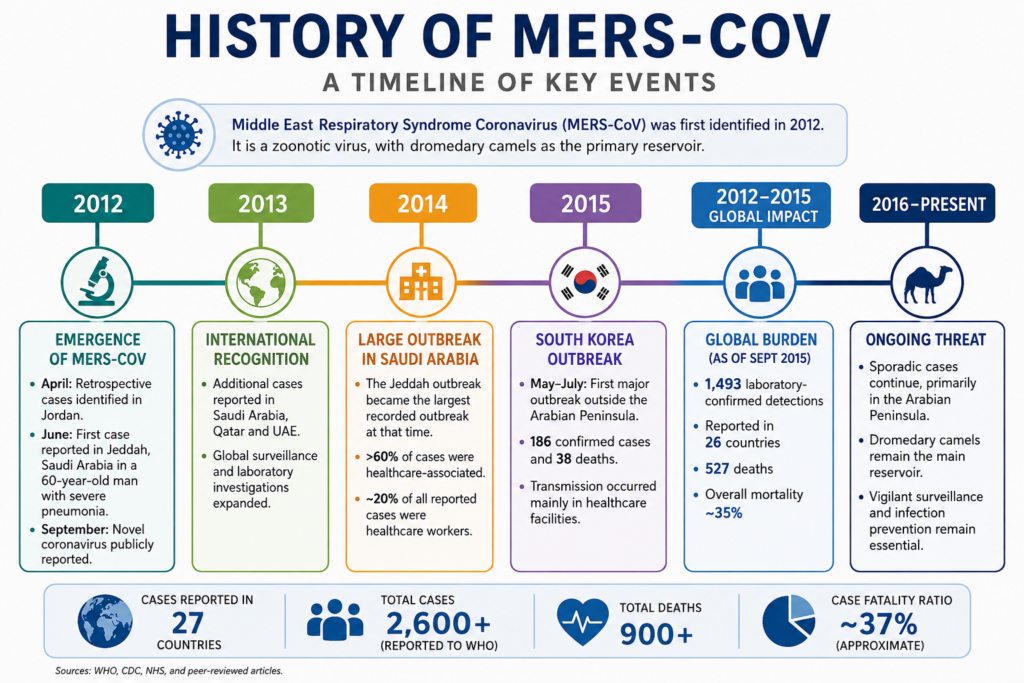
- Middle East Respiratory Syndrome (MERS) emerged in 2012 as a newly identified zoonotic coronavirus infection caused by Middle East Respiratory Syndrome Coronavirus (MERS-CoV).
- The earliest recognized cases occurred in Jordan in April 2012, although they were identified retrospectively after the virus was discovered.
- The first publicly reported case was identified in Jeddah, Saudi Arabia, in a 60-year-old man suffering from severe pneumonia and acute renal failure.
- The virus was initially described as a novel coronavirus (nCoV) before being officially named MERS-CoV by international health authorities.
- In June 2012, First isolation and identification of the novel coronavirus was done from a fatal pneumonia case in Saudi Arabia.
- Virus discovery was announced internationally through ProMED reporting in September, and cases increased across the Middle east and imported infections globally afterwards.
Origin and Evolution of MERS-CoV
MERS-CoV belongs to the family Coronaviridae and the genus Betacoronavirus. It is genetically related to other zoonotic coronaviruses, including:
- SARS coronavirus (SARS-CoV)
- Bat coronaviruses
Genetic investigations identified links between MERS-CoV and viruses found in:
- Bats
- Dromedary camels (Camelus dromedarius)
Dromedary camels were identified as the major animal reservoir. Serological studies demonstrated widespread previous exposure among adult camels in the Arabian Peninsula and parts of Africa. Human infections are believed to occur through repeated animal-to-human spillover events.
Global Timeline of MERS Emergence and Spread
Early Phase: Initial Cases (2012-2013)
First human infections occurred in:
- Saudi Arabia
- Jordan
- Qatar
Early cases were characterized by:
- Severe pneumonia
- Respiratory failure
- Acute kidney injury
Several early cases resulted in death, raising concerns about a highly pathogenic emerging coronavirus.
Expansion Phase: Saudi Arabia outbreak (2014)
- Saudi Arabia became the epicentre of MERS transmission.
- The 2014 Jeddah outbreak represented the largest outbreak at that time.
- The outbreak was mainly associated with:
- Healthcare facilities
- Infection prevention and control failures
Important epidemiological findings:
- More than 60% of cases during the Jeddah outbreak were linked to healthcare-associated transmission.
- Healthcare workers represented approximately 20% of all reported MERS infections.
International Spread and South Korea Outbreak (2015)
- The first major outbreak outside the Arabian Peninsula occurred in South Korea in 2015.
- The outbreak occurred between May and July 2015, resulting in 38 deaths from a total of 186 confirmed cases.
- Transmission was primarily associated with:
- Hospitals
- Delayed recognition of infected patients
- Secondary transmission among healthcare workers, patients, and visitors
The South Korean outbreak demonstrated that:
- MERS-CoV could cause large healthcare-associated outbreaks.
- Human-to-human transmission was possible under conditions of prolonged exposure and inadequate infection control.
Epidemiology of MERS
By September 2015:
- 1,493 laboratory-confirmed detections of MERS-CoV RNA or antibodies had been reported.
- Cases occurred across 26 countries.
- At least 527 deaths were reported.
- Overall mortality was approximately 35%.
- The majority of human cases originated from Saudi Arabia.
- Factors contributing to high case numbers:
- Large camel populations
- Frequent human–camel contact
- High healthcare activity
- Repeated hospital outbreaks
Transmission Epidemiology
Animal-to-Human Transmission
Primary transmission pathway:
Dromedary camel → Human infection
- MERS-CoV antibodies were detected widely among camels.
- Viral sequences from camels showed close genetic similarity to human viruses.
- Camel exposure was associated with increased infection risk.
However, the exact mechanism of camel-to-human transmission remained uncertain.
Human-to-Human Transmission
Characteristics:
- Sustained community transmission was uncommon.
- Most human transmission occurred through:
- Hospitals
- Close contacts
- Healthcare exposure
Factors increasing transmission:
- Delayed diagnosis
- Poor infection prevention practices
- Crowded healthcare environments
Clinical and Epidemiological Characteristics
Average incubation period is approximately 5–6 days.
Common clinical manifestations include:
- Fever
- Cough
- Shortness of breath
- Pneumonia
Severe disease progression resulted in:
- Acute respiratory distress syndrome (ARDS)
- Multiorgan failure
- Death
Approximately 20–40% among recognized infections. Reported fatality was substantially higher than seasonal human coronaviruses and higher than SARS-CoV (~9%).
MERS Timeline
| Year | Major Event |
| 2012 | First identified MERS-CoV case in Saudi Arabia; retrospective cases identified in Jordan |
| 2012 | Novel coronavirus publicly reported |
| 2013 | International recognition and surveillance expansion |
| 2014 | Large healthcare-associated outbreak in Jeddah, Saudi Arabia |
| 2015 | South Korea outbreak; first major outbreak outside Arabian Peninsula |
| 2015 | 1,493 detections across 26 countries; 527 deaths reported |
Global Epidemiological Burden of MERS-CoV (2012–Present)
Since the identification of MERS-CoV in 2012, the virus has caused a prolonged series of zoonotic spillover events rather than a continuous global pandemic.
Global case burden:
- More than 2,600 laboratory-confirmed human cases have been reported to WHO.
- Cases have been reported from 27 countries across six WHO regions.
- Approximately 84% of all reported cases originated from Saudi Arabia, making it the central epidemiological hotspot.
- More than 900 deaths have been reported globally.
- The overall case fatality ratio (CFR) is approximately 37%, although this may be overestimated because mild and asymptomatic infections are likely underdiagnosed.
Geographic distribution:
Major affected countries include:
- Saudi Arabia
- United Arab Emirates
- Qatar
- Jordan
- Oman
- Kuwait
- South Korea (major outbreak in 2015)
Imported cases have occurred in:
- Europe
- North America
- Asia
- Africa
Most infections outside the Middle East were associated with travel from the Arabian Peninsula.
References
Mackay IM, Arden KE. MERS coronavirus: diagnostics, epidemiology and transmission. Virol J. 2015;12:222. doi:10.1186/s12985-015-0439-5.
Al-Tawfiq JA, Zumla A, Memish ZA. The emergence of Middle East Respiratory Syndrome Coronavirus (MERS-CoV).Viruses. 2018;10(2):93.
Memish ZA, Cotten M, Meyer B, et al. Human infection with MERS coronavirus after exposure to infected camels.Emerg Infect Dis / related epidemiological analysis. 2014.
Zumla A, Hui DS, Perlman S. Middle East respiratory syndrome.Lancet. 2015;386(9997):995–1007.
Alraddadi BM, Watson JT, Almarashi A, et al. Risk factors for primary Middle East respiratory syndrome coronavirus illness in humans, Saudi Arabia, 2014.BMC Infect Dis. 2016.
World Health Organization. Middle East respiratory syndrome coronavirus (MERS-CoV) [Internet]. Geneva: WHO; 2025 [cited 2026 Aug 4]. Available from: WHO MERS-CoV fact sheet.